Jōurugami Kofun: A Late Kofun-Period Burial Mound in Japan
Site at a Glance
- Rating
- 3.5
- Popularity
- Very Low
- Country
- Japan
- Primary era
- Medieval
- External website
- Open
- Eras represented
- Medieval
- Civilizations
- Yamato
- Site type
- Burial
- Remains
- Burial Mound
On this page9 sections
History
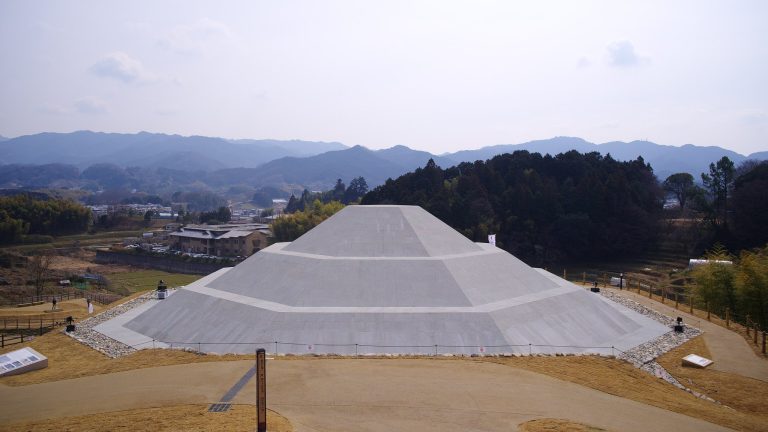
Jōurugami Kofun is a burial mound in Gose, Nara, Japan, constructed during the latter half of the sixth century in the late Kofun period. The Kofun period, which broadly extended from the third to the seventh centuries, was marked in part by large burial mounds for members of the elite. Jōurugami Kofun lies on the southwestern edge of the Nara Basin, while the Koseyama Kofun Cluster, with more than 700 tombs, extends through the hills to the south.
A Tomb within the Koseyama Cluster
The mound is also known as Koseyama Kofun No. 658. Its original plan has been difficult to establish because later leveling substantially altered the mound. It has consequently been classified either as a keyhole-shaped tumulus, combining a rounded rear mound with a projecting rectangular front section, or as a rectangular tumulus.
The person buried at Jōurugami Kofun is unknown. The scale and distinctive character of the stone chamber and sarcophagus, together with their similarities to tombs in the Koseyama cluster, have led to the proposal that the tomb belonged to the leader of the Kose clan. The Kose clan was a powerful ancient lineage associated with the cluster.
Records and Archaeological Investigation
The mound appeared in an 1893 survey of ancient burial mounds. In 1916 it was reported as a keyhole-shaped tumulus called Jō-no-Kofun. A 1972 archaeological map produced by Nara Prefecture showed it as a circular mound, and a 1984 distribution survey assigned it the number Koseyama Kofun No. 658.
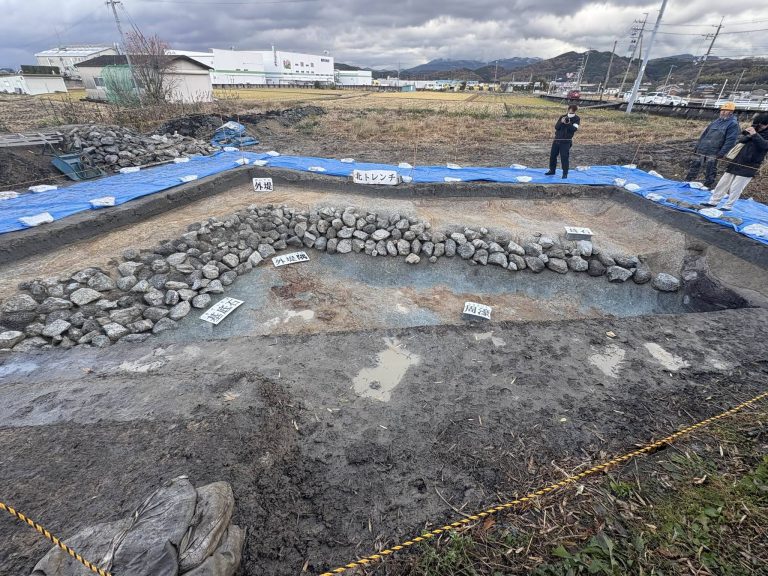
Investigations in 2001 confirmed the location and condition of the stone chamber. A preliminary investigation followed in 2005 before construction of a private house, and range-confirmation excavations took place from 2013 to 2016. The investigations were reported in 2008 and 2019. The tumulus precinct became a National Historic Site of Japan on October 11, 2021.
Remains
Mound Layout
The mound measures approximately 70 meters in length and is aligned toward the south-southeast. Extensive later leveling has left its original shape uncertain. It may have consisted of a northern circular mound and a southern projecting mound forming a keyhole-shaped plan, or it may have been rectangular. The principal burial facility lies within the northern mound, while the southern mound is believed to have contained another burial facility.
Northern Burial Facility
Horizontal Stone Chamber
The main tomb is a horizontal-entry stone chamber, meaning that it is reached through a passage rather than from above. It has a double-shouldered form, with projections on both sides where the passage meets the burial chamber. The entire chamber and passage measure at least 15.6 meters. The burial chamber is approximately 7.1 meters long and the passage approximately 8.5 meters long.
The burial chamber is at least 2.35 meters wide at the rear wall, 2.67 meters wide at its center, and 2.78 meters wide at the entrance. Its height is at least 3.8 meters, or 4.18 meters when measured from the small stones in a test pit. The passage is at least 1.9 meters wide at its opening, at least 1.76 meters wide near the burial chamber, and 1.82 meters high. A thick accumulation within the chamber prevents its complete configuration from being determined, but its measurable scale is comparable to the chambers of Gojyo-no-Maruyama Kofun, Ishibutai Kofun, and Tsukaana-yama Kofun.
House-Shaped Sarcophagus
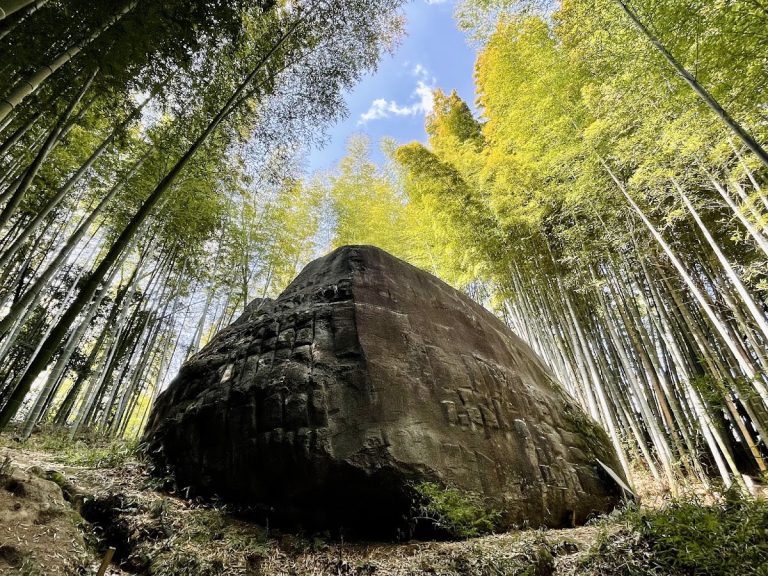
The chamber contains a house-shaped stone sarcophagus, whose lid imitates the roof form of a house. The cover is 278 centimeters long excluding its rope-hanging projections, 147 centimeters wide, and 53 centimeters high. Its length is comparable to the 289-centimeter cover from Gojyo-no-Maruyama Kofun.
Eight rope-hanging projections are carved on the cover, with one at each end and three along each side. Three projections on each side are unusual because house-shaped sarcophagi normally have two on each side. The proportion of the upper flat surface to the total width of the cover is recorded as 37.
Southern Burial Facility and Finds
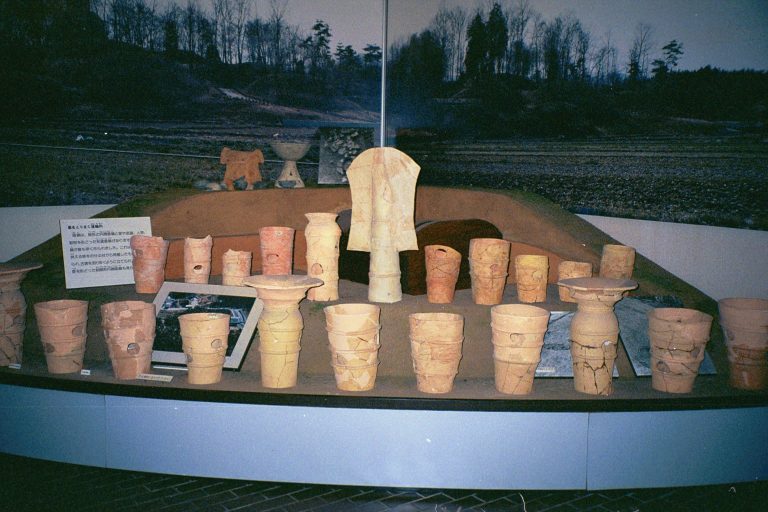
The southern mound is believed to have held a separate burial facility. Fragments of chamber stones and sarcophagus stone were found there, while later destruction has left the facility’s details uncertain. Excavated materials from the tumulus include fragments of Sue ware pottery and haniwa clay figures. Sue ware was high-fired gray pottery made with kiln technology and commonly placed in elite Japanese tombs; haniwa were modeled clay figures and other objects associated with burial mounds.