Rizinia: An Ancient Cretan City on the Patela Plateau
Site at a Glance
- Popularity
- Low
- Country
- Greece
- Primary era
- Iron Age
- Eras represented
- Bronze Age, Iron Age, Classical
- Civilizations
- Ancient Greek, Minoan
- Site type
- City
On this page17 sections
History
Rizinia was an ancient Cretan city on the Patela plateau near modern Prinias, Greece. Its occupation extended from at least the thirteenth century BCE, within the Minoan civilization, a Bronze Age society centered on Crete, through the Archaic period of early Greek history. Its continuity through the Greek Dark Age, the interval between the collapse of Bronze Age societies and the rise of the Archaic Greek world, makes it an important site for understanding the transition from Bronze Age Crete to Greek communities.
Early occupation and identity
Settlement continued through the Late Minoan period and the Sub-Minoan period, a transition toward the Early Iron Age. Rizinia may be the ancient city of Apollonia. A local inscription preserves the reading (I)ZENIA(A), while inscriptions at Gortyn, another ancient Cretan city, refer to Rizinia in the fifth century BCE.
Archaic city and later decline
Rizinia flourished as an independent city-state in the Archaic period. A city-state was an autonomous political community centered on a city and its surrounding territory. In one excavated phase, the latest floors date to the middle of the sixth century BCE. The buildings were abandoned shortly before they were destroyed.
From the fifth century BCE, Rizinia became dependent on Gortyn. The community was required to provide sacrificial animals every four years for rites at the Idaean Cave, a sanctuary on Mount Ida. Inscribed pottery sherds show that Athena was worshipped at Rizinia in the second century BCE, when the city was being gradually abandoned. Rizinia itself was unfortified, although a separate fortress was built nearby during the Classical or Hellenistic period and remained in use for about three centuries.
Rediscovery and continued use
Federico Halbherr identified the site in 1894 and accidentally found objects from a Late Minoan III C offering deposit there in 1899. Luigi Pernier’s Italian archaeological mission carried out three major excavation campaigns from 1906 to 1908. The Italian Archaeological School of Athens was formally established in 1909, with Pernier as its first director.
Excavations resumed in 1969 under a University of Catania mission initially directed by Giovanni Rizza, who led the work until 2005; Dario Palermo subsequently took charge. The Italian National Research Council’s Institute for Archaeological and Monumental Heritage joined the research in 1984, while wars interrupted investigations during the twentieth century. Excavations at the nearby cemetery ran from 1969 to 1978. Across from the hill, pottery workshops at Mandra di Gipari are linked to Rizinia by the forms they produced and the vessels’ destinations in the city. The attribution of some cemetery vessels to the Painter of Prinias, a conventional name for an unknown vase painter, helped clarify the transition between the Minoan palace era and the beginnings of Greek art.
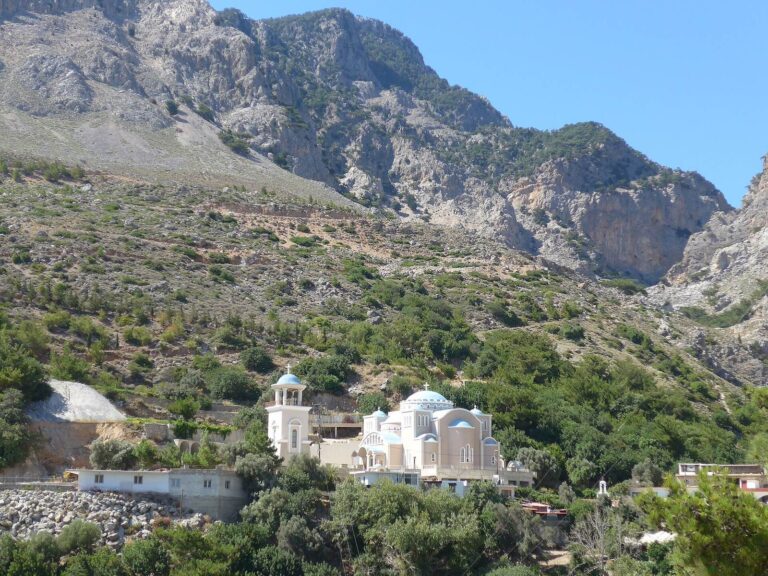
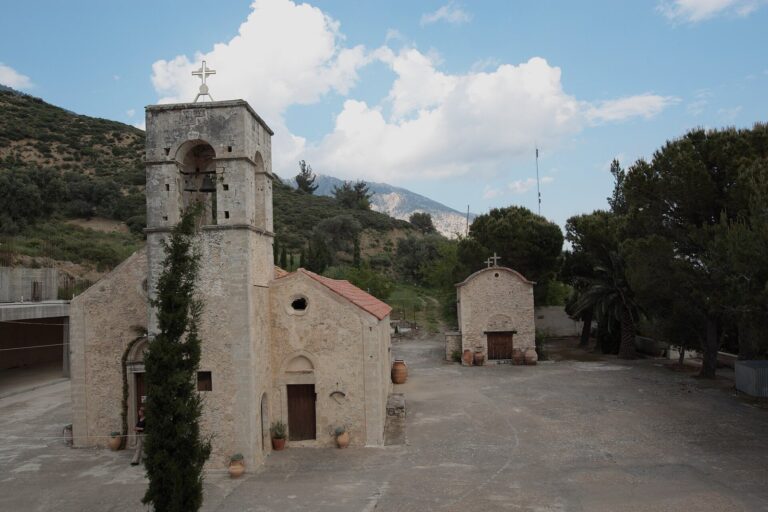
A chapel dedicated to Saint Panteleimon stands on the plateau. Its annual feast brings worshippers from Crete and mainland Greece together on the afternoon of 26 July and the morning of 27 July for vespers, the blessing of spiced sweet bread, and its distribution.
Remains
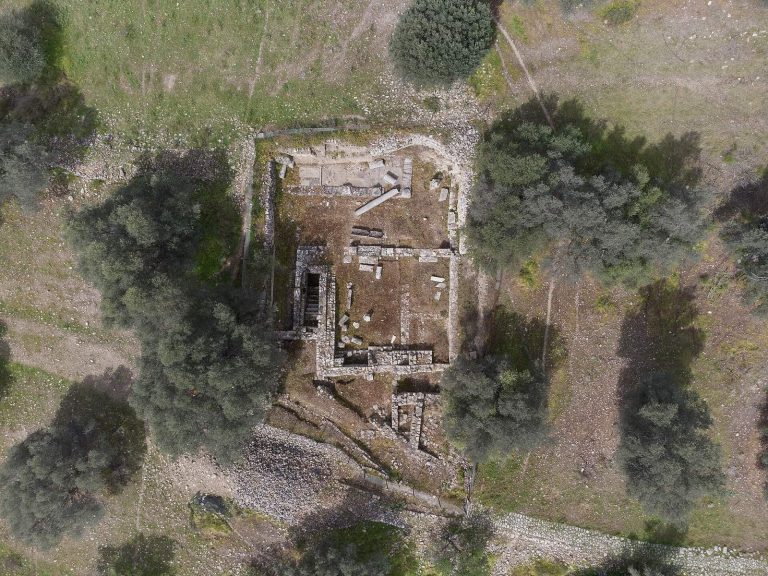
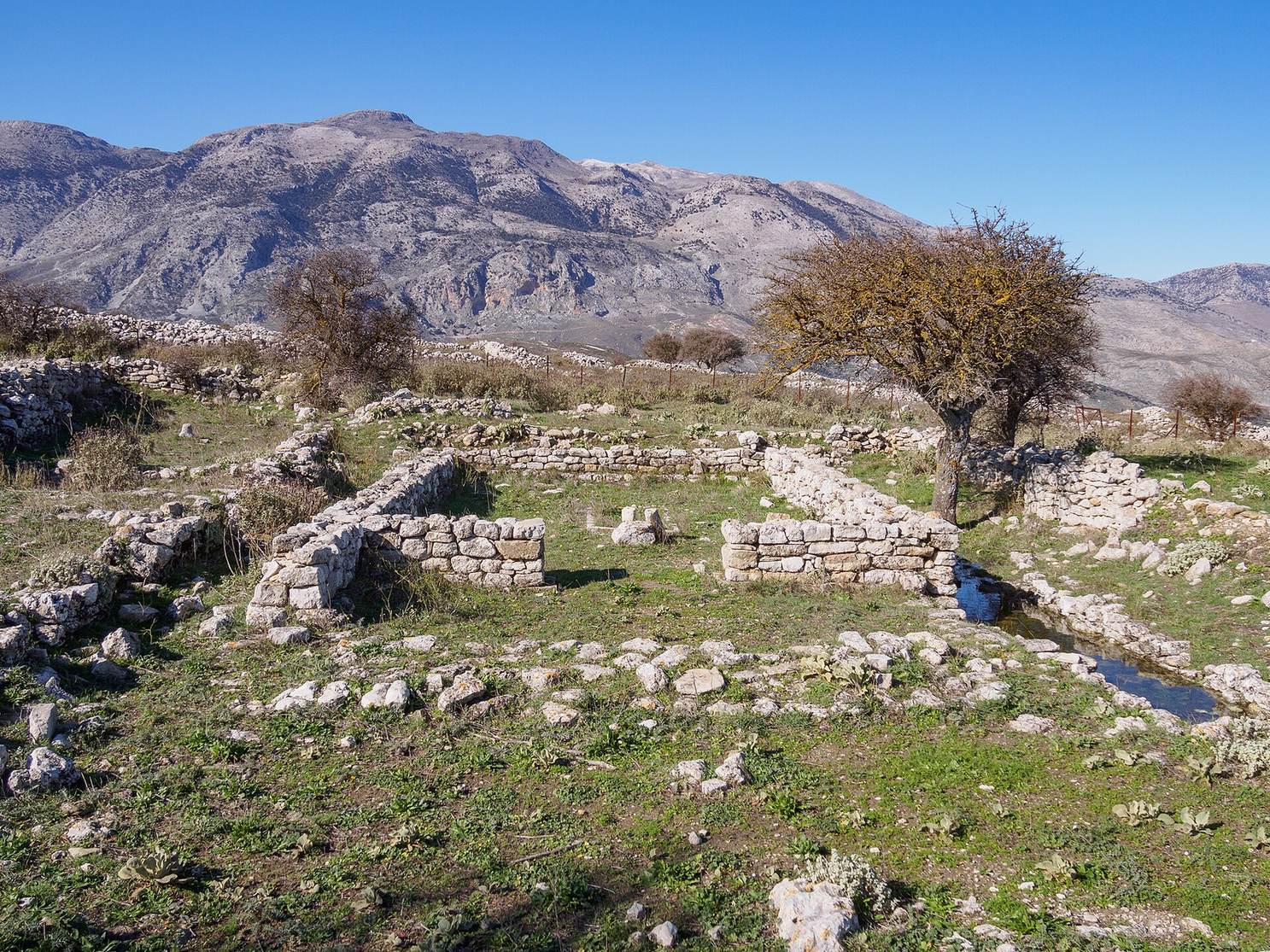
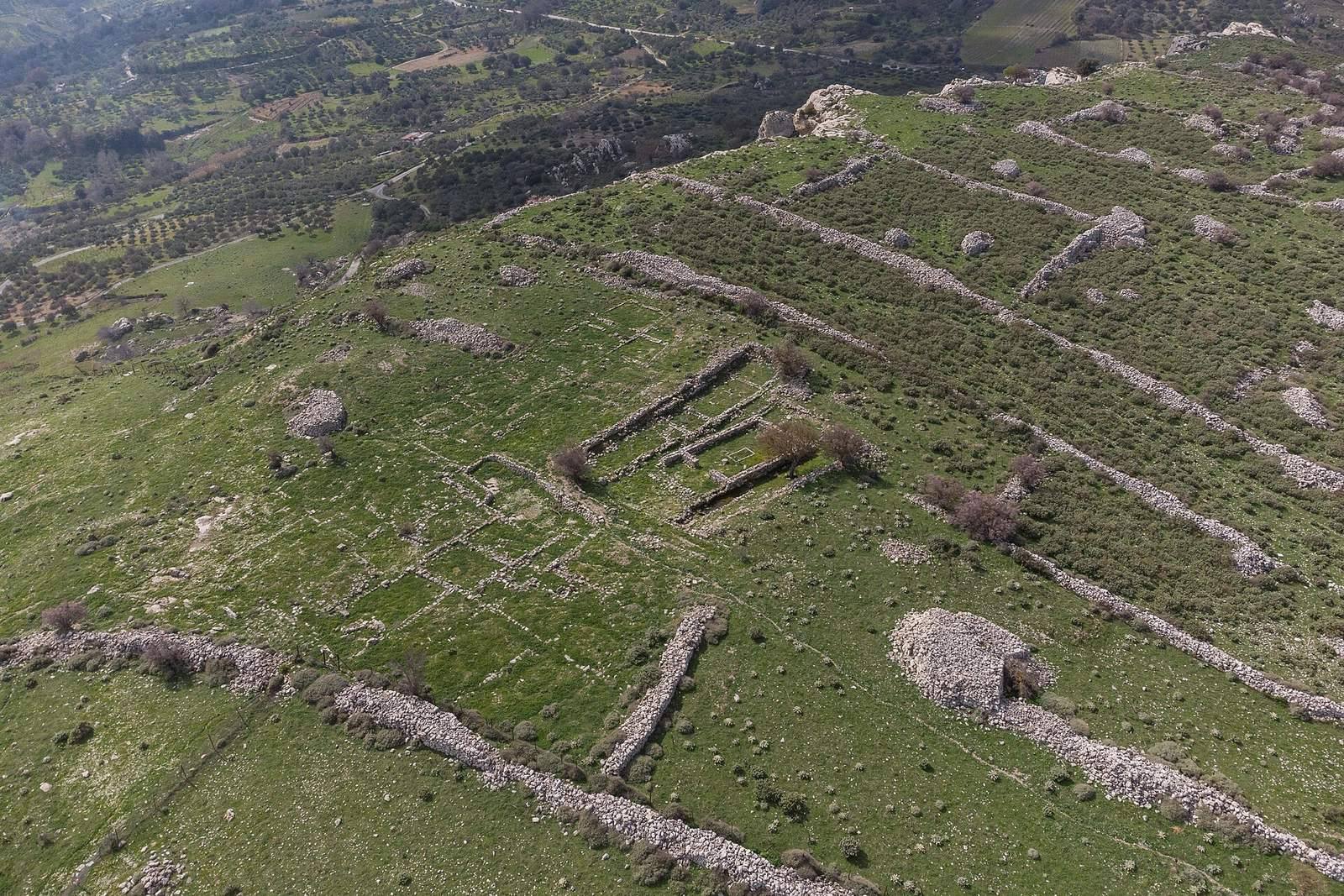
The remains on the Patela plateau include successive urban layouts, three temples, and separate areas for burial and defense. The site lies about two kilometres from Prinias on the eastern slopes of Mount Ida. Excavation has focused especially on the southeastern part of the plateau, east of Temples A and B and on a terrace above its southern edge. At the plateau’s northern end, the chapel of Saint Panteleimon occupies the highest point; a narrow path follows the northern edge above a steep drop.
Urban layout and temples
Street plan
In one urban phase, irregular buildings extended from east to west, with winding lanes that followed the ground. The later layout, dated to the eighth and seventh centuries BCE, used regular streets to define blocks of large rooms.
Temple A
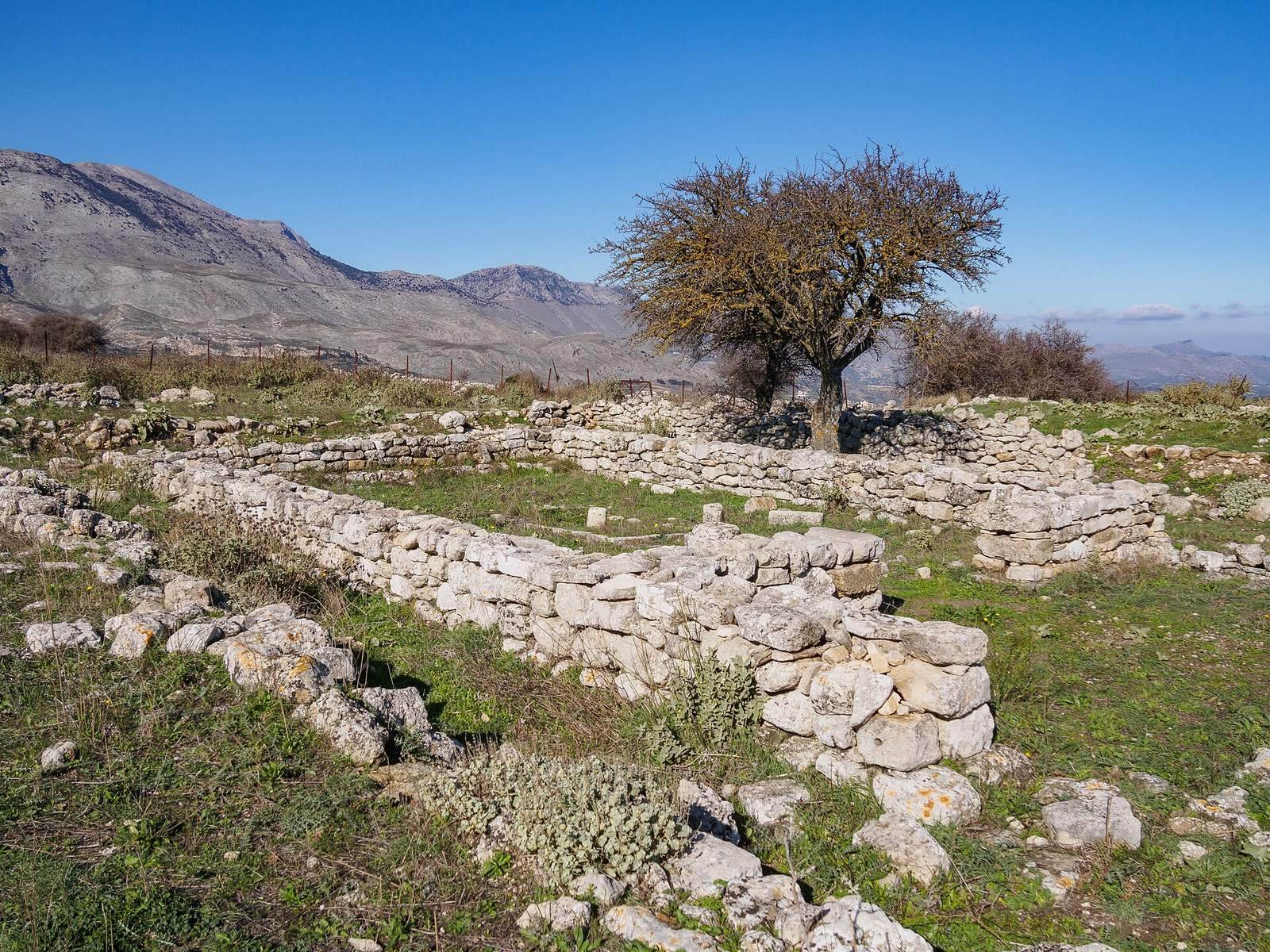
Temple A, dated to about 625–620 BCE, is a simple enclosed chamber with an entrance framed by projecting side walls. Two wooden columns running along the building may have supported a pitched roof; their stone bases remain visible. A rectangular hearth containing abundant ash points to ritual activity involving fire. The building is regarded as one of the earliest Greek temples and as important evidence for the development of Greek temple sculpture.
Its carved decoration includes a horizontal band showing horsemen, deer, and panthers, two seated female divine figures, and a relief-decorated beam above the columns. The beam bears a standing female figure in a niche, possibly Rhea or Artemis. The sculptures’ original positions in the building remain debated. Some have been compared with the Lady of Auxerre, an Archaic Greek statue dated to 650–625 BCE. The sculptures are now in the Heraklion Archaeological Museum, and further relief fragments have prompted renewed proposals for reconstructing the temple.
Other temples and sanctuary
Temples B and C, like Temple A, belong to the Archaic architectural group. Temples A and B date broadly to the seventh century BCE, while Temple C is assigned to the transitional phase between them. An earlier sanctuary also belongs to the site’s religious remains.
Ritual deposits and sculpture
Snake Goddess precinct
Foundations of houses and parts of a precinct associated with the Minoan Snake Goddess survive near the temples. A votive deposit, a group of objects offered to a deity, yielded material dating from Late Minoan III C through the Orientalizing period of early Greek history. Finds include fragments of fired-clay female figurines with raised arms, of a type conventionally called the Gazi goddess, and four Minoan ritual objects shaped as tubes and associated with snakes.
Worship in this area was interrupted, probably in connection with the construction of Temple A for a female deity. Artemis has been suggested as the temple’s deity, and the new cult may have displaced the earlier Minoan one; Temple A has also been tentatively associated with Rhea.
Eastern-edge cult area
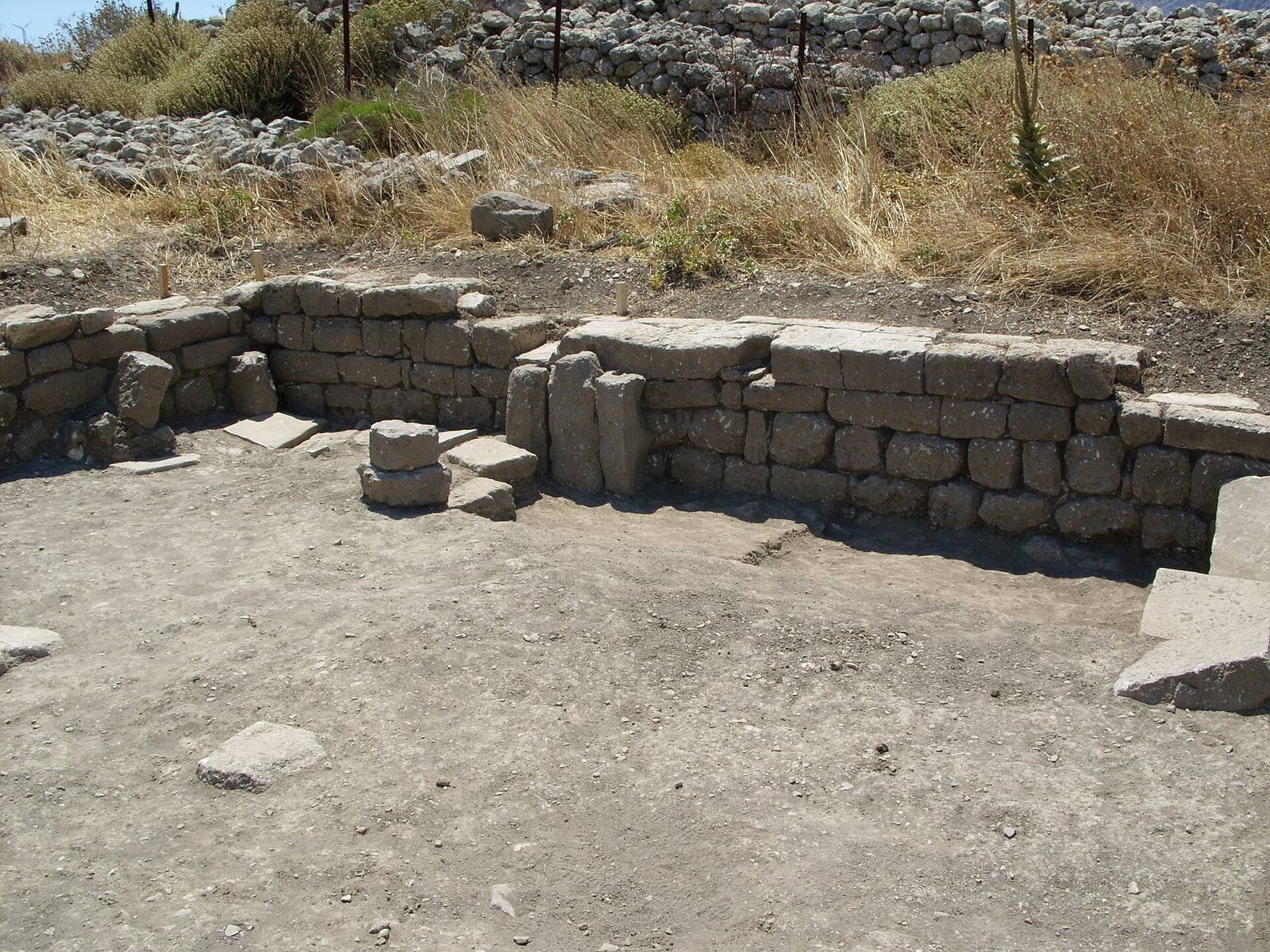
Excavations along the plateau’s eastern edge in 1996 exposed traces of buildings, including part of a room with a stone-slab floor, a channel cut into the rock, and a large rectangular hearth also cut into the rock. Finds included a Late Minoan III C fired-clay head, fragments of a Gazi goddess figure, part of a fantastic animal, and a model altar with a window. The cult deposit in this area has been dated to the end of the Bronze Age. Its elevated position and broad views have been compared with Minoan peak sanctuaries, high-elevation places of worship.
Three small pillars found in 2007 have been interpreted as a possible divine triad represented without human or animal images. They have been compared with a three-pillar shrine at Kommos, where a connection with Phoenician merchants and seafarers has been proposed. That comparison alone does not assign the same connection to Rizinia.
Figurines from the 1906 trench
In 1906, the eighth of nine excavation trenches exposed statuettes and fragments at a depth of about half a metre. Among them were two high-relief heads with Egyptian-style wigs.
Fortress and cemetery
Fortress
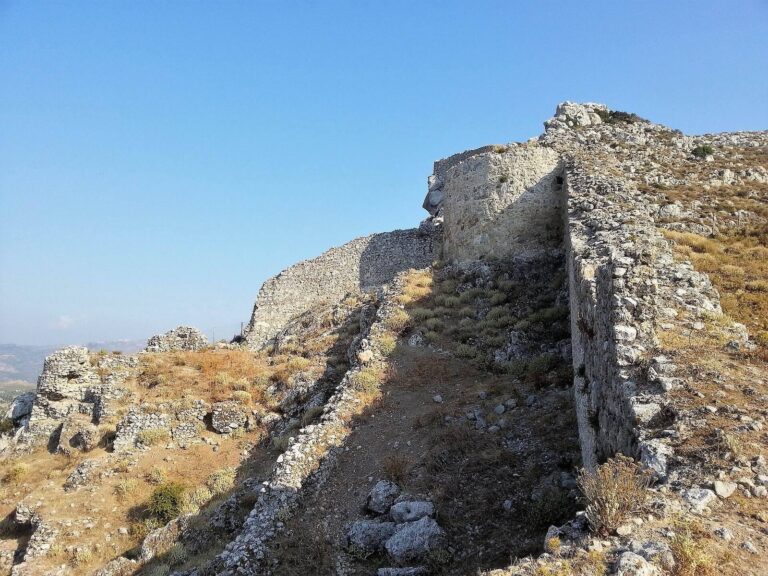
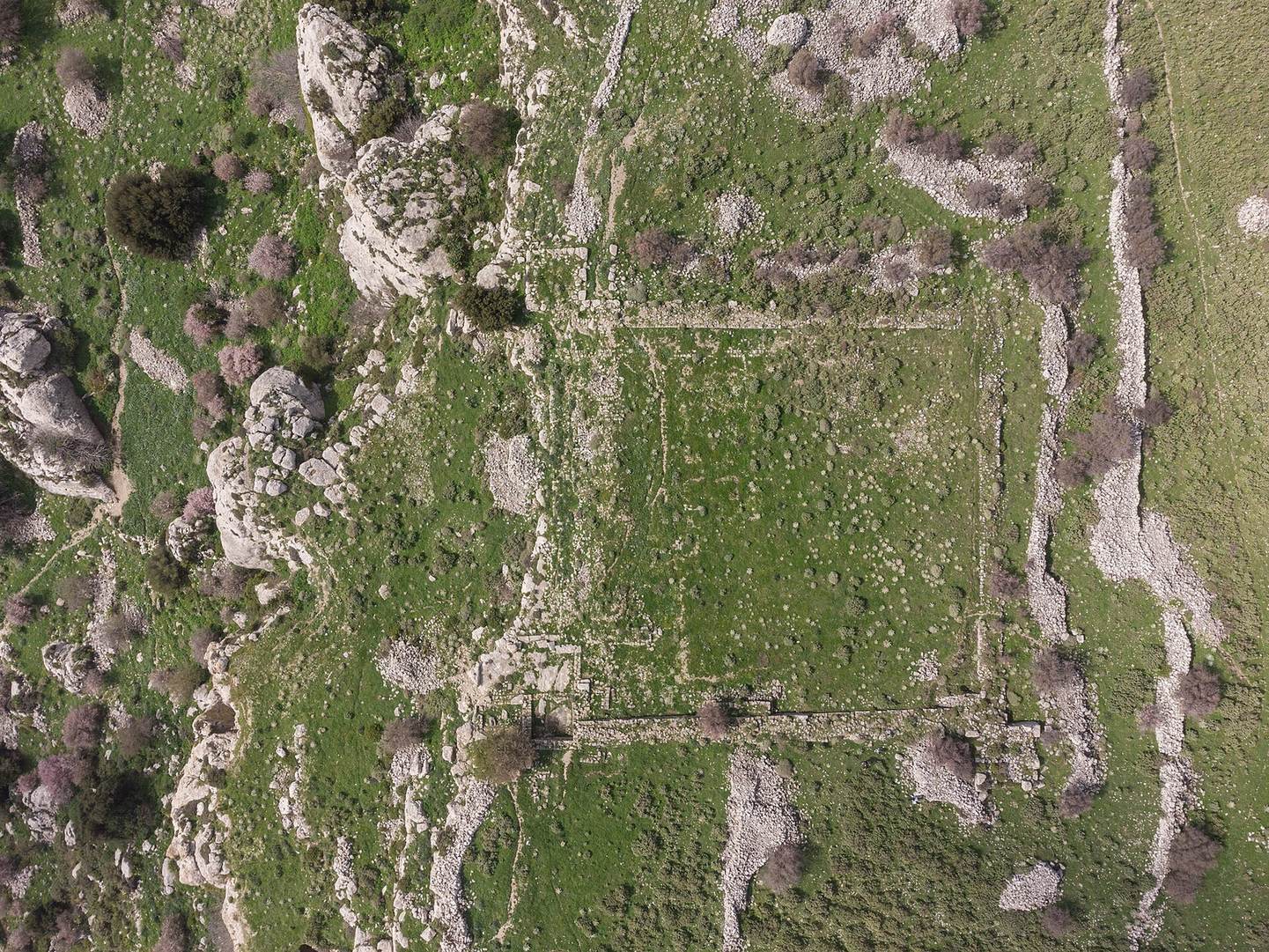
The nearby fortress had a rectangular plan and four towers. Its construction reused porous limestone grave markers taken from a neighboring seventh-century BCE cemetery. These stones carry incised ornaments and human figures. Iron and lead weapons were also found in the fortress area.
Cemetery
The nearby cemetery contains evidence of several burial practices. Late Minoan III C cremations were placed in oval pits cut into rock. A partly concurrent practice involved burials in circular tombs, alongside groups of horse burials. From the Geometric to the Orientalizing period, cremated remains were placed in pottery vessels covered with stones. Numerous upright grave markers were also recovered.
Pottery workshops
Across from the hill, Mandra di Gipari preserves remains of ancient pottery workshops and discarded kiln material. These remains provide evidence of kiln use and of the vessel forms made in the different workshops.