Bazjaš Monastery: A Medieval Serbian Orthodox Foundation in Romania


Site at a Glance
- Rating
- 4.8
- Popularity
- Very Low
- Country
- Romania
- Primary era
- Early Modern
- Eras represented
- Early Modern, Modern
- Civilizations
- Habsburg, Serbian
- Site type
- Religious
- Remains
- Monastery
On this page9 sections
History
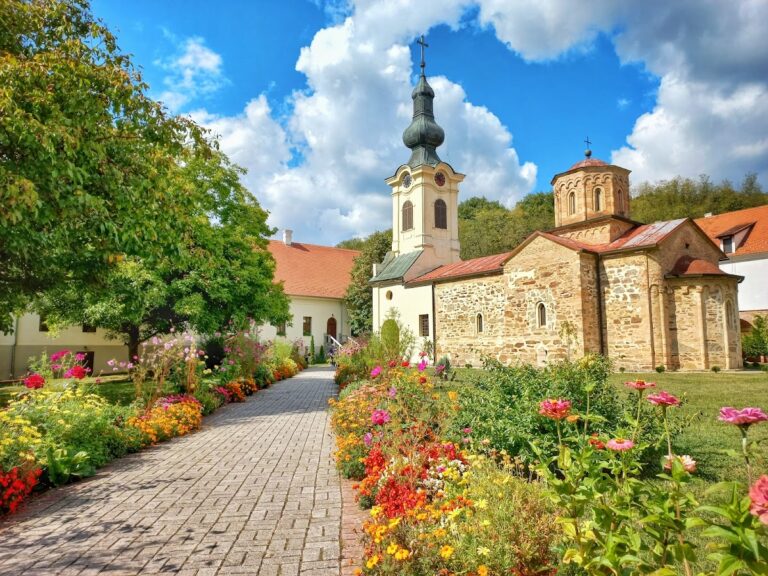
Bazjaš monastery is a medieval Serbian Orthodox monastery in Romania, situated in Baziaș village at the beginning of the Danube Gorge. It was traditionally founded by Saint Sava of Serbia, born Rastko Nemanjić, during the reign of King Andrew II of Hungary, with construction dated to 1225–1229. Today it belongs to the Timișoara Diocese of the Serbian Orthodox Church and is dedicated to the Ascension of the Lord. Its long history reflects the persistence of Serbian Orthodox religious life in the Banat borderlands.
Foundation and medieval development
The foundation of Bazjaš is associated with negotiations on the Danube between Andrew II and a Serbian delegation led by Saint Sava. A local legend says that a storm arose when Sava reached the site and that he shouted at the wind, “You are gaping!” The expression is traditionally linked with the monastery’s name. Another tradition holds that one of seven Orthodox hermit monks from Sinai settled at Bazjaš after fleeing to the free Orthodox Serbian state ruled by the Nemanjić dynasty.
The monastery was established as a Serbian religious institution and became a dependency, or metoch, of the Peć Patriarchate. This historic Serbian Orthodox patriarchal institution governed Serbian Orthodox communities and monasteries across parts of the medieval and early-modern Balkans. Nearby Bazjaš first developed as an Ottoman derbend settlement, a guarded community responsible for protecting an important river route, and later served as the monastery’s dependent village estate.
Evidence from the fourteenth and fifteenth centuries indicates that the monastery was then dedicated to the Transfiguration of the Lord and housed one of the Sinai monks. Its wooden buildings were repeatedly destroyed, but monastic activity continued during Ottoman rule. Bazjaš was omitted from the Peć Patriarchate register for 1660–1666, probably because it had been destroyed or was inactive at that time.
Ottoman and Habsburg conflicts
During the Ottoman-Habsburg conflicts of the early eighteenth century, Bazjaš was destroyed as Ottoman forces withdrew from Banat and the surrounding territory passed to the Habsburg monarchy. The church was rebuilt in stone in 1721, but Ottoman forces burned the monastery again in 1738.
A diocesan document from 1757 described Bazjaš as being in poor condition. Four houses stood in its dependent village, while only one elderly monk, Benjamin, the deputy superior, lived at the monastery. In 1771 Benjamin, also identified as Nikolaević, was still its sole resident. By decree of Empress Maria Theresa, Bazjaš was joined to the nearby Zlatica monastery in 1772. Three years later, Zlatica, Bazjaš, and Kusić together had eight residents under Abbot Paisius Andrejević.
Bazjaš survived the Ottoman burning of Zlatica in 1788, although later conflicts continued to affect the community. A stone brotherhood building was constructed at Bazjaš in 1805. In 1848, monks from Zlatica moved to Bazjaš after Hungarian forces destroyed their monastery. They returned to Zlatica after its restoration in 1860.
Restoration and changing administration
The church was restored and redecorated in 1860–1861. Repairs to the church and monastery buildings continued from 1868 to 1872 under Abbot Lukijan Jeremić of Zlatica, who later left for Vojlovica Monastery in 1887. As the monasteries’ financial condition worsened, Zlatica and Bazjaš were attached to Vojlovica.
Bazjaš became independent again in 1900 under Abbot Josif Popović. Popović had studied at the Vršac theological seminary and became a monk in 1878. In 1902 he publicly thanked donors who had contributed toward rebuilding the monastery brotherhood. An ecclesiastical report from the same year nevertheless classified Bazjaš as a dependency rather than an independent monastery. It placed the institution in Krassó-Szörény County and within the Vršac bishopric, recording an estate of two cadastral acres and 988 square fathoms, buildings valued at 30,600 crowns, and other property valued at 1,072 crowns and 40 potura. The total estate value was given as 31,735 crowns and 60 potura. The report allocated 1,694 crowns and 20 potura for urgent repairs and proposed regular annual assistance of 5,000 crowns.
The 1902 church discussions described Bazjaš as financially distressed and receiving little assistance, while emphasizing its importance to the Serbian community in the surrounding Romanian environment. During the Serbian-Romanian ecclesiastical division, the poorer monasteries of Bazjaš and Zlatica were considered less attractive objects of dispute than wealthier churches and monasteries.
Josif Jorgović, who had supervised both Zlatica and Bazjaš, died in 1898 at the age of 68 and was buried in Zlatica’s monastery cemetery. Before becoming a monk, he had worked as an official and had been widowed. An earlier superior, Danil Janković, was recorded in Bela Crkva in 1818 together with Abbot Isaiah Grujić of Zlatica.
War, Romanian administration, and renewed monastic life
Josif Popović was transferred to Vojlovica on 15 May 1914. During the First World War, Bazjaš lay in a combat zone and its buildings were damaged by artillery. Retreating Austro-Hungarian troops fired several shells at the monastery in 1918. After the war, Bazjaš became part of Romania.
Konstantin Jovanović became abbot in 1919 but was transferred to Zlatica in 1923. Bazjaš was again attached to Zlatica during the 1930s, and by 1934 it had no resident monks. The monastery reopened on 1 June 1936 under Abbot Panteleimon Doshen, although it was attached to Zlatica again in 1937. It became independent once more in 1939 under Georgije Dragić, who was appointed administrator of Zlatica in 1940.
Artillery damaged Bazjaš during the Second World War. From 1 December 1945 to 12 January 1949, Zlatica, Bazjaš, and Kusić were administered by Hieromonk Kiril Sekulić. He died at Bazjaš of a heart attack on 13 November 1955. Monastic life declined again afterward, and the monastery reopened in 1980.
Remains
Setting and surviving buildings
Bazjaš monastery stands on the Romanian-Serbian border, about ten kilometres by air from Bela Crkva. The Nera River flows below the site, while low hills rise above it within the Romanian Banat mountain area. The earliest buildings were made of wood, a construction choice that contributed to their vulnerability during repeated destruction. The church was rebuilt in stone in 1721, and a stone brotherhood building followed in 1805. That building contained five rooms and a refectory. A later wooden house provided accommodation for the monastic community.
Church decoration
The monastery church was painted in 1860–1861. Živko Petrović produced the iconostasis, the screen of icons separating the sanctuary from the main worship space, while the wall paintings were created by Petrović with his son Dimitrije and the fresco painter Moritz Brajer. The iconostasis contained 40 icons. The church and monastery buildings bear the physical consequences of artillery damage during both world wars, while the church survived the Ottoman attack of 1788.
Icons and ecclesiastical books
A copy of the Three-Handed Virgin, a revered Orthodox image of the Virgin Mary, was preserved at Bazjaš. Dated to 1799, it was brought to the monastery through the efforts of monks from Hilandar, a Serbian Orthodox monastery on Mount Athos and an important center of Serbian monasticism. The icon attracted pilgrims for veneration and was especially associated with gatherings during the Feast of the Transfiguration. Visitors traditionally arrived on the preceding evening and spent the night at the monastery.
In the early twentieth century, Bazjaš also preserved a Serbian church book from 1765 together with 42 other old ecclesiastical books. These objects, along with the church’s painted decoration and surviving buildings, preserve material evidence of the monastery’s continuing religious role through repeated destruction, rebuilding, and changes in administration.
Nearby sites