Galleria Nazionale delle Marche: A Renaissance State Museum in Urbino


Site at a Glance
- Rating
- 4.7
- Popularity
- Medium
- Country
- Italy
- Primary era
- Medieval
- External website
- Open
- Eras represented
- Medieval, Early Modern
- Civilizations
- Duchy of Urbino
- Site type
- Domestic
- Remains
- Palace
On this page11 sections
History
The Galleria Nazionale delle Marche is an Italian state museum in Urbino, Italy, established in 1912 within the Renaissance Palazzo Ducale. Its historical core is the court of Federico da Montefeltro, the fifteenth-century Duke of Urbino whose patronage transformed the city into a major Renaissance centre. The museum’s collections are especially associated with Piero della Francesca and artists connected with Federico’s court, while also including important sixteenth-century works, including paintings by Raphael, and seventeenth-century works by Federico Barocci and others.
The ducal palace and its original collections
Palazzo Ducale was built largely during Federico da Montefeltro’s rule under the supervision of several architects, notably Luciano Laurana and Francesco di Giorgio Martini. It became one of the most celebrated princely palaces of Renaissance Italy. Its rooms originally held an extensive library and collections of paintings, ancient and modern sculpture, small bronzes, silverware, tapestries, decorated leather, and inlaid furniture. The palace therefore served both as a residence and as an organized setting for the intellectual, religious, and political life of the court.
The original ducal collections were dispersed over several centuries, so they form a relatively small part of the museum’s present holdings. The first major dispersal followed Cesare Borgia’s conquest of Urbino in 1502. Among the works removed was Michelangelo’s Sleeping Cupid, which went to Mantua and was later lost. Further changes followed in 1631, when the Duchy of Urbino passed to the Papal States, territories governed directly by the pope until Italian unification.
The movable possessions of the duchy were not transferred to the pope. Instead, they became the extraordinary dowry of Vittoria della Rovere, the last descendant of the della Rovere dynasty in Urbino, when she married Ferdinando II de’ Medici, Grand Duke of Tuscany. Jewelry, sculptures, gems, and paintings were taken to Florence, including works by Raphael, fourteen paintings by Titian, and Piero della Francesca’s double portrait of the Dukes of Urbino. Less valuable furniture and ceramics were sold publicly.
Other removals took place under papal administration. Cardinal Antonio Barberini, the first papal legate, removed the cycle of illustrious men from Federico’s private study, or studiolo, and took Apollo and the Muses from its chapel. The Barberini paintings remained in that family’s collection until 1812. Fourteen later entered the Sciarra-Colonna collection, then passed to Giampietro Campana and were acquired by Napoleon III in 1863 for the Louvre. The Barberini group was acquired by the Italian state and returned to Urbino in 1934, before being rearranged in the studiolo in 1983.
In 1657, Pope Alexander VII transferred hundreds of illuminated books from Federico’s library to the Vatican Apostolic Library. The decorated leather wall coverings that had adorned much of the palace were also destroyed. During the Napoleonic occupation, fourteen portraits from the cycle of illustrious men were exported to France. They are now in the Louvre and form the largest surviving group of artworks removed from Urbino during the Napoleonic seizures.
Formation of the state museum
The museum’s later holdings were formed through several channels. After Italian unification in 1861, paintings were confiscated from suppressed convents in the Marche region. Churches and confraternities, especially those in Urbino, deposited works temporarily or permanently. Other objects entered state ownership through bequests and inheritances, while purchases expanded or completed the collection.
Among the inherited and donated holdings is the Mauruzi bequest of 1865, consisting mainly of ceramics from Castelli in Abruzzo. The Volponi collection, received in 1991 and 2003, contains about twenty paintings dating from the fourteenth to the seventeenth century. From 2003, the museum has also preserved the collection donated by the family of writer Paolo Volponi, chiefly a group of Baroque works by artists including Guido Reni and Giovanni Battista Caracciolo. The Bruno Brun collection, received in 2000, contains Roman gold and silver coins.
The museum also holds ancient inscriptions assembled by Cardinal Giovanni Francesco Stoppani, who inaugurated a lapidary museum in Palazzo Ducale in September 1756. Other acquisitions include nine fifteenth-century paintings from the Giorgio Cini Foundation, three works by Sassoferrato, ceremonial ceramics from the sixteenth and seventeenth centuries, works by Andrea Lilli, Andrea Boscoli, and Federico Barocci, and a della Rovere cabinet inlaid with ebony and ivory.
On 6 February 1975, Piero della Francesca’s Madonna di Senigallia and Flagellation of Christ were stolen from the palace. Both paintings were recovered at Locarno in Switzerland on 22 March 1976. Donations and purchases subsequently gave the museum a national scope, while its holdings continued to include works whose dates, styles, and original functions differed from those of the Renaissance palace.
Changing uses of the palace
The rooms and collections reflect successive ducal, papal, state, ecclesiastical, and museum functions rather than one continuous collection. The Sala delle Veglie is associated with Baldassarre Castiglione’s Book of the Courtier, which was set in this part of the ducal palace. The apartments also served later court purposes. In 1717–1718, the Duke’s Apartment was rearranged to house James Stuart, a Catholic claimant to the English throne, and his entourage during their exile in the Papal States.
The installation developed in 1982 and was progressively improved in later years. Rather than impose a strictly chronological order, it placed works in relationships with particular palace environments. The camera picta, or painted chamber, was associated with works from Camerino; late Gothic works were placed in the oldest decorated rooms; fifteenth-century works were shown in the Laurana rooms; Giovanni Santi was presented in the Sala delle Veglie; and Barocci and seventeenth-century ceramics were displayed in the della Rovere apartment.
The museum has belonged to the Italian Ministry of Culture and, since 2014, has been classified as a museum institution with special autonomy. It also incorporates the archaeological museum of Urbino in several ground-floor rooms, with particular strength in ancient inscriptions. In 2022, the second-floor display was reorganized and expanded through the deposit of works from the collection of the Cassa di Risparmio di Pesaro Foundation.
Remains
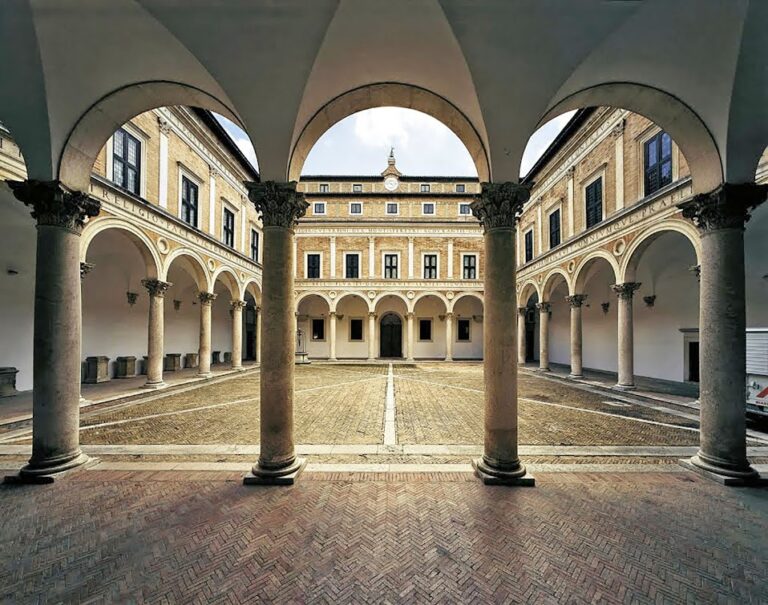
Palazzo Ducale covers approximately 6,000 square metres and occupies a steep site in Urbino. The museum’s rooms are arranged through the palace’s apartments, representation rooms, service areas, and archaeological spaces. The entrance from Piazza Duca Federico leads into the rectangular Cortile d’Onore. Its north and south sides each have five arches, while the other two sides have six. A seventeenth-century well stands in the southeast corner. Along the architraves on all four sides, a dedicatory inscription praises Federico’s construction of the palace, his military victories, justice, mercy, generosity, and religious devotion.
Jole and Melaranci apartments
The eastern wing contains the Jole Apartment, rooms 1–7. Its first room has a monumental fireplace decorated with figures of Hercules and Jole by Michele di Giovanni da Fiesole, known as il Greco. The apartment also contains Federico da Montefeltro’s alcove, made by Giovanni da Camerino and collaborators around 1459–1460, perhaps for Federico’s marriage to Battista Sforza. Federico used these rooms before becoming duke while the larger Duke’s Apartment was being completed.
The alcove is a wooden cube measuring 340 by 340 by 340 centimetres. Its panels, pilasters, and ceiling boards are painted in tempera and gilded. Fra Carnevale decorated the exterior with imitation polychrome marble in an architectural design recalling the Florentine Palazzo Rucellai associated with Leon Battista Alberti. The Jole rooms also display early Renaissance sculpture by Luca della Robbia, Michele di Giovanni da Fiesole, Agostino di Duccio, and Francesco di Giorgio Martini. Rooms 5 and 6 contain early fifteenth-century works from the Marche, while the final room contains fourteenth-century paintings.
The Melaranci Apartment occupies rooms 8–11. Together with the adjoining Guest Apartment, these rooms were probably intended for important visitors. Their late medieval works come principally from the Marche, Rimini, and other parts of central Italy. Among them are Giovanni Baronzio’s polyptychs, or multi-panel altarpieces, Madonna and Child and Stories from the Life of Jesus, as well as Olivuccio di Ciccarello’s Annunciation and Nicola di Maestro Antonio’s Annunciation.
Guest and Duke’s apartments
The Guest Apartment occupies rooms 12–15. Four of its five rooms are open as part of the museum display. One is traditionally called the Room of the King of England, recalling the palace’s tradition of accommodating important guests. The apartment contains fifteenth-century paintings from Venice and the southern Marche, Renaissance wooden sculpture, and a small hoard of fifteenth-century gold coins discovered in recent times.
The Duke’s, or Realissimo, Apartment occupies rooms 16–20. Room 16, the Audience Hall, contains Piero della Francesca’s Flagellation of Christ and Madonna di Senigallia. Federico’s studiolo, room 18, was completed in 1476. Its vault has elaborate stucco decoration, while the lower walls are faced with wooden intarsia, an inlay technique using contrasting materials to form images and geometric designs. Baccio Pontelli made the intarsia after designs associated with Sandro Botticelli, Francesco di Giorgio Martini, and Donato Bramante.
The band between the vault and the intarsia cabinets originally held twenty-eight portraits of illustrious men by Justus of Ghent and Pedro Berruguete. Fourteen recovered portraits are displayed again in the studiolo. The adjoining library has been dispersed, but its intarsia doors survive. Room 20, formerly the Duke’s bedroom, retains doors with intarsia designs attributed to Botticelli and Francesco di Giorgio Martini. Its works include Pedro Berruguete’s Portrait of Federico da Montefeltro with His Son Guidobaldo, dated 1476–1477.
Representation rooms
Rooms 21–23 formed the historical centre of the ducal palace and court life. The Sala degli Angeli, room 21, contains the Ideal City, whose attribution has been associated with Luciano Laurana, Piero della Francesca, Francesco di Giorgio Martini, Fra Carnevale, and Leon Battista Alberti, as well as, in another attribution, Melozzo da Forlì.
The same room contains the Corpus Domini altarpiece. Its central work is Justus of Ghent’s Communion of the Apostles, dated 1473–1474, accompanied by Paolo Uccello’s predella, the lower section of an altarpiece divided into narrative scenes, titled Miracle of the Profaned Host. The six scenes depict the exchange and profanation of a consecrated host, its miraculous bleeding, an attempted re-consecration, the execution of the woman involved, the burning of a Jewish merchant and his family, and a struggle between angels and demons over the woman’s body.
The predella was made for the Corpus Domini church in Urbino. It was later moved to the church of Saint Agatha and then to the Scolopi college, where it was found in an attic in 1858 or 1859, damaged and discolored by lime. It was subsequently transferred to Palazzo Ducale. The Sala delle Veglie, room 23, contains a substantial group of works by Giovanni Santi and Luca Signorelli’s Descent of the Holy Spirit and Crucifixion, dated 1494. The two Signorelli canvases were once the sides of a single processional banner.
Duchess’s Apartment
The Duchess’s Apartment occupies rooms 24–28. Room 25, the Duchess’s Drawing Room, contains Raphael’s Portrait of a Lady, traditionally called La Muta, together with the small Saint Catherine of Alexandria. Room 26, the Duchess’s Bedroom, contains Titian’s Last Supper and Resurrection. Painted in Venice between 1542 and 1544, the two works formed the sides of a processional banner commissioned from Titian by the Corpus Domini confraternity of Urbino. They reached Urbino in June 1544.
The Duchess’s Prayer Room has a stucco ceiling by the Urbino sculptor Federico Brandani. The ceiling was transferred there from Palazzo Corboli Aquilini between 1918 and 1919. These rooms retain the relationship between court apartments, religious practice, and the display of paintings and sculptural decoration within the palace.
Della Rovere Apartment
The second-floor della Rovere Apartment was built under Guidobaldo II della Rovere, a sixteenth-century Duke of Urbino. It contains works by Federico Barocci, Giovanni Francesco Guerrieri, Giovanni Battista Salvi, Claudio Ridolfi, Girolamo Cialdieri, Gaetano Lapis, Alessio De Marchis, and other artists. Paintings by Ridolfi and Cialdieri were made for the 1621 marriage of Federico Ubaldo della Rovere and Claudia de’ Medici. They were displayed with temporary decorations along the streets used by the wedding procession and are now preserved in the museum.
The apartment also contains Orazio Gentileschi’s Madonna and Child with Saint Frances of Rome, Federico Zuccari’s Porta Virtutis, and a substantial collection of Renaissance maiolica, tin-glazed earthenware often decorated in bright colours. The Volponi collection on this floor includes Baroque works by Guido Reni, Giovanni Battista Caracciolo, Mattia Preti, and other artists. The 2022 reinstallation extended the display into additional rooms through the deposit of works from the Cassa di Risparmio di Pesaro Foundation.
Basement and archaeological spaces
The basement contains the palace’s service areas, including stables, kitchens, baths, and cellars. Other installations include a dye workshop, an icehouse, and the duke’s private baths. Although these spaces lie below the Cortile d’Onore, the steep slope allowed ground-level entry from the side. Several ground-floor rooms also form the archaeological museum of Urbino, whose collections are especially rich in ancient inscriptions.
Nearby sites