Franciscan Monastery in Heilbronn: A Medieval Religious Complex

Site at a Glance
- Rating
- 4.5
- Popularity
- Very Low
- Country
- Germany
- Primary era
- Medieval
- External website
- Open
- Eras represented
- Medieval, Modern
- Civilizations
- German, Holy Roman Empire
- Site type
- Religious
- Remains
- Monastery
On this page12 sections
History
The Franciscan Monastery in Heilbronn, Germany, was a thirteenth-century religious foundation established by Franciscan friars, members of a Catholic mendicant order associated with preaching, poverty, and reliance on alms. The community was first recorded in Heilbronn in 1272 and later built the church dedicated to the Virgin Mary and Saint Francis. The foundation stone is traditionally associated with 1290, and the church was consecrated in 1314.
Foundation and Franciscan Life
The friars initially established their monastery “in a corner of the city,” although its original plan and exact location are unknown. The year 1290 appears on a coat of arms in the vault of the later Franciscan Marienkirche and is interpreted as the date when the church’s foundation stone was laid. The first burial in the church also took place that year.
The monastery church was consecrated in 1314. In 1309, King Heinrich IV attended a service there during a meeting in Heilbronn with Peter, Archbishop of Mainz. After the sermon, Brother Mathäus announced the arrival of a messenger from Pope Clement V, who carried an invitation to the imperial coronation. The church also became a burial place for the friars, members of Heilbronn’s patrician families, and supporters from the lower nobility of the surrounding region.
The convent belonged to Argentina, the Upper German or Strasbourg province of the Franciscan Order. This province followed a relatively relaxed interpretation of Franciscan poverty, known as usus moderatus, which permitted limited property use. Each monastery’s property was administered by an external procurator, and Konrad Leineweber held that position at Heilbronn in 1339.
The friars depended mainly on food and other goods given as alms. Their collection district extended between Pforzheim, Esslingen, Brettach, and Obergriesheim. Further collecting was allowed only when the supplies already received were insufficient for their livelihood.
Reform and Dissolution
Over time, observance of the Franciscan poverty vow weakened. The convent permitted private possessions, abandoned the habit, or accepted privileges. As a result, the Heilbronn Franciscan monastery and the city’s Clarissan convent, whose members belonged to the women’s branch of the Franciscan movement, became targets of reforms in 1465 and 1466 promoted by Pope Paul II and the Franciscan Observant movement.
The friars opposed the Reformation, the sixteenth-century religious movement that challenged Catholic institutions and led to the creation of Protestant churches in parts of Europe. Brother Johann Eberlin of Günzburg was among those associated with this opposition in Heilbronn. The Reformation nevertheless contributed to the decline of monasteries in reform-minded imperial cities, including Heilbronn, Nuremberg, and Ulm. Imperial cities were governed directly by the Holy Roman Emperor rather than by a territorial prince.
From 1525, Heilbronn’s city council progressively took control of the monastery. In 1529, it declared its intention to seize the complex and establish an arsenal there, and demolition of the monastery walls began. Georg Truchsess von Waldburg-Zeil obtained a mandate from the Imperial Chamber Court suspending the work, but his death in 1531 removed this protection. The city then prohibited the friars from celebrating several Masses and offered a benefice, an ecclesiastical office or endowment providing income, to a friar who would leave the monastery.
Harassment continued, and the convent gradually declined. Only two friars remained in 1542, and the last died in 1544. The reform-minded city then dissolved the monastery. The Franciscan Order unsuccessfully sought its return in 1549 and again in 1629, during the Thirty Years’ War. The complex remained under Heilbronn’s control.
Municipal and Educational Use
After 1544, the city used the former monastery as premises for its Latin school. In 1566, the Franciscan provincial formally transferred the former monastery buildings to Heilbronn, and in 1575 the cloister and convent were adapted for the council library. Classes continued in parts of the complex until the Karlsgymnasium for boys was built in 1827.
During the nineteenth century, the buildings underwent four major additions and alterations. They temporarily accommodated several schools, including the Higher Girls’ School and Heilbronn’s vocational school, which remained there until 1889.
Destruction and Later Memorial Use
The Marienkirche became a Protestant church after 1544. The French army destroyed it in 1688. Heilbronn’s council sought donations for reconstruction, and Emperor Leopold I issued an empire-wide appeal for contributions around 1698, but the funds were insufficient to rebuild the nave. The previously secularized Nikolaikirche was therefore reconsecrated in 1706, while the surviving church tower was reconstructed by 1727.
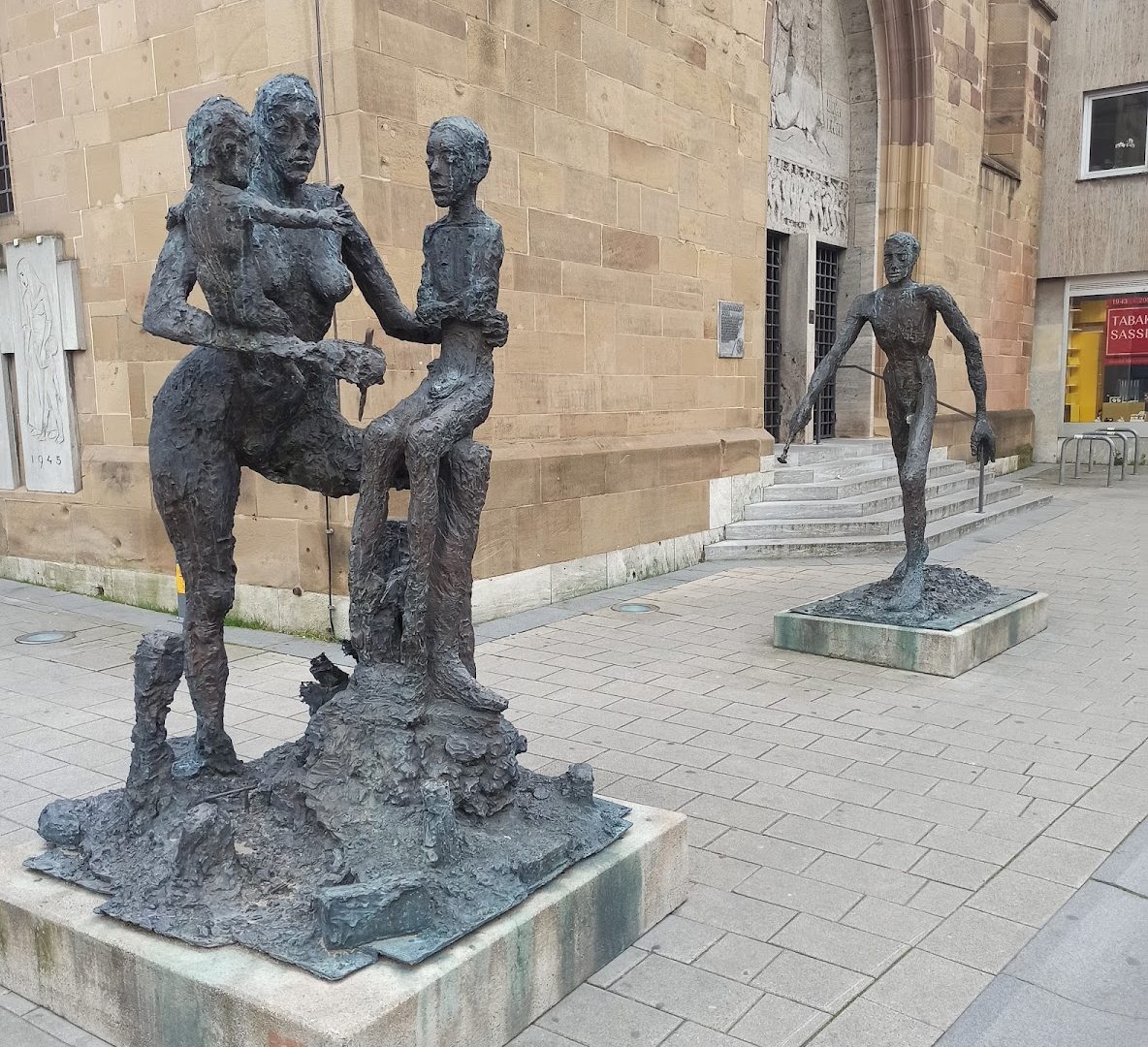
Around 1800, the rebuilt tower was used as a factory producing shot pellets. Its base became a memorial to those killed in the First World War between 1926 and 1936. The former monastery cloister was demolished in 1925 when the inner courtyard was roofed over for use as a gymnasium. The remaining monastery buildings were completely destroyed in the major air raid on Heilbronn in 1944. During postwar reconstruction, a phoenix designed by Heinrich Röhm in 1951 was placed on the tower summit, and in 1963 the base was converted into a passage containing further memorials to victims of war and expulsion.
Remains
Church and Hafenmarktturm
Marienkirche
The monastery church, later called the Marienkirche, formed the principal religious building of the complex. It was dedicated to the Virgin Mary and Saint Francis, and a building inscription dated 1314 recorded its consecration. A vault carried a coat of arms with the year 1290, associated with the laying of the foundation stone. Burials beneath the church included members of the counts of Löwenstein, the Marshals of Hohenried, numerous noble families from the surrounding region, and Heilbronn patricians from families including Erer, Feurer, Sandritter, Berlin, Schreiber, Stirner, Ansen, Waller, Walther, Lorcher, and Laemmlin.
Hafenmarktturm
The church was destroyed in 1688, and only its tower was rebuilt. Now known as the Hafenmarktturm, the tower was reconstructed by 1727 under the direction of building councillor Johann Philipp Meyer. The nave was not rebuilt. The tower’s base, previously adapted as a First World War memorial, was converted into a passage in 1963. The passage contains memorials to victims of war and expulsion, while the summit carries the phoenix designed by Heinrich Röhm in 1951.
Monastery Complex
Cloister and Courtyard
The former complex comprised the church, a cloister, a convent, surrounding monastery walls, and an inner courtyard. A cloister is a covered walkway enclosing an open courtyard. The cloister was removed in 1925 when the courtyard was roofed over and converted for use as a gymnasium.
Former Monastery Buildings
The convent and other monastery buildings were altered and extended four times during the nineteenth century. Their successive educational uses included the Latin school, the council library, the Higher Girls’ School, and the vocational school. These buildings were completely destroyed in the 1944 air raid on Heilbronn.