Forte Larino: An Austro-Hungarian Border Fort in Italy


Site at a Glance
- Rating
- 4.2
- Popularity
- Low
- Country
- Italy
- Primary era
- Modern
- External website
- Open
- Eras represented
- Modern
- Civilizations
- Habsburg
- Site type
- Military
- Remains
- Fort
On this page7 sections
History
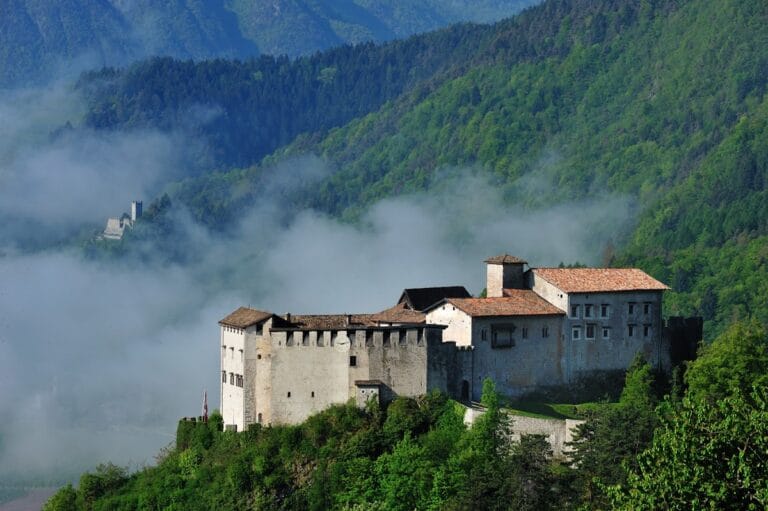
Forte Larino is an Austro-Hungarian military fort at Lardaro in Italy, built in 1860–1862 as a fortified roadblock in the Chiese Valley. Its position at a narrowing of the valley allowed it to control the road from the Brescia area, which had recently become Italian territory.
Construction and the Lardaro Barrage
The fort belonged to the Lardaro Barrage, a group of fortifications intended to defend the border and control territory in the Chiese Valley. Within the larger Austrian fortification system along the Italian border, it formed part of Subrayon III, a subdivision of that defensive network. The Imperial-Royal Army was its first owner, and the fort was used by the Austro-Hungarian Empire. The Lardaro Barrage also included Forte Corno, Forte Danzolino, Forte Cariola, and Forte Revegler.
Wartime Service and Restoration
Forte Larino played an important role during the Third Italian War of Independence, the 1866 conflict through which the Kingdom of Italy acquired Venetia from the Austrian Empire. It was also part of the military landscape during the First World War, the international conflict of 1914–1918 in which Italy and Austria-Hungary fought as opposing belligerents.
The fort is now in Italy, although it formerly stood within Austria-Hungary. Restoration took place between 2006 and 2008, leaving the structure in restored condition.
Remains
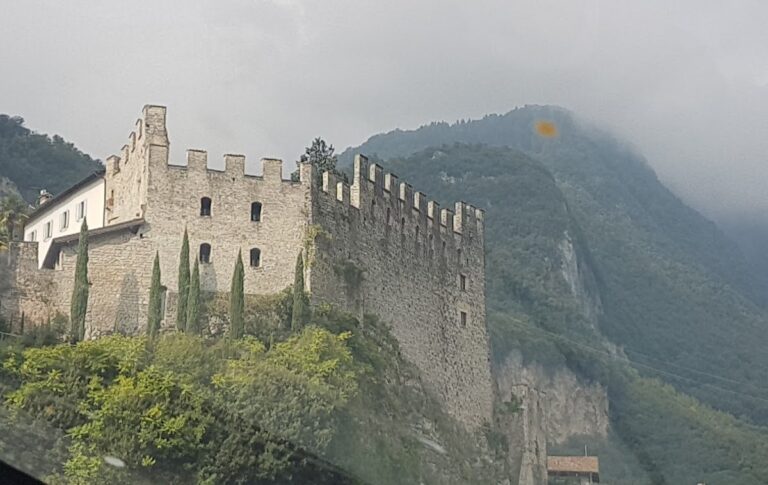
Forte Larino survives as a restored fortified military structure enclosed by a continuous ditch. Its masonry is built from granite ashlar blocks, each worked with chisels. The fort’s defensive enclosure and artillery arrangements express its role as a roadblock controlling the narrowed valley.
Defensive Structure and Artillery
Fortification and Ditch
The fort is surrounded by a continuous ditch that forms part of its defensive design. Its walls consist of carefully shaped granite ashlar blocks, providing the principal surviving expression of the fort’s masonry construction.
Guns and Emplacements
Forte Larino was armed with four 150 mm Model 61 guns. Four 80/5 guns were later mounted in barbettes, open gun platforms from which artillery could fire over a parapet. These were subsequently replaced by four 90/75 field guns installed in minimal gun emplacements, compact protected positions for artillery pieces.