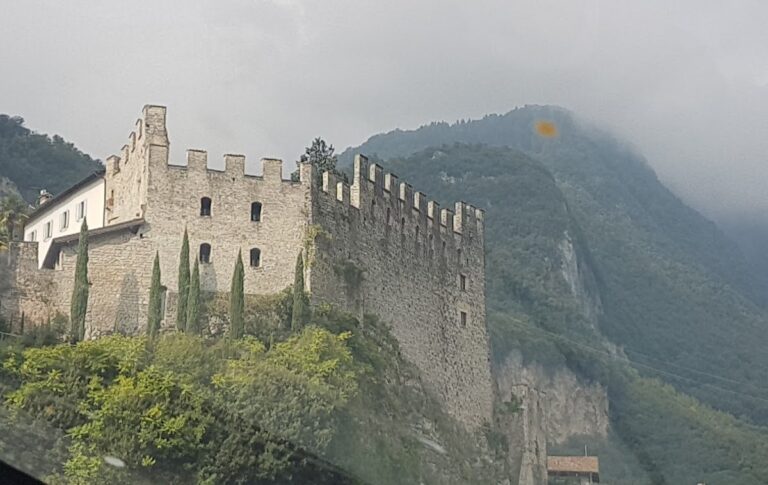
Castello di Stenico: An Episcopal Residence in Italy


Site at a Glance
- Rating
- 4.5
- Popularity
- Medium
- Country
- Italy
- Primary era
- Medieval
- External website
- Open
- Eras represented
- Medieval
- Civilizations
- Holy Roman Empire
- Site type
- Military
- Remains
- Castle
On this page6 sections
History
Stenico Castle, known as Castello di Stenico, is a twelfth-century castle in Italy’s Val Giudicarie, associated with an earlier prehistoric hillfort and built in a position that controlled the territory west of Trento. Its later development made it an important episcopal residence and the political, administrative, and judicial center of the valley.
From hillfort to episcopal residence
The castle dates from the twelfth century and occupied a strategically important location above the Giudicarie. In the thirteenth century, it passed into the possession of the prince-bishop of Trento. A prince-bishop combined the religious authority of a bishop with the secular powers of territorial government. The prince-bishops repeatedly enlarged and altered Stenico Castle, transforming it into a major residence and seat of administration.
The prince-bishop governed the territory through the Captain of the Giudicarie, a senior official responsible for military, economic, political, and administrative affairs. For almost eight centuries, the Captain and his lieutenants lived in the castle and exercised the highest political and administrative authority in the Giudicarie on the bishop’s behalf. The territory’s seven parish districts retained recognized local autonomy, while the castle served as the central political, administrative, and judicial institution for the entire valley.
Secular government and modern preservation
After the secularization of the prince-bishopric, when its ecclesiastical territory and governing powers were transferred to a secular government, the Austrian administration used the castle as the seat of an Imperial-Royal court and tax office. Imperial-Royal institutions belonged to the Habsburg monarchy, which governed Trentino before its incorporation into Italy. After ownership passed to the Italian state, the complex served first as a magistrates’ court and later as a Carabinieri station. The Carabinieri are Italy’s national gendarmerie and military police force.
The Province of Trento began restoration work in 1973 and later opened the castle as a museum. Stenico Castle now forms part of the museum and exhibition network of Buonconsiglio Castle in Trento. It is also associated with the UNESCO biosphere designation for the Ledrensi and Giudicarie Alps, an area where ecosystem conservation is combined with sustainable human use and research. The castle is designated Italian national heritage.
Remains
The surviving complex brings together an older fortified core and buildings enlarged or modified during its long use as an episcopal residence and administrative seat. Later changes affected the appearance of parts of the castle, while the complex now accommodates a museum devoted to its history and art.
Oldest fortified core
The oldest part rises in the structure known as the Hunger Tower. Tradition identifies this tower as the place where prisoners were condemned to die from starvation, giving it a direct association with the castle’s judicial past.
Later coverings and museum use
During the Austrian administration of Trentino, toward the end of the nineteenth century, parts of the castle were covered with cement boards. The complex is currently used as a castle-history and art museum.