Tagliata Bariola: An Italian Road-Block Fortification at Valli del Pasubio


Site at a Glance
- Rating
- 4.3
- Popularity
- Very Low
- Country
- Italy
- Primary era
- Modern
- Eras represented
- Modern
- Civilizations
- Italian
- Site type
- Military
- Remains
- Fort
On this page11 sections
History
Tagliata Bariola is a former Italian military road-block fortification at Valli del Pasubio in northern Italy, built in the 1880s to control routes toward the Pian delle Fugazze and the upper Leogra Valley. Also occasionally called Tagliata San Antonio, it formed part of the Agno-Assa road barrage, a coordinated defensive system of forts, gun positions, and road barriers controlling mountain valleys and passes.
Road and defensive system
The fortification stood beside the road from Schio through the Leogra Valley toward the Pian delle Fugazze Pass. This route was already important before Tagliata Bariola was built because it led toward the Adige Valley. Napoleon Bonaparte’s administration planned the road, and it was constructed under Emperor Francis I between 1817 and 1818.
The pass, a few kilometres from the fortification, marked the border between Austria-Hungary and Italy until the end of the First World War. It now forms the boundary between the Provinces of Trento and Vicenza. Tagliata Bariola belonged to the Schio sector and the Agno-Posina subsection of the wider defensive organization. Together with Forte Monte Maso, approximately 250 metres away across the air, and the nearby Monte Castelliero gun position, it was intended to block incursions from the Pian delle Fugazze and Xomo passes into the upper Leogra Valley.
Decline and disarmament
The Italian Royal Army operated Tagliata Bariola, but the fortification was never modernized or strengthened after its construction. It had become obsolete well before the First World War and would not have resisted modern artillery fire for long. Although designed to prevent Austro-Hungarian forces from reaching the Pian delle Fugazze, it never entered combat because it lay too far from the front. Around the turn of the twentieth century, the Austro-Hungarian Evidenzbüro, a military intelligence and information office, nevertheless examined the installation in detail as part of its assessment of the defensive system.
The fortification was partially disarmed in May 1916. Its original strategic purpose ended after the South Tyrol offensive, the major Austro-Hungarian attack on the Italian front in May and June 1916, concluded and the front in this sector stabilized. Tagliata Bariola was then completely disarmed.
Demolition and conservation
Road widening during the 1930s caused most of the fortification to be demolished. The remaining ruins were later used partly as storage areas. Between 2006 and 2008, the Veneto Region cleared vegetation and accumulated debris from the site and carried out safety measures intended to slow further deterioration. Tagliata Bariola now survives as a partially demolished fortification, with its possible entrances secured against entry.
Remains
Tagliata Bariola was built lengthwise along the road as a fortified road barrier, or tagliata stradale, using rubble stone, large blocks, and brick. Its stone construction was intended to resist grenades used in close combat. A defensive ditch originally surrounded the front, the rear or gorge, and the flank facing the valley. The road crossed the gorge ditch by a drawbridge, passed through a gate and a partly covered passage, and then crossed the front ditch by a second bridge and gate.
Road passage and defensive ditches
Covered passage
The passage was partly covered, while the adjacent yard was uncovered. Both occupied a defiladed position, meaning that their arrangement concealed the masonry roof from views outside the fortification. The front and gorge slopes were flat, while the outer side slopes had bevelled angles. Rifle loopholes in the casemates, fortified chambers protected by masonry or earth, allowed defenders to direct flanking fire along the ditches.
Surviving ditch lines
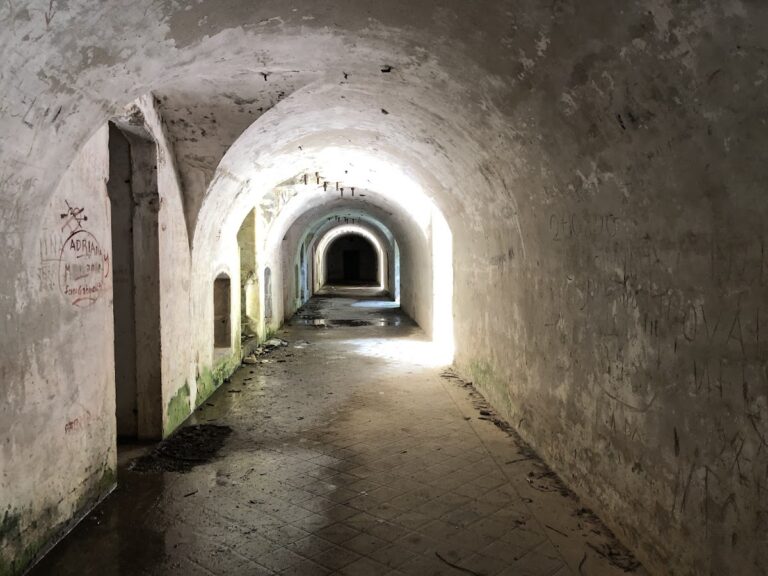
Road widening removed the central building through which the road had passed and filled the front and gorge ditches. Portions of the former ditch remain visible, together with some defensive loopholes. These surviving elements preserve parts of the relationship between the road, the barrier, and the enclosed defensive works.
Casemates and armament
Front and gorge casemates
The upper levels on the front and gorge sides contained casemates for four 42 mm Nordenfelt rapid-fire guns mounted on pedestals. A Nordenfelt was a rapid-fire gun system intended to deliver repeated shots. The rifle loopholes also allowed small-arms fire to sweep the surrounding ditches.
Flank casemate block
Along the flank ditch stood a two-storey casemate block adapted to the mountain slope and the gradient of the road. Its upper storey contained rifle and machine-gun loopholes. Below road level, the lower storey held embrasures for two 87 B guns, bronze 87 mm weapons used to protect the flank. Each corner casemate carried a Gardner machine gun. The Gardner was an early mechanically operated machine gun, and the Italian Army imported these American-made weapons directly from the United States in limited numbers for the close defence of fortifications, especially their ditches.
Parts of the flank casemate block remain, along with sections of the gorge-side corner casemate. On the mountain side, the fortification directly abutted the hillside, and parts of the slope were excavated into caves to create depot rooms. These rooms also survive. The installation was designed for a garrison of 100 men, while its full armament consisted of four 42 mm Nordenfelt guns, two 87 B guns, and four Gardner machine guns of 10.33 mm calibre.