Forte Coldarco: An Italian First World War Cave Battery


Site at a Glance
- Rating
- 4.1
- Popularity
- Very Low
- Country
- Italy
- Primary era
- Modern
- Eras represented
- Modern
- Civilizations
- Italian
- Site type
- Military
- Remains
- Fort
On this page8 sections
History
Forte Coldarco is an Italian First World War artillery position in Italy, in the municipality of Enego. Built by Italian military authorities between 1912 and 1914, it was a cave battery, an artillery position excavated into rock, within the Brenta-Cismon barrage. This network of forts, batteries, road barriers, and related military works controlled the Brenta and Cismon approaches and the Valsugana, while protecting the Italian frontier against Austria-Hungary.
Origins in the Brenta-Cismon barrage
Late nineteenth-century Italian planning included the Coldarco area in the defensive system because the lower road barriers at della Scala and Fontanelle were considered too weak to withstand modern artillery. Before 1896, an open battery for 149 G guns had been established north of Coldarco above the Valsugana. It protected the flank of the military installations near Primolano.
When construction of Forte Lisser on Monte Lisser began in 1911, the Coldarco position was considered for modernization. A permanent concrete battery was rejected because of its expected cost and the difficulty of building it. Instead, the authorities chose a cave battery for four 75 A guns, together with an artillery observation post. The position was intended to stop infantry advancing from the Valsugana toward Primolano and to cover sectors beyond the effective range of Forte Leone. It was also meant to work with Forte Lisser and Forte Cima Campo.
Construction and the First World War
Work began in 1912 and ended in summer 1914. The battery was still unarmed when the First World War began, so its weapons were installed rapidly, with the armament completed in autumn 1914.
When fighting opened on the Italian-Austro-Hungarian front on 24 May 1915, Coldarco was expected to support the Italian advance and fire on possible counterattacks from the Tezze area. The withdrawal of the Austro-Hungarian front prevented these operations, and the battery fired no shots. After about ten days, the Italian advance had carried troops beyond the guns’ range, removing the position’s military value.
The Austro-Hungarian South Tyrol offensive of May 1916 did not restore Coldarco’s usefulness. The battery was formally abandoned on 23 November 1916, when the Brenta-Cismon barrage was dissolved, and its guns had probably already been transferred elsewhere. Coldarco also played no role after the Twelfth Battle of the Isonzo, the Italian withdrawal to the Grappa-Piave line in November 1917, or the subsequent occupation of the area by Austro-Hungarian troops.
Postwar damage and restoration
After the war, Italian military engineers and salvage workers used the tunnels to detonate unexploded shells recovered from the plateau. The explosions destroyed much of the original concrete lining but caused no other major structural damage. The former battery was restored between 2006 and 2009.
Remains
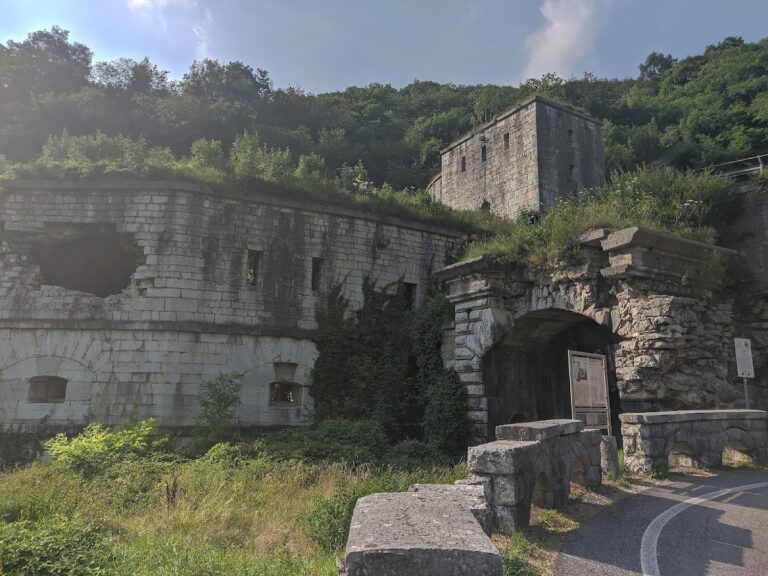
Forte Coldarco was cut directly into a rock face at about 587 metres above sea level, between Coldarco di Sotto and Coldarco di Mezzo, above the Canale di Brenta and the Valsugana. Its layout centres on a main tunnel about 60 metres long, with five side galleries extending northeast. The excavated rock formed the protective shell of the battery, while concrete was used for the floors and internal linings.
Main tunnel and artillery galleries
The side galleries are partly raised and are reached by concrete-lined steps. The first served the artillery observer. The next four lead to gun chambers from which the Valsugana around and north of Primolano could be shelled. Small gun embrasures were designed for four weapons on wall carriages, although that arrangement was later abandoned. Nickel-alloy steel armour plates could close the openings.
Four ammunition niches stand opposite the gun galleries in the main tunnel. The last niche is at the end of the passage rather than along its side. Drainage channels gathered water and carried it to a cistern beside the right-hand side of the main entrance, where the cistern’s remains are still visible.
Armament and restored interior
The battery used rapid-fire 75 A guns on pedestal carriages. Each carriage rested on iron plates bolted to a concrete base, and its central support allowed the gun to traverse across a broad horizontal arc for firing at moving targets. The gun fired shells weighing up to about 6 kilograms over distances of approximately 3,700 to 8,100 metres. Its muzzle velocity was about 500 metres per second, and its intended targets included the valley floor and enemy infantry.
One gun chamber has been re-concreted. A 75 mm Model 1911 gun now stands on a pedestal carriage, representing a successor to the Model 75 A originally intended for the battery. The restored interior is illuminated by LED lights controlled by sensors powered by a solar panel.
Service and accommodation building
About 70 metres in front of the entrance stood a partly earth-embedded service and accommodation building. It contained storage for food and other materials and was designed to house up to 100 men. A road and a communication trench linked this building with the cave battery.
Nearby sites