Forte Leone: An Italian Border Fortress at Cima Campo


Site at a Glance
- Rating
- 4.4
- Popularity
- Low
- Country
- Italy
- Primary era
- Modern
- External website
- Open
- Eras represented
- Modern
- Civilizations
- Italian
- Site type
- Military
- Remains
- Fort
On this page5 sections
History
Construction and defensive role
Forte Leone is an Italian military fortress in Arsiè, Italy, built between 1906 and 1911 to defend the border against the Austro-Hungarian Empire, the dual monarchy that ruled much of Central Europe from 1867 until its dissolution in 1918. It formed part of the Brenta–Cismon defensive barrage, a coordinated system of Italian fortifications intended to control strategic routes and approaches in the Brenta and Cismon area.
Construction took place under Antonio Dal Fabbro, a captain in the Italian military engineering corps. The fortress stood on Cima Campo and was intended to cover the mule tracks climbing from the Valsugana toward the Asiago Plateau. Its guns could also provide fire coverage across the surrounding area within a radius of 12 kilometres.
Role during the First World War
By the Battle of Caporetto, a major Austro-German offensive against the Italian Army in October and November 1917, Italian troops were using Forte Leone as a warehouse rather than as an active artillery position. Like Forte Cima Lan and Forte Lisser, two other forts associated with the same defensive system, it was considered too far from the front.
Its cannons were consequently removed and replaced with fir-tree trunks painted black. The fortress is currently undergoing restoration.
Remains
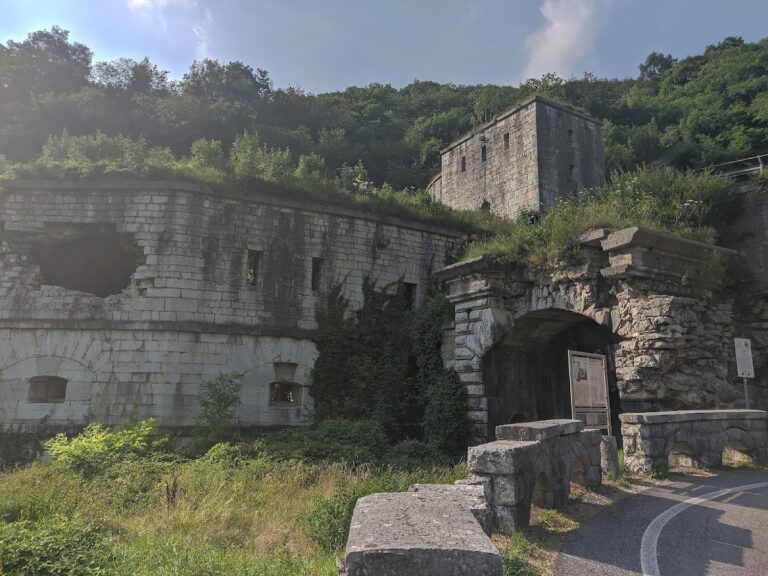
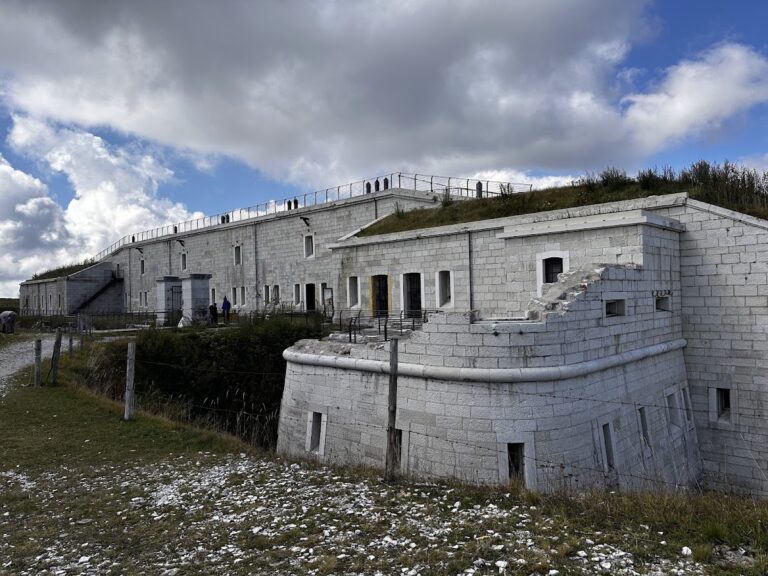
Forte Leone occupies the summit of Cima Campo, the hill that gave rise to its alternative name, Forte Cima Campo. The fortress survives as a fortified military installation within the municipality of Arsiè in the province of Belluno.
Armament and observation works
The original armament comprised six 149A guns mounted in armored cupolas, protected gun positions enclosed by heavy armor. Five machine guns were installed in casemates, fortified chambers for weapons, while six more machine guns occupied an armored turret. A rotating observation post completed the fortress’s principal defensive and surveillance equipment.
Nearby sites