Tagliata della Scala: An Italian Frontier Fortress in Valbrenta


Site at a Glance
- Rating
- 4.2
- Popularity
- Low
- Country
- Italy
- Primary era
- Modern
- Eras represented
- Modern
- Civilizations
- Italian
- Site type
- Military
- Remains
- Fort
On this page6 sections
History
Tagliata della Scala is a military fortress in Italy, near Primolano in the present municipality of Valbrenta, built by the Kingdom of Italy between 1892 and 1904 to defend the frontier against the Austro-Hungarian Empire. It formed part of the Brenta-Cismon barrage, a chain of Italian fortifications designed to control routes through the Brenta and Cismon valleys toward the Valsugana, Feltre, and Primiero areas. Construction began shortly after Primolano was annexed to the Kingdom of Italy, the state ruled by the House of Savoy.
The Brenta-Cismon defensive system
Tagliata della Scala occupied the heights near Primolano and guarded the road corridor through the defensive area. Its position was linked to Tagliata delle Fontanelle, a related work near the locality of Metà Scala–Minori. Together, the two structures helped control a strategically important route connecting several valleys and regional districts.
The Caporetto retreat
During the Caporetto defeat in late 1917, an Austro-German breakthrough on the Italian Front forced the Italian Army to withdraw toward the Piave and Monte Grappa. The Italian garrison abandoned Tagliata della Scala on 12 November 1917. Before departing, the troops detonated the ammunition depots, producing two large breaches in the fortress walls. The Austrian 1st Mountain Brigade occupied the complex on 13 November. Although the fortress did not take an active part in the fighting, it was severely damaged during the defeat and the subsequent retreat.
The Scala–Fontanelle structures largely survived their wartime damage and remain evidence of the regional defensive system established by Italy. Tagliata della Scala is privately owned. Its entrance portal still bears the coat of arms of Savoy, linking the fortress to the Kingdom of Italy.
Remains
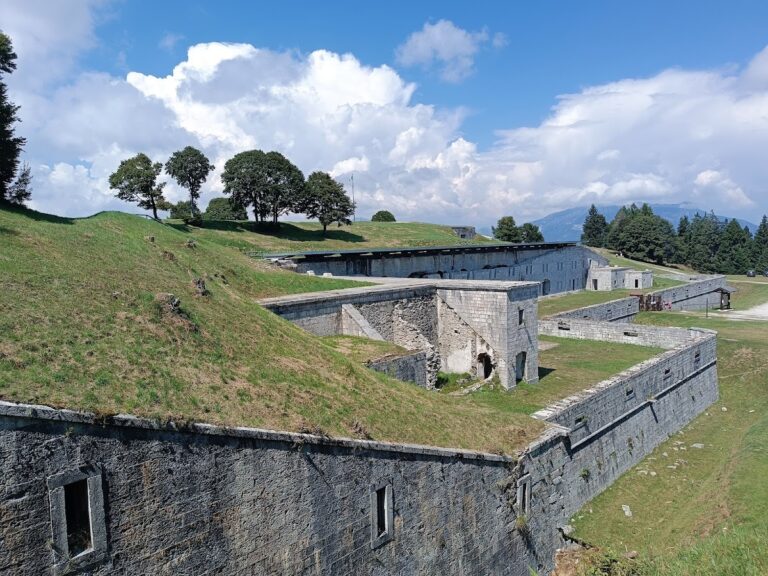
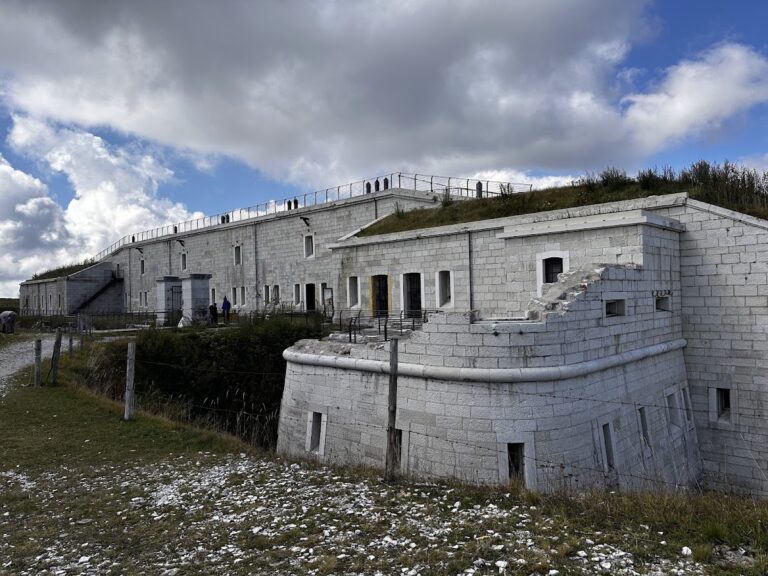
Tagliata della Scala consists principally of a casemate, an enclosed fortified structure designed to shelter artillery or troops from bombardment, with a bombproof covering. An exterior artillery position accompanied the main building. The fortress stood above the road corridor near Primolano, where its defenses were integrated with the related works of the Brenta-Cismon barrage.
Fortified buildings and artillery
The recorded armament comprised eight 120-millimeter cannons, two 75-millimeter cannons, and two machine guns. The casemate and the exterior artillery position formed the principal elements of the surviving fortress complex. The entrance portal retains the Savoy coat of arms, while the substantial walls still show two broad breaches made when the ammunition depots were destroyed before the Italian withdrawal.
Covered road defense
A long covered gallery, or caponniere, extended along the road and blocked it for a considerable distance. This defensive passage connected Tagliata della Scala with Tagliata delle Fontanelle and allowed the two works to function as related elements of the same fortified corridor. Much of the Scala–Fontanelle complex remains in place despite the damage caused in 1917.
Nearby sites