Fort VII in Kaliningrad: A Principal Fort of the Königsberg Fortress


Site at a Glance
- Rating
- 4.2
- Popularity
- Low
- Country
- Russia
- Primary era
- Modern
- External website
- Open
- Eras represented
- Modern
- Civilizations
- German, Kingdom of Prussia
- Site type
- Military
- Remains
- Fort
On this page5 sections
History
Fort VII, also known as Herzog von Holstein, is a late nineteenth-century fortification in Kaliningrad, Russia, and one of the twelve principal forts of the Königsberg Fortress. Construction began in 1887 and was completed in 1890. Its position west of Pregolsky settlement allowed it to defend the Königsberg Canal and the Pregolya River from the west.
Name and construction
The name Herzog von Holstein refers to the title shared by the dukes of Holstein, a historical duchy and region in northern Germany. Several of those dukes held offices in the Prussian state and military. The fort formed part of the defensive system surrounding Königsberg, whose principal forts were built to protect the city and its approaches.
The assault of April 1945
During the Soviet assault on Königsberg in the final stages of the Second World War, Fort VII lay outside the main axis of the 43rd Army’s attack. It therefore escaped bombardment by special-power artillery. After the Königsberg garrison capitulated, an assault group from the 24th Guards Division attacked the fort on 10 April 1945.
Self-propelled guns commanded by Lieutenant I. A. Patrushev suppressed the fort’s machine-gun positions with direct fire from a distance of 100 to 150 metres. Infantry from the 84th Guards Regiment, under Major Timoshenko, then captured the fort with almost no losses. The operation resulted in 250 soldiers and officers being taken prisoner, while 30 bodies were found in the casemates, fortified chambers used for shelter, storage, or weapons.
Later use and protection
After the war, a Baltic Fleet repair plant used the fort as a warehouse. On 23 March 2007, the Government of Kaliningrad Oblast designated Fort VII a cultural-heritage site of regional significance.
Remains
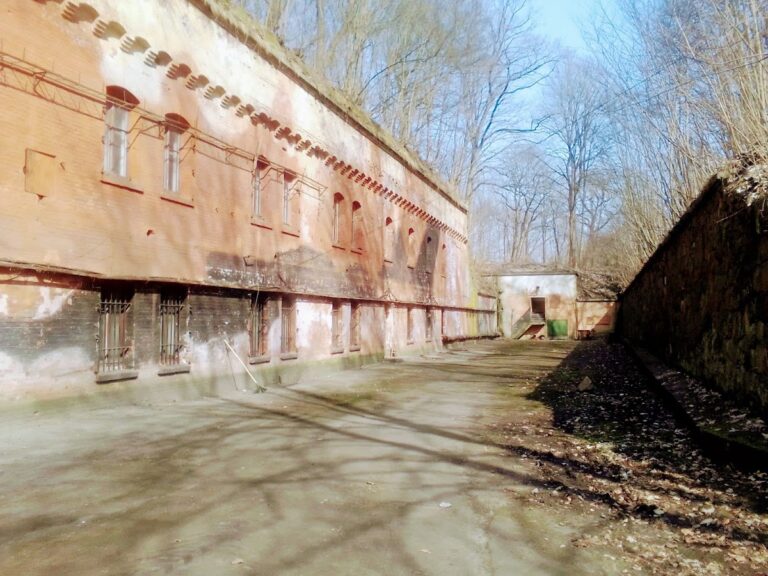
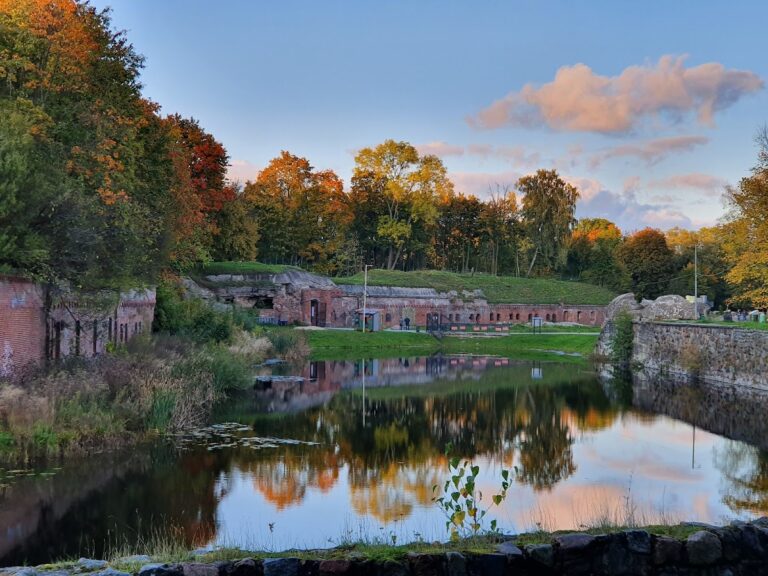
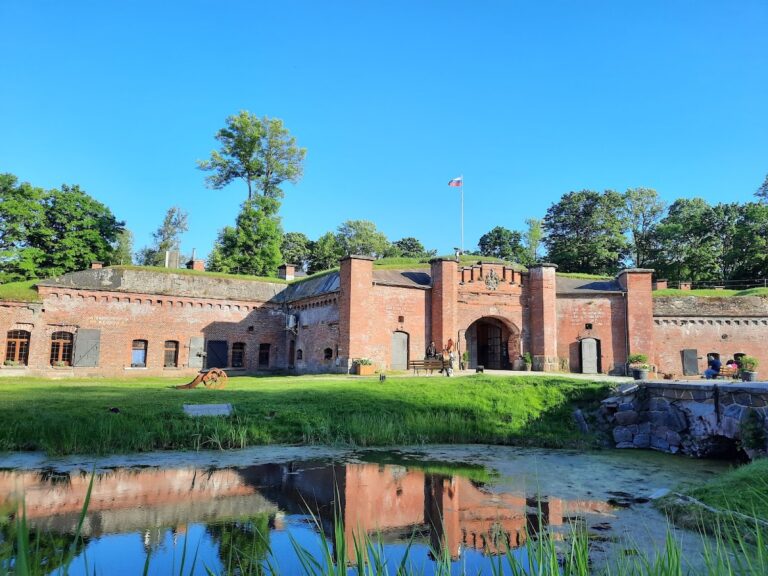
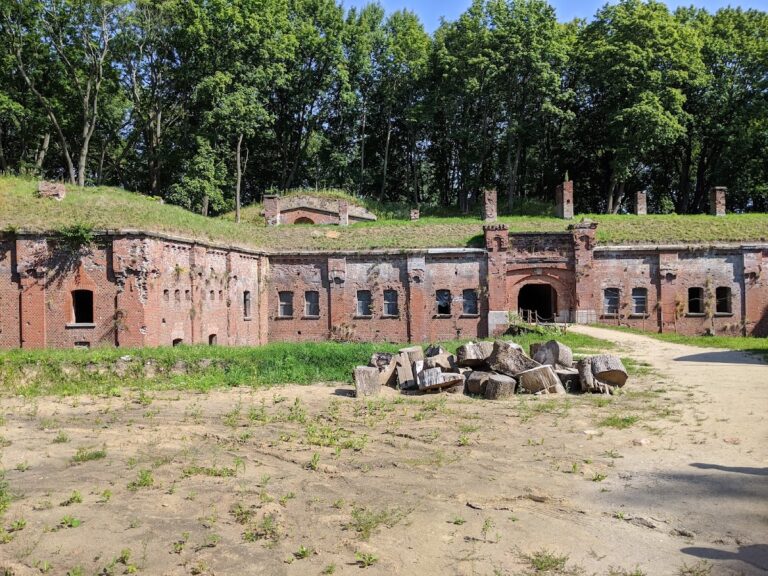
Fort VII stands on the right bank of the Pregolya River, near the point where the river flows into the Kaliningrad Gulf. Its defensive layout consists of a closed pentagonal enclosure surrounded by a water-filled moat. An earthen rampart protects the principal structure, integrating the fort into the surrounding defensive groundworks.
At the corners of the rampart’s faces are coffers, structures bordering or projecting into the ditch and designed to provide flanking fire. Their embrasures, openings through which weapons could be fired, formed part of the fort’s defensive arrangement. The surviving enclosure, moat, rampart, coffers, and casemates preserve the main elements associated with the fort’s military function and its later combat history.
Nearby sites