Fort 5, King Frederick William III: A Königsberg Fortification


Site at a Glance
- Rating
- 4.7
- Popularity
- Medium
- Country
- Russia
- Primary era
- Modern
- Eras represented
- Modern
- Civilizations
- German, Kingdom of Prussia
- Site type
- Military
- Remains
- Fort
On this page14 sections
History
Fort 5, King Frederick William III, is a Prussian military fortification in Kaliningrad, Russia, built in the late nineteenth century as part of Königsberg’s outer ring of forts. Constructed approximately between 1870 and 1890, it protected the highway approaching the city from the direction of Pillau. The fort was named for Frederick William III, King of Prussia from 1797 to 1840, who led the Prussian state during the wars against Napoleon.
Construction and defensive role
In 1886, Fort 5 received additional protection in the form of a reinforced-concrete covering approximately two metres thick. It was also equipped with a rotating armoured observation cupola. These improvements strengthened the fort as artillery developed and formed part of the wider modernization of Königsberg’s defensive ring.
Before the Soviet assault on Königsberg in 1945, the fort was reinforced with an anti-tank ditch, trenches, artillery positions, anti-tank obstacles, barbed wire, and minefields. Its position covered the highway to Rauschen during the battle and obstructed the advance of the Soviet 43rd Army.
The assault of April 1945
From late March 1945, Soviet assault units prepared for the attack on fields containing detailed mock-ups of the German defenses. One of these was a three-dimensional earthen model of Fort 5. The assault groups included experienced soldiers from the 263rd and 33rd Guards Rifle Divisions, many of whom had previously fought at Stalingrad, Sevastopol, and Vitebsk.
Soviet artillery shelled the fort from 3 to 5 April. Weapons of exceptional power stripped away its covering earth and made approximately 90 direct hits, yet the fort suffered only isolated breaches and breaks at this stage. Artillery preparation continued from 6 April, when assault detachments of the 801st and 806th Rifle Regiments of the 235th Rifle Division advanced with support from tanks, artillery, and self-propelled artillery.
Soldiers of the 2nd Rifle Company of the 806th Regiment crossed the ditch and captured the right-flank casemate, a fortified chamber protected by thick masonry or concrete. Lieutenant Mirza Dzhabiev and Sergeant Alexei Kondrutsky raised the Red Banner there. German resistance continued, and the 550th Rifle Regiment of the 126th Rifle Division joined the attack. The fighting was successively continued by the 1st Battalion of the 732nd Rifle Regiment and the 2nd Battalion of the 550th Rifle Regiment under Senior Lieutenant Roman Babushkin.
Soviet sappers destroyed the casemate on the left flank. During the night, a team led by Sergeant Major Pyotr Merenkov, Senior Sergeant Grigory Malygin, and Private Vladimir Polupanov carried out two directed explosions. These enabled crossing equipment to be lowered to the water-filled ditch, after which the men crossed and demolished the fort’s forward caponier, a covered defensive structure projecting into or protecting a ditch.
Soviet assault troops entered through the breach and fought inside the fort throughout the night of 7 to 8 April. The remaining German garrison capitulated on the morning of 8 April, while fighting had already reached central Königsberg. The garrison numbered approximately 350 soldiers and officers. Soviet figures recorded more than 200 German soldiers and officers killed and approximately 100 captured.
Fifteen Soviet soldiers and officers received the title Hero of the Soviet Union for the blockade and capture of Fort 5. They were Roman Babushkin, Gennady Nyrkov, Ilya Tkachenko, Mirza Dzhabiev, Ivan Sidorov, Ishmai Ishkinin, Pyotr Merenkov, Alexei Shubin, Grigory Malygin, Alexei Kondrutsky, Vasily Kurasov, Anton Salamakha, Ivan Dvorsky, Vladimir Polupanov, and Fyodor Chirkov. The title was the Soviet Union’s highest honorary distinction for exceptional service, especially military achievement.
Postwar memorial and museum history
The fort was severely damaged during the 1945 fighting because it lay on the main axis of the 43rd Army’s advance and offered strong resistance. After the war, sappers detonated ammunition collected from the surrounding area in the left wing, causing further destruction.
Since 1979, Fort 5 has functioned as a museum of the history of the Great Patriotic War and as a branch of the Kaliningrad Regional Museum of History and Art. The non-state Museum of Fortification and Military Technology was established there in 2001. Part of the fort opened to visitors in 2010, and an exhibition of military photographs titled The Assault on Königsberg was installed inside.
A military memorial in the area commemorates Soviet soldiers killed during the assault, with the names of the fifteen Heroes of the Soviet Union carved on a memorial stone. The Kaliningrad Regional Museum of History and Art maintains an open-air exhibition at the fort, and historical reconstructions concerning the assault on Königsberg have been held nearby. Fort 5 is a cultural-heritage monument of federal significance in Russia.
Remains
Fort layout and defensive envelope
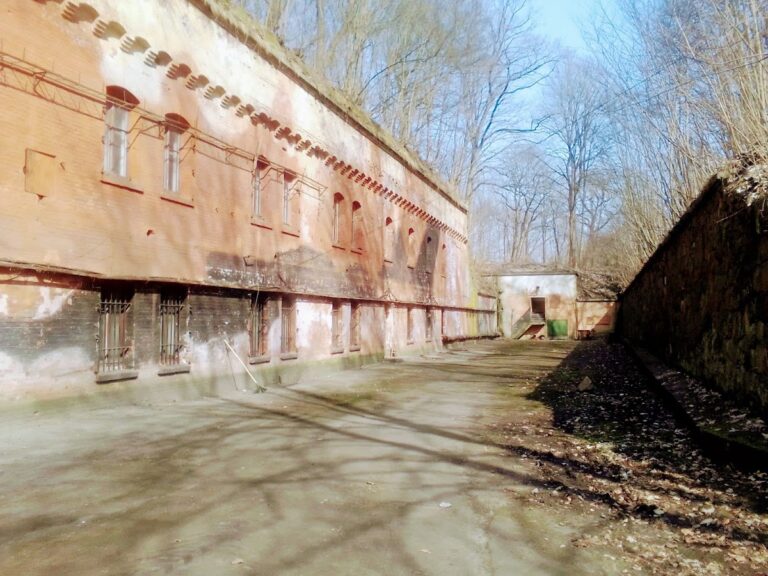
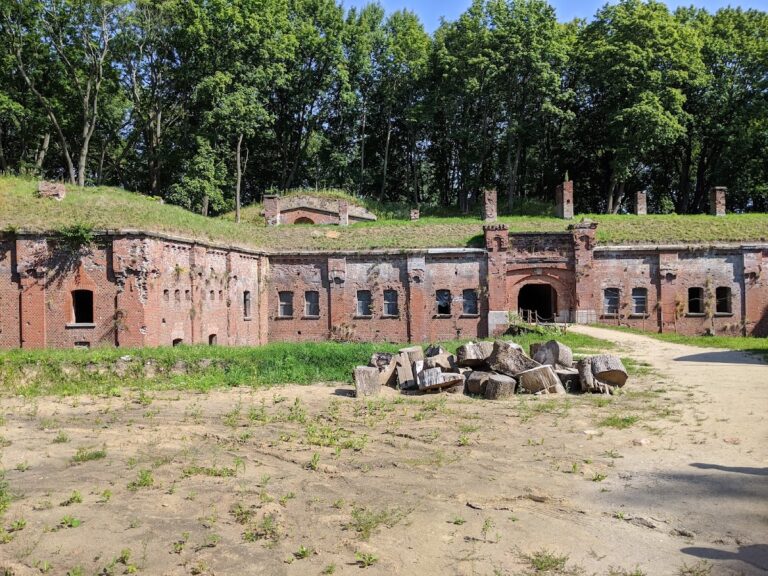
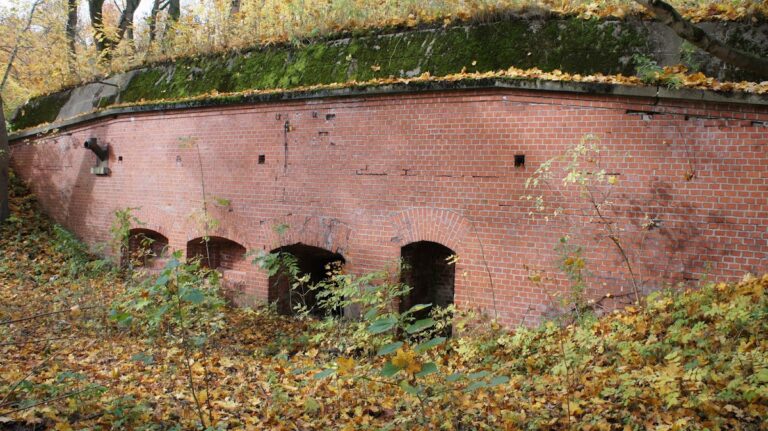
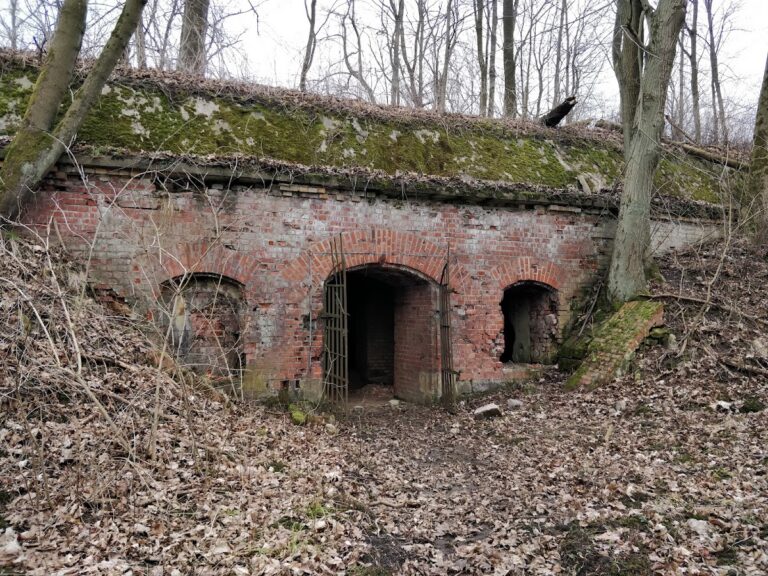
Fort 5 is a hexagonal brick-and-concrete structure elongated along its front. It measures approximately 215 metres in length and 105 metres in width. A water-filled ditch, stone wall, and earthen rampart surround the main structure. The walls reach up to five metres in thickness, while the ditch is approximately 20 to 25 metres wide and five metres deep.
Rampart defenses
The earthen rampart contains trenches and firing positions for machine guns, flamethrowers, mortars, and artillery pieces. Trees and shrubs were planted over the fort to provide camouflage. The defensive ring’s forts stood approximately 2.5 to 3 kilometres apart, allowing their fire to overlap across the surrounding area.
Entrance and bridge defenses
A drawbridge connected Fort 5 with the surrounding ground. A concrete pillbox protected the approach to the bridge. The entrance pillbox was destroyed during the fighting, leaving the bridge defenses among the damaged elements of the surviving fort.
Casemates and internal accommodation
Flank casemates
Two half-caponier structures adjoined the flanks. A half-caponier is a covered defensive structure that protects part of a ditch or flank. These chambers could shelter personnel and formed important elements of the fort’s close defenses. The right-flank casemate was captured during the Soviet assault, while the left-flank casemate was destroyed by Soviet sappers.
Barracks and armament
Within the fort were barracks for an infantry company, an artillery detachment, and a group of sappers. Its armament included eight guns, 25 mortars, up to 50 machine guns of various calibres, 60 submachine guns, and more than 200 rifles. The fort’s surviving fabric retains substantial battle damage, including breaches made during the assault and destruction in the left wing caused by postwar ammunition detonations.
Reinforced structures and military exhibits
Concrete covering and observation cupola
The 1886 modernization added a reinforced-concrete covering approximately two metres thick and a rotating armoured observation cupola. These features formed part of the fort’s protected upper works and remain associated with its late nineteenth-century defensive design.
Open-air collection
The ramp displays Soviet guns ranging from anti-tank to anti-aircraft pieces, together with a Katyusha multiple rocket launcher. The open-air exhibition also contains torpedoes, depth charges, and a naval deck gun, placing the fort’s surviving defensive architecture alongside military equipment from the Soviet period.
Nearby sites