Fort 8: A Brialmont Fort in Antwerp, Belgium


Site at a Glance
- Rating
- 4.3
- Popularity
- Low
- Country
- Belgium
- Primary era
- Modern
- External website
- Open
- Eras represented
- Modern
- Civilizations
- Belgian
- Site type
- Military
- Remains
- Fort
On this page6 sections
History
Fort 8 is a nineteenth-century Belgian fort in Antwerp, constructed between 1859 and 1864 as one of eight forts intended to defend the city against invasion. It formed part of the Brialmont fortification belt, a defensive ring around Antwerp designed under the supervision of Henri Alexis Brialmont, a Belgian military engineer and fortification architect.
Construction and defensive role
The fort was built on land that had formerly belonged to noble estates, including Scaldisburg, which was associated with Count Moretus. Its artillery arrangements reflected the defensive planning of the period, but by the outbreak of the First World War the fort had become largely ineffective because its military technology was already obsolete.
Modern ownership and protection
The former municipality of Hoboken purchased Fort 8 in 1977. The grounds later became part of Hoboken’s extensive green areas and accommodated sports and youth organizations, including Sportschuur. The site also contains the visitor center In de Gulden Mammoet.
Fort 8 is among the most authentic and best-preserved Brialmont forts because it was never reinforced with concrete or modernized. It forms part of the Historical Fortified Belts of Antwerp and is included in the Natura 2000 network, the European Union’s system of protected areas for habitats and species of conservation importance. Under the EU Habitats Directive, the fort serves as a protected bat habitat. Management involves the Agency for Nature and Forests, Natuurpunt, and private parties.
Remains
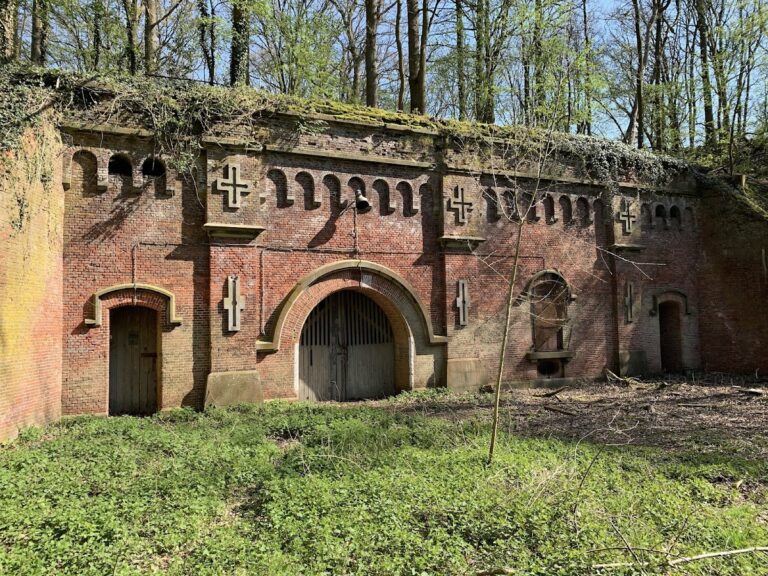
Fort 8 occupies much of the southern side of Hoboken, on the southern or southwestern edge of the district. The complex covers approximately 32 to 36 hectares, while the associated Natura 2000 protected area is listed separately at 3.585 square kilometres. High defensive walls and ramparts define the site, with heights comparable to those of Fort 7.
Fortifications and batteries
The surviving complex consists of an inner fort with defensive walls, an entrance, a gate, and access passages. This inner fort remains distinct from the surrounding grounds. The defenses included an artillery battery and a traditore battery, a battery designed to fire into an attacking force’s flank or rear rather than directly at its front. The lack of later concrete reinforcement or modernization has helped preserve the fort’s original character.
Grounds and associated finds
The former defensive grounds are now incorporated into a large green area. A sports hall and facilities for athletics, badminton, basketball, handball, korfball, volleyball, and futsal occupy the site, while the fort houses sports and youth organizations.
During construction, workers discovered a mammoth skeleton. Known as the “Mammoth of Hoboken,” it remains an archaeological find associated with Fort 8 and gives the site a connection to the area’s prehistoric past.
Nearby sites