Fort Prins Frederik: A Dutch River Defence Fort in the Netherlands


Site at a Glance
- Rating
- 4.6
- Popularity
- Very Low
- Country
- Netherlands
- Primary era
- Modern
- Eras represented
- Modern
- Civilizations
- French
- Site type
- Military
- Remains
- Fort
On this page9 sections
History
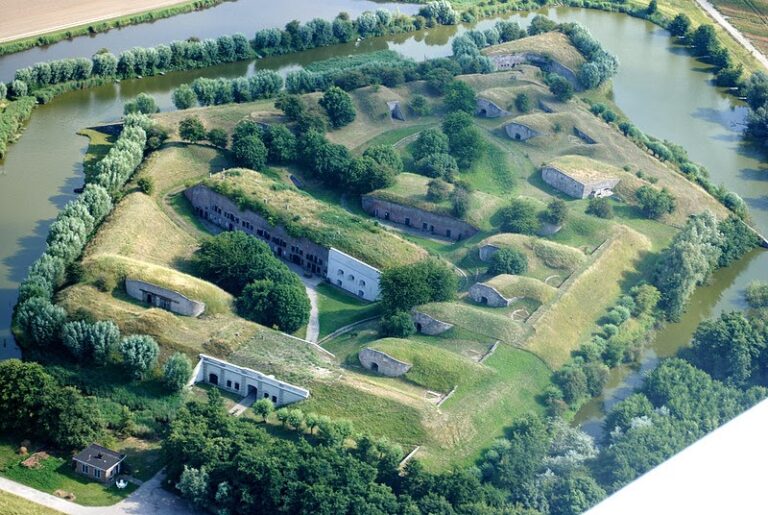
Fort Prins Frederik is a French-built fort near Ooltgensplaat in the Netherlands, constructed in 1809 as part of the defensive line along the Hollandsch Diep and Volkerak. Its brick fortifications belonged to the coastal-defence measures introduced during the Napoleonic Wars, after a British expedition to Walcheren prompted France to strengthen its positions in the Netherlands.
French construction and Dutch capture
French troops had occupied large parts of the Netherlands from 1795. In 1809, France built two forts on opposite sides of the Hellegat, Fort Duquesne near Ooltgensplaat and Fort De Ruijter near Willemstad. Together, they were intended to prevent enemy ships from passing from the Volkerak into the Hollandsch Diep.
On 4 December 1813, Dutch troops overcame the fort’s weak French garrison and seized Fort Duquesne. After the capture, the fort was renamed Fort Prins Frederik. The position was then repeatedly altered and strengthened as military requirements changed.
Expansion under Dutch defence policy
The Dutch Fortress Act of 1874, legislation designed to reinforce the country’s fortifications, led to major improvements along the Hollandsch Diep and Volkerak line. New gun positions, covered military storage structures, protected gun and supply spaces, and a large bombproof barracks were added to the fort.
By the beginning of the twentieth century, the fort’s armament included seven 24-centimetre guns, with five directed towards the river fronts and two towards the south. Two 10-centimetre Brons guns were placed in the gun casemate. In 1909 and 1910, the authorized garrison consisted of three officers, 31 non-commissioned officers, 157 gunners, one medical officer, three medical-service personnel, and one telegraph operator.
Decline and changing uses
After the First World War, Fort Prins Frederik lost its strategic importance. A Royal Decree dated 24 February 1928 abolished it as a fortified work. During the Second World War, German occupying forces used the fort as a prison and observation post. Following liberation, it served as a re-education camp, but it did not return to military use.
In 1969, the fort became a holiday and conference centre. It was designated a national monument in 1973. The protected status also limited accommodation on the island to caravans and tents, excluding static caravans and holiday homes.
Recent rehabilitation
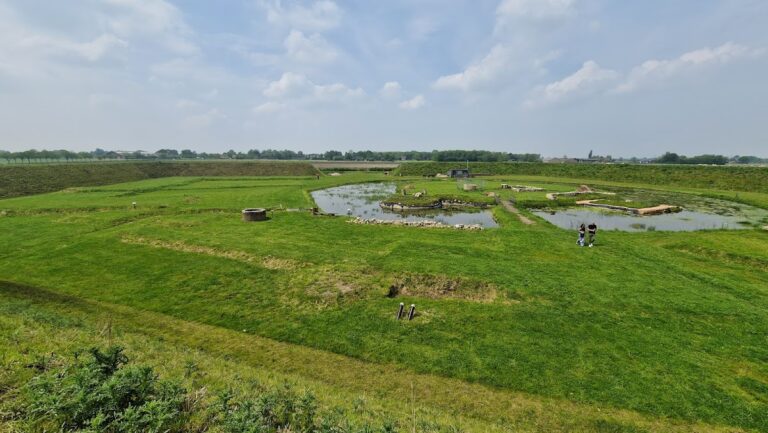
Over time, 157 illegal buildings were erected on the fort island with the tacit permission of the municipality. The operator went bankrupt in October 2014, and poor management subsequently caused serious deterioration of the open grounds. The municipality of Goeree-Overflakkee purchased the fort in 2018. A rehabilitation programme relocated residents from 19 illegal structures, cleared housing from the rampart, removed about 1,200 tonnes of demolition waste and uncontrolled vegetation, repaired the buildings, and restored historic planting. The municipality intended to develop the fort as a tourist attraction with a new operator.
Remains
Central French tower
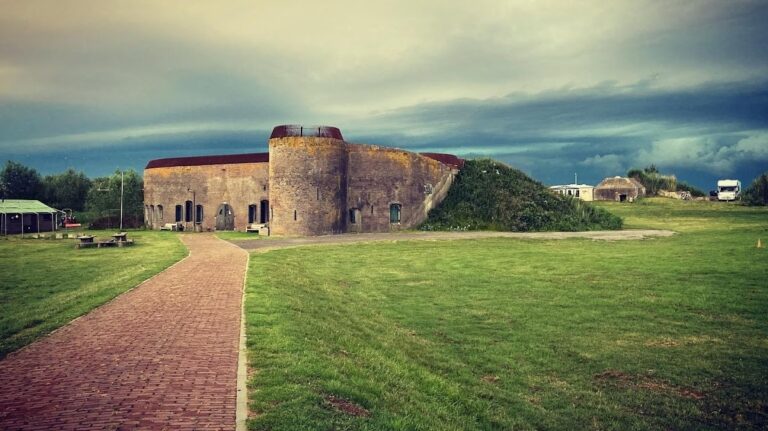
The original fort was an earthen bastioned work built by France in 1809 with brick construction. At the centre of its courtyard stands a French Tour modèle no. 1, a standardized masonry tower designed for observation and artillery. The tower dates from after 1811 and has three storeys, brick walls, rooms covered by masonry vaults, and a flat roof. Multiple gun openings pierce its façades, reflecting its combined observation and artillery role.
Later defensive buildings
The additions made after 1874 form an L-shaped arrangement around the older French tower. They include gun positions, remises, which were covered military storage or shelter buildings, casemates, and a large two-storey bombproof barracks covered with earth. The gun casemate held two 10-centimetre Brons guns, while seven 24-centimetre guns occupied positions facing the river and the south.
Rehabilitated grounds and fabric
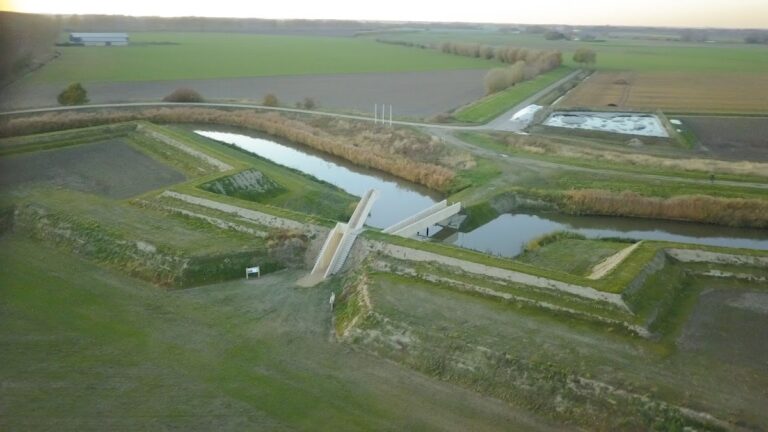
Rehabilitation work addressed both the masonry and the landscape. It included bricklaying and repointing, restoration of plasterwork, construction of a bridge for cyclists and pedestrians, and the reintroduction of historic vegetation. These interventions form part of the effort to recover the fort’s built and planted character after the deterioration of its grounds.