Fort of São Teodósio da Ponta do Cavalo: A Portuguese Coastal Fortification


Site at a Glance
- Rating
- 4.2
- Popularity
- Very Low
- Country
- Portugal
- Primary era
- Early Modern
- External website
- Open
- Eras represented
- Early Modern, Modern
- Civilizations
- Portuguese
- Site type
- Military
- Remains
- Fort
On this page9 sections
History
The Fort of São Teodósio da Ponta do Cavalo is a Portuguese coastal military fortification at Sesimbra, Portugal, built in the seventeenth-century Mannerist style during the Portuguese Restoration War. This conflict began in 1640, when Portugal regained and defended its independence from the Spanish Habsburg monarchy. Construction formed part of the modernization of the kingdom’s coastal defenses under King John IV.
Foundation during the Restoration War
An initial design was conceived in 1640 by Simão Falónio using rammed earth. The fort was begun in 1648 and inaugurated in 1652 under a project attributed to Sebastião Pereira de Frias, a military engineer and architect. It was named for Dom Teodósio, Crown Prince and Prince of Brazil, the title used by the heir apparent to the Portuguese throne.
The fort belonged to the seventeenth-century defensive line between Albarquel and Sesimbra. Its purpose was to support the defense of Setúbal, an important maritime settlement. Together with the Fort of Santiago de Sesimbra, it formed part of the area’s coastal defenses. The forts of Santiago do Outão, Santa Maria da Arrábida, São Domingos da Baralha, and Nossa Senhora do Cabo at Espichel were subordinate to the Fort of Santiago de Sesimbra within this defensive system.
War, damage, and renewed military use
The earthquake of 1755 badly damaged the fort, although it retained its strategic importance. During the Peninsular War, the conflict between France and its opponents on the Iberian Peninsula, the fort was garrisoned and equipped with artillery under General Junot during the first French invasion in 1807 and 1808.
The garrison abandoned the fort in 1822. It returned to military use during the Portuguese Liberal Wars from 1828 to 1834, the civil conflicts between supporters of constitutional liberalism and absolute monarchy. After these wars, the fort fell into disrepair.
Lighthouse and modern conservation
Construction of the present lighthouse began in 1895 in the area known as the Bateria Alta. Its light began operating in 1896 to signal the entrance to Sesimbra harbor. Reconstruction and adaptation works followed in 1976, when the Directorate-General for Buildings and National Monuments acted at the request of the Directorate-General of Lighthouses. Further recovery and improvement took place in 1981 to 1983, in 1986, and in 1991.
The fort was classified as a Property of Public Interest under Decree 95/78, published on September 12, 1978. It is under the Portuguese Ministry of National Defence and is operated by the Portuguese Navy, which also manages the lighthouse. The fort’s installations serve as the lighthouse keeper’s residence.
Remains
Fortification layout
Entrance and central tower
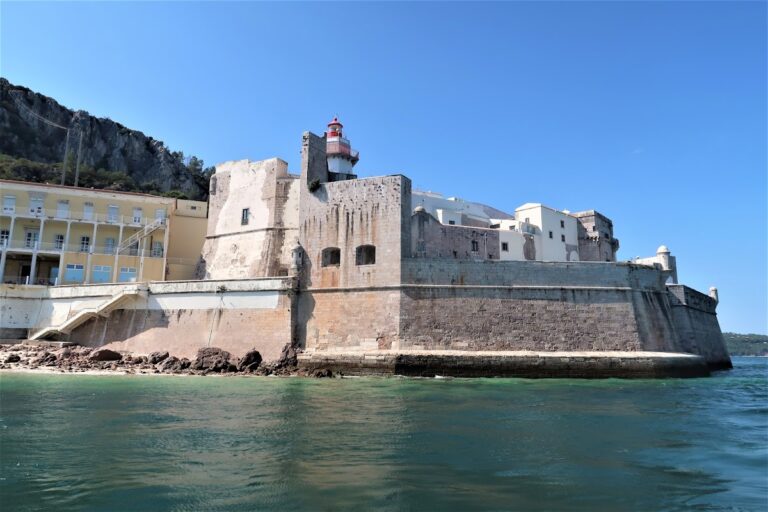
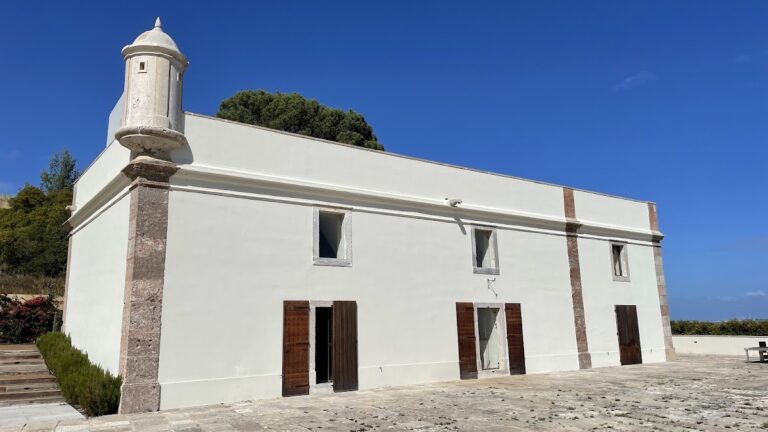
Built of stone and brick masonry, the fort has an irregular polygonal plan and originally extended farther east. The eastern section was destroyed during construction of the harbor and its access road. A simple round doorway gives access to the parade ground, whose center is occupied by a circular tower with a terrace.
Bastions and sentry box
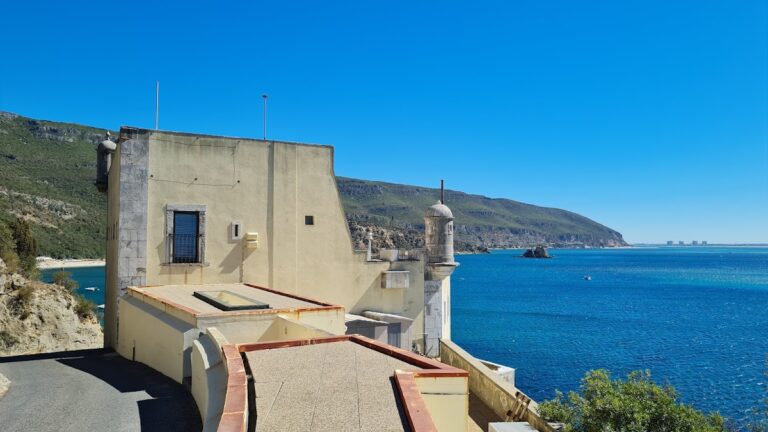
Two bastions, projecting defensive structures designed to allow artillery fire along adjoining walls, occupy the ends of the fortification. They have square plans and sloping walls, and originally contained artillery embrasures. A prismatic sentry box stands at the western salient angle. More recent buildings flank the fort and accommodate the lighthouse keeper’s residence.
Fort of Cavalo Lighthouse
The Fort of Cavalo Lighthouse stands within the fort in the Bateria Alta. The lighthouse was constructed in the area in 1895 and began operating the following year as a signal for vessels entering Sesimbra harbor. Its presence reflects the later adaptation of the military site to a maritime signaling function.
Nearby sites