Fort of São Teodósio da Cadaveira: A Coastal Bastion Fort in Portugal


Site at a Glance
- Rating
- 4
- Popularity
- Very Low
- Country
- Portugal
- Primary era
- Early Modern
- External website
- Open
- Eras represented
- Early Modern
- Civilizations
- Portuguese
- Site type
- Military
- Remains
- Fort
On this page7 sections
History
Fort of São Teodósio da Cadaveira is a coastal bastion fort in Portugal, located in Estoril and built by Portuguese forces in 1642–1643 during the Portuguese Restoration War. This conflict restored Portugal’s independence from the Spanish Habsburg monarchy after 1640. The fort formed part of a defensive line of more than a dozen fortresses extending from the Tower of Belém on the Tagus to Cabo da Roca on the Atlantic coast, protecting Lisbon and the approaches to the river.
Construction during the Restoration War
Construction began in April 1642 and was completed in 1643. The fort was named for Teodósio, 9th Duke of Bragança, the first-born son of John IV, king of Portugal. Its construction was supervised by António Luís de Meneses, 1st Marquis of Marialva, a Portuguese military commander. The fort’s position allowed it to exchange crossfire with the nearby Fort of Saint Anthony of Barra, helping defend the cove of Poça Beach.
Later military use
Subsequent works added an external curtain wall, a defensive wall joining the fort’s stronger points, together with a parapet, or low protective wall, that formed a forward line of defence. Three brick houses were built against the eastern facade at the beginning of the eighteenth century. Later in that century, the fort was described as ruined, but it returned to a military role in 1805, when troops sheltered there while attempting to prevent vessels from landing during a threat of cholera.
The fort regained military importance during the Portuguese Civil War of 1828–1834, a conflict between supporters of absolutism and constitutional government. Restoration began on 3 June 1831 and was completed within one month. The fort was no longer required for military purposes in 1843, when it was transferred to the Holy House of Mercy of Cascais, a Portuguese charitable and religious institution associated with caring for poor, sick, and vulnerable people.
Transfer, rehabilitation, and decline
In 1942, after construction of the Marginal coastal road along the Lisbon District shoreline and the demolition of some of the fort’s parapets, the property was transferred to the Portuguese Customs Authority. Rehabilitation followed in 1950 and 1958. During the 1960s, the fort functioned as a tea house. It was later transferred to the Municipality of Cascais, which intended to restore it, but by 2018 the fort had been abandoned and was in considerable disrepair.
Remains
Fort plan and construction
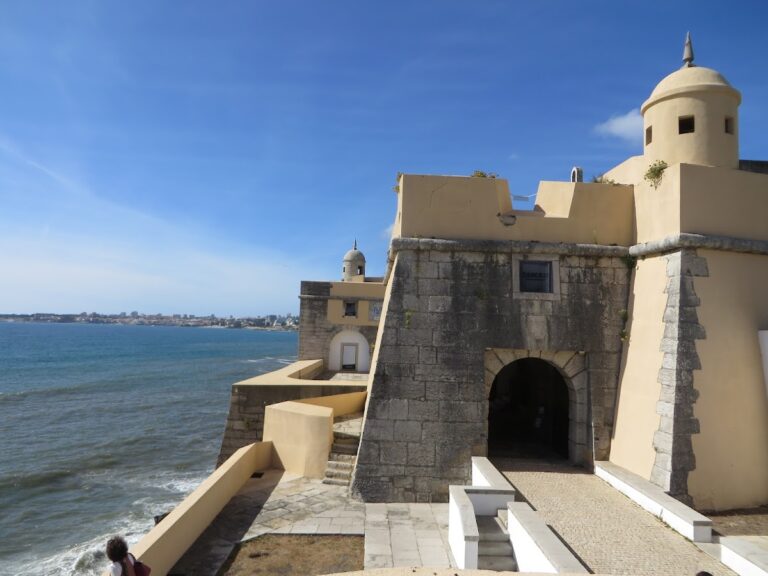
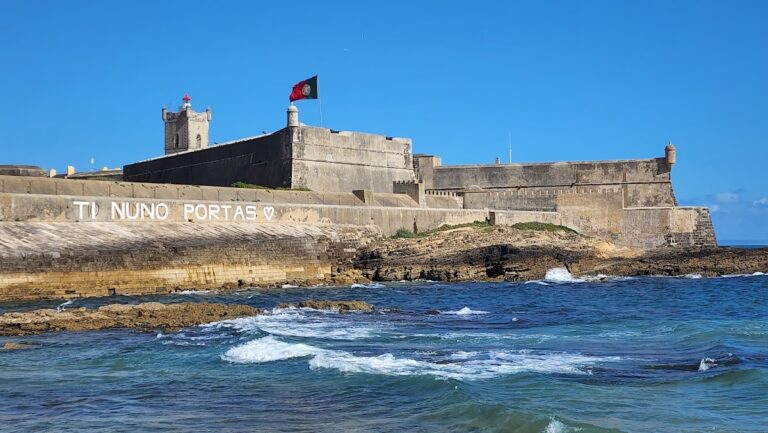
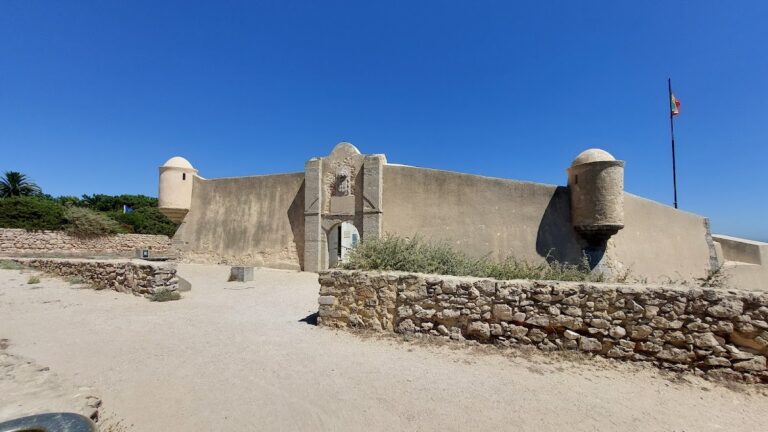
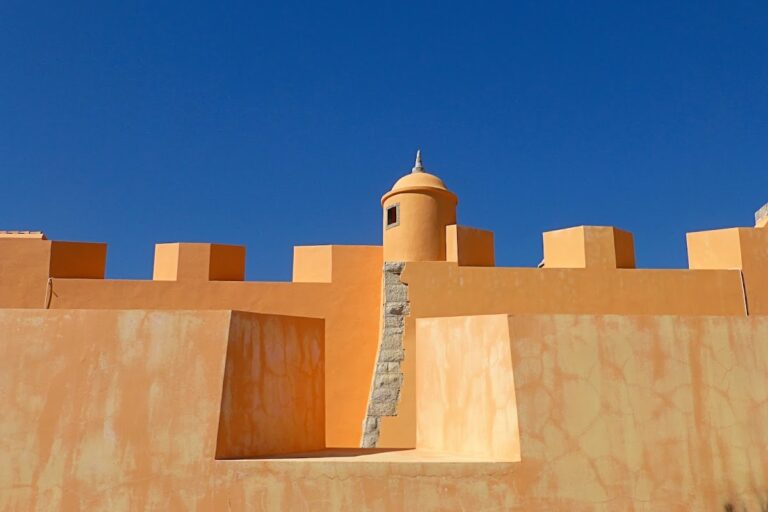
The surviving fort is a square coastal bastion fort built of basalt. Its basic arrangement follows the standard layout of coastal fortifications of its period and was not fundamentally changed by later improvements. The interior is divided into two rectangular areas. One served as the artillery battery, while the other provided accommodation, linking the fort’s defensive and residential functions within a compact plan.
Outer defenses and eastern additions
An external curtain wall surrounded the original fort, and a parapet ran around it as a forward defensive line. Three brick houses were added along the eastern facade at the beginning of the eighteenth century, forming a later extension to the basalt fortification. Some parapets were demolished in 1942 during construction of the Marginal coastal road, altering the fort’s defensive profile.
Nearby sites