Fort of São Jorge at Oitavos: A Portuguese Coastal Defence Fort


Site at a Glance
- Rating
- 4.3
- Popularity
- Low
- Country
- Portugal
- Primary era
- Early Modern
- External website
- Open
- Eras represented
- Early Modern
- Civilizations
- Portuguese
- Site type
- Military
- Remains
- Fort
On this page6 sections
History
The Fort of São Jorge at Oitavos is a small maritime fortification in Cascais, Portugal, built by the Portuguese during the Portuguese Restoration War in the seventeenth century. This conflict enabled Portugal to recover its independence from the Spanish Habsburg monarchy. Constructed approximately between 1641 and 1643, the fort formed part of a coastal defensive line stretching from the Tower of Belém near Lisbon to Cabo da Roca. Its purpose was to prevent landings between Guincho Beach and Guia Beach, complementing the defence of the Tagus estuary.
Construction and wartime defence
João IV, the first king of Portugal’s Braganza dynasty, promoted the fort’s construction. The work was directed by António Luís de Meneses, 1st Marquis of Marialva, a Portuguese military commander and nobleman associated with the kingdom’s wartime defence. The fort’s position allowed it to exchange fire with the Fort of Nossa Senhora da Guia and the Fort of São Brás de Sanxete at Cabo Raso.
The installation was designed for a small garrison, normally comprising a corporal, three artillerymen, and eighteen soldiers. Four guns remained in its armament until the nineteenth century. An inscription on the Gate of Arms gives 4 May 1642 as the beginning of construction and 1648 as its completion, while the construction itself is more accurately dated to approximately 1641–1643.
Heritage protection and museum use
Portugal classified the fort as a property of public interest under its heritage legislation in 1974. After restoration returned it to its original layout, it was reinaugurated in December 2000 as a historical-military museum and cultural space. The museum opened on 1 March 2001, presenting the everyday life of a maritime-fortification garrison in the late eighteenth century. Its first two exhibition rooms are permanent, while the third hosts temporary exhibitions about the fort and its relationship with Cascais.
The fort and museum closed in September 2005 to address structural problems. They reopened on 28 February 2009.
Remains
Layout and defensive works
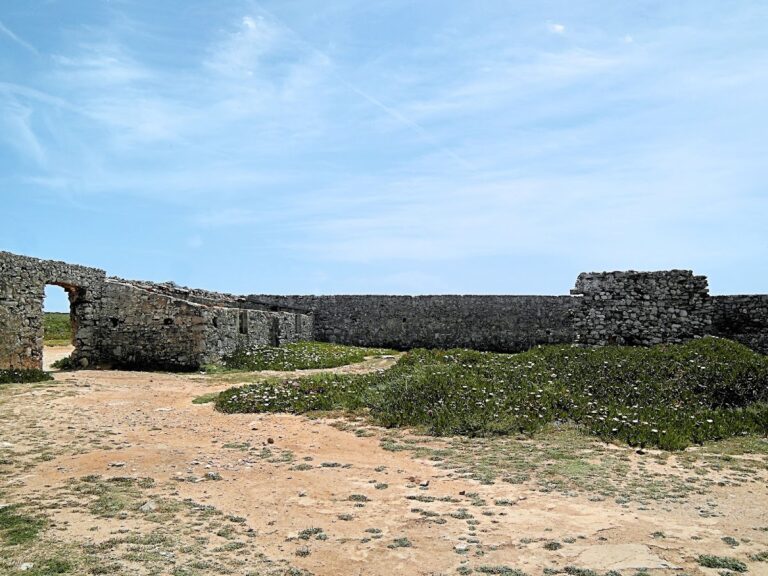
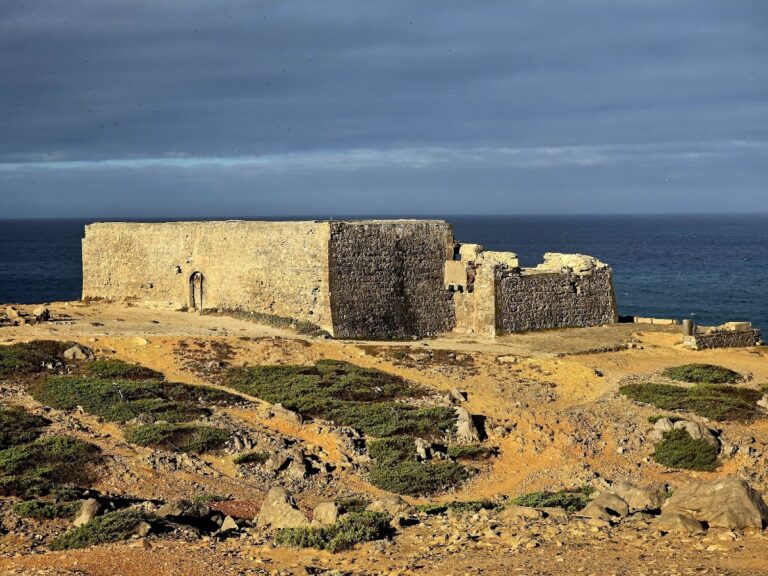
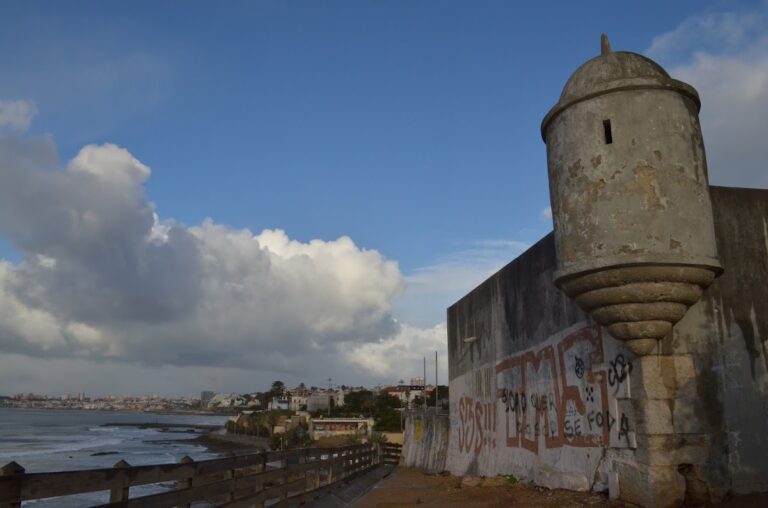
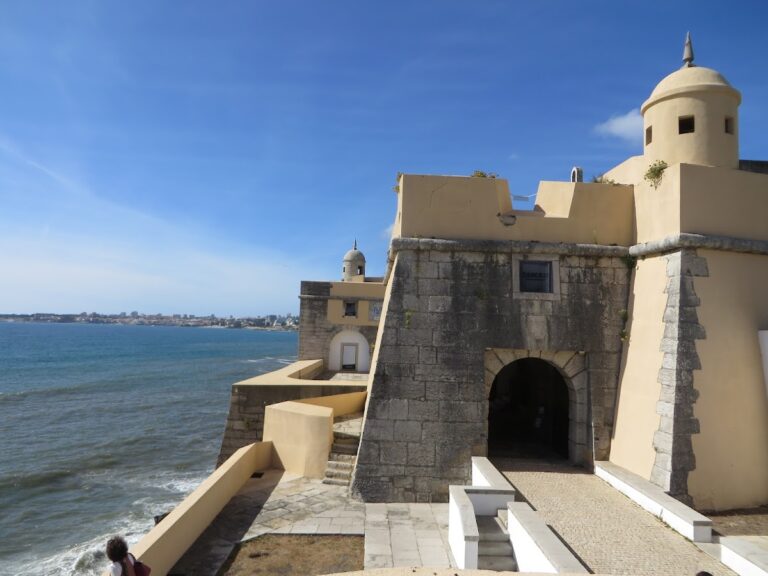
The fort stands on ground adapted to the relief of a sea cliff on Portugal’s Atlantic coast, near the Oitavos dunes and the Duna Grande de Oitavos, beside the coastal road EN 247. Its organically rectangular plan follows a bastioned defensive design, using projecting angular works that enabled defenders to cover the walls and the ground outside them with intersecting fire. The masonry is reinforced by covered sentry boxes at the salient angles and by a covered line for musketeers. A battery occupies the esplanade, the open area adjoining the fortification used for artillery and to keep approaches clear. The principal entrance is the Gate of Arms, which carries the inscription associated with the fort’s construction.
Internal arrangements
A 1796 drawing identifies four internal dependencies within the fort. These comprised the troop barracks; a combined area containing the kitchen, refectory, and dormitories; the powder magazine, a secure store for gunpowder and other ammunition; and the command house. The fort also contains a cistern, a structure for collecting or storing water.
Nearby sites