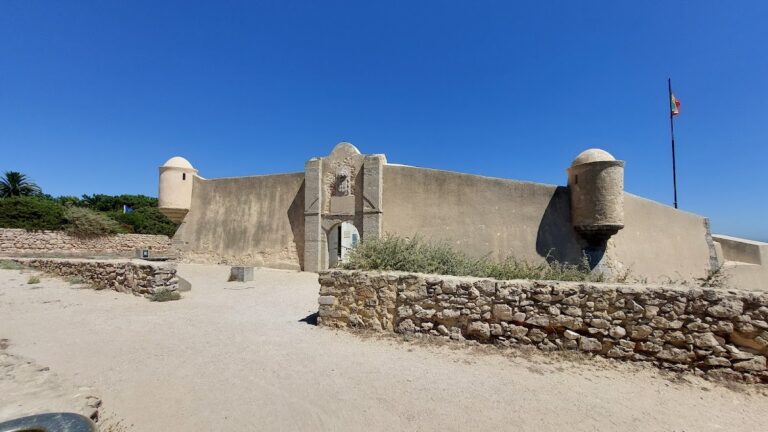
Fort of Santo António da Barra: A Coastal Bastion Fort in Portugal


Site at a Glance
- Rating
- 4.4
- Popularity
- Low
- Country
- Portugal
- Primary era
- Early Modern
- Eras represented
- Early Modern
- Civilizations
- Portuguese
- Site type
- Military
- Remains
- Fort
On this page8 sections
History
The Fort of Santo António da Barra is a coastal bastion fort in Estoril, Portugal, built in 1590 during the Philippine Dynasty, when Portugal and Spain were ruled by the same monarchs. It was created to strengthen the approaches to Lisbon and the Tagus after troops led by the Duke of Alba secured Philip II of Spain’s claim to the Portuguese crown in 1580. The fort formed part of a wider defensive effort against English and Dutch ships.
Construction under the Philippine Dynasty
Philip I of Portugal, who was also Philip II of Spain, commissioned Giovanni Casale, a military engineer and architect from Naples, to prepare the plans. Construction took slightly more than a year. In a letter dated 16 February 1591, Casale informed the king that the fort was ready to receive soldiers and artillery, although the building is listed as having been completed in 1590.
Expansion and restoration
After Portugal restored its independence, the Crown undertook a major reform of its land and maritime defenses under António Luís de Meneses, 1st Marquis of Marialva, a Portuguese nobleman and military commander associated with the Restoration. The fort was modernized and expanded to increase its firepower and withstand improved naval artillery. It became part of the defensive chain extending from Belém in Lisbon to Cabo da Roca on the Atlantic coast.
The Lisbon earthquake of 1755 heavily damaged the fort. Restoration followed in 1762 and 1763. At the end of the nineteenth century, the building was converted into a customs post, giving it a new administrative role after its principal military importance had declined.
Institutional and political uses
From 1915, the fort served as a holiday camp for the Odivelas Institute, a Portuguese military educational institution for girls. In 1950, it became the seasonal residence of Prime Minister António de Oliveira Salazar, who led Portugal’s authoritarian Estado Novo regime from 1932 until 1968.
On 3 August 1968, Salazar suffered a stroke and fell at the fort. As his condition deteriorated, the President appointed a new prime minister without informing him. Salazar died two years later. The fort therefore became associated with the final episode of the leader’s political career and with the later history of the Estado Novo, which ended in the 1974 Carnation Revolution.
Abandonment and renewed protection
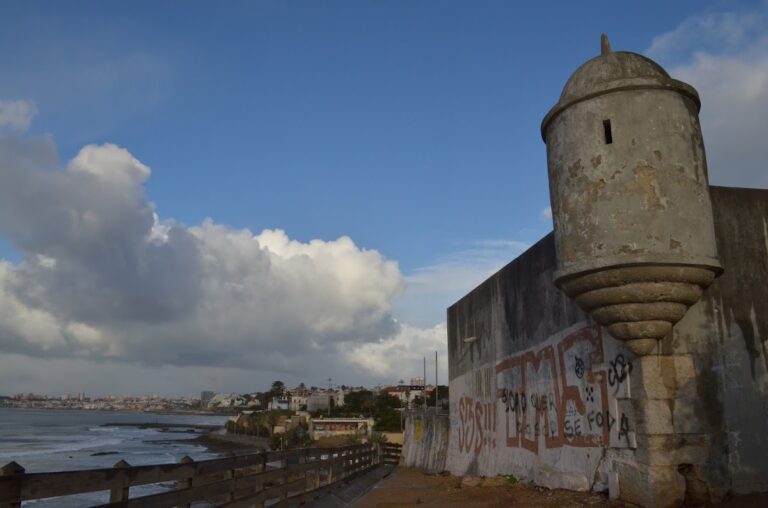
After the Instituto de Odivelas closed in 2015, the fort was abandoned. It suffered vandalism, extensive graffiti, and internal damage, and a fire was reported in one of its areas in 2016. In March 2018, the site was transferred to the Municipality of Cascais under an agreement intended to develop it as a research centre. The municipality restored the fort that year, and it opened for public viewing for the first time on 25 April 2018, Portugal’s Freedom Day, which commemorates the overthrow of the Estado Novo in 1974.
Remains
Defensive layout
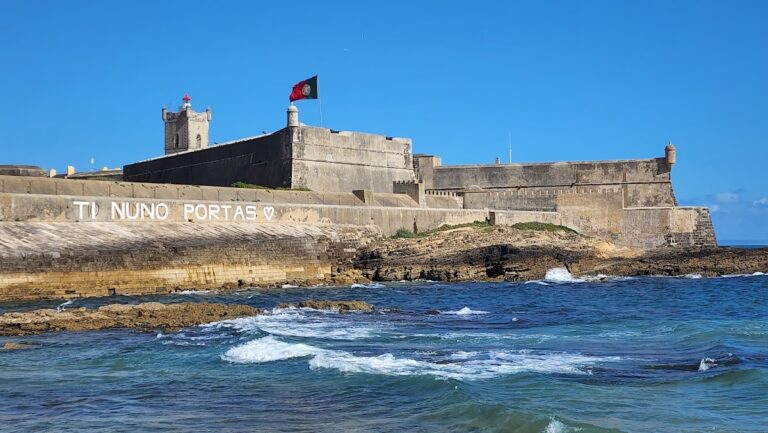
The fort overlooks the sea at Estoril in the municipality of Cascais, in Portugal’s Lisbon District. It is a bastion fort, a type of artillery defense that uses projecting angular platforms to create overlapping fields of fire. Built of basalt, its plan forms an irregular, star-shaped polygon with two outer bulwarks. A moat, or defensive ditch, lies between the two outer walls.
Central building
At the centre of the fort stands a square building containing a chapel dedicated to Saint Anthony and vaulted barracks. These spaces formed the principal internal accommodation within the defensive enclosure. The fort was restored in 2018 after its period of disuse and vandalism.
Nearby sites