Fort of São Julião da Barra: Portugal’s Bastioned Defense of the Tagus


Site at a Glance
- Rating
- 4.5
- Popularity
- Low
- Country
- Portugal
- Primary era
- Early Modern
- Eras represented
- Early Modern, Modern
- Civilizations
- British, Portuguese, Spanish
- Site type
- Military
- Remains
- Fort
On this page12 sections
History
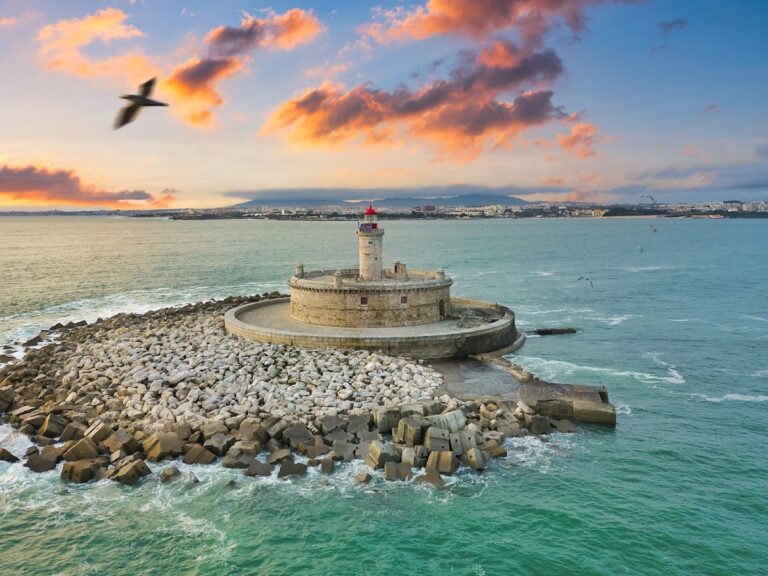
Fort of São Julião da Barra is a sixteenth-century Portuguese coastal fortress at Oeiras, Portugal, built during the reign of King John III as part of the coordinated defense of Lisbon. Construction began in 1553 on the right bank of the Tagus estuary, where the fort and the nearby Fort of São Lourenço do Bugio controlled the estuary entrance and shipping access to the capital’s port.
Foundation and construction
A hermitage dedicated to São Gião may previously have occupied the site. King Manuel I recommended a fortification there to his son and successor, John III, who promoted more modern coastal defenses for Lisbon. In 1549, John III established the office of Master of the Works of Fortification of the Kingdom and entrusted it to the architect and military engineer Miguel de Arruda. The resulting defensive system also included the Citadel of Cascais, the Tower of Belém, and the Fort of São Sebastião de Caparica.
The principal structure was considered complete in 1568, although further work continued in 1573. Prisoners held in the fort’s dungeons while awaiting deportation were used as forced labor during the construction of its defenses.
Spanish conquest and enlargement
In 1579, João Baptista Gésio, a Spanish spy serving Philip II of Spain, prepared a description and drawing of the fort. Spanish troops commanded by the Duke of Alba attacked from the landward side, and the garrison surrendered on 13 August 1580 after a six-day siege. Negotiations involved Tristão Vaz da Veiga, Sancho Dávila y Daza, and the fort’s command.
Philip II became king of Portugal in 1580, beginning the Iberian, or Spanish Habsburg, rule of the country. During the occupation, the Duke of Alba commissioned Giacomo Palearo to strengthen São Julião. Palearo altered the moat, added artillery batteries, and extended the western defenses. From 1582, work included the lower eastern esplanade and the bastions of São Filipe and São Pedro. From 1597, the military engineer and architect Leonardo Torriani directed further enlargement and reinforcement. These changes made São Julião da Barra the largest and most powerful fortification in Portugal at that time.
The fort also became a political prison during the Spanish period, a function that continued through later centuries until the First Portuguese Republic. During the Restoration of Portuguese Independence, which ended the dynastic union with Spain in 1640 and placed the Duke of Braganza on the Portuguese throne as John IV, São Julião faced a second land siege. On 12 December 1640, Fernando Mascarenhas, first Count of Torre and a political detainee, helped persuade the Spanish governor Fernando de La Cueva to negotiate the surrender.
Seventeenth- and eighteenth-century works
In 1645, the governor Martim Correia da Silva reported that the fort urgently needed repairs. Expansion and strengthening began in 1650, including a new landward ravelin, an advanced detached defensive work positioned beyond the main wall. Barracks and lodgings for the garrison followed in 1655.
Further enlargement and repairs took place in 1751 under the Pombaline government. The Lisbon earthquake of 1755 damaged the fort, with the lighthouse tower in the center of the parade square suffering the most serious collapse. Reconstruction raised the tower by approximately six metres, and the lighthouse resumed operation in 1761. From 1759 onward, more than one hundred Jesuits were imprisoned at São Julião.
War, occupation, and political imprisonment
During the Peninsular War, a conflict in which British and Portuguese forces opposed Napoleonic France in the Iberian Peninsula, French troops under General Jean-Andoche Junot reached Lisbon on 30 November 1807. São Julião became barracks and a headquarters for occupation forces commanded by General Jean-Pierre Travot. The British navy blocked the entrance to the Tagus, and the fort passed into British hands after the Convention of Sintra on 2 September 1808.
From 1809, the fort again had a Portuguese military governor and formed the most important position in the Oeiras line, the third of the defensive lines associated with the Lines of Torres Vedras. Those lines were a system of defensive works north of Lisbon intended to stop a French advance and protect the capital. Coastal redoubts were built under British direction to supplement São Julião’s landward defenses and protect the possible evacuation of British troops. The fort was also designated as an evacuation point for forces under Arthur Wellesley, first Duke of Wellington, if another French invasion could not be repelled.
São Julião continued to serve as a political prison. General Gomes Freire de Andrade was detained there during accusations of conspiracy against the British presence. After his execution on 18 October 1817, his body was burned and his ashes were thrown into the Tagus. During the Portuguese Civil War, the fort was shelled in 1831 by the French fleet commanded by Admiral Albin Roussin.
Loss of military function and later use
Modern weapons eventually ended the fort’s defensive role. It was formally removed from the military-fortification classification on 22 August 1951 and adapted for government receptions and accommodation for distinguished visitors. General Dwight D. Eisenhower stayed there in 1951, followed by Field Marshal Bernard Montgomery in 1952.
The former barracks were later adapted as salons, a dining room, and a library. Consolidation and restoration campaigns took place in 1952–1954, 1962–1969, 1975, and 1994–2000, with additional work carried out in cooperation with IST/LNEC from 1998 to 2001. The fort is state property under the Ministry of National Defence, serves as the official residence of Portugal’s Minister of National Defence, is classified as a Property of Public Interest, and forms part of the Campo Entrincheirado, Lisbon’s fortified defensive complex.
Remains
Fortress layout and outer defenses
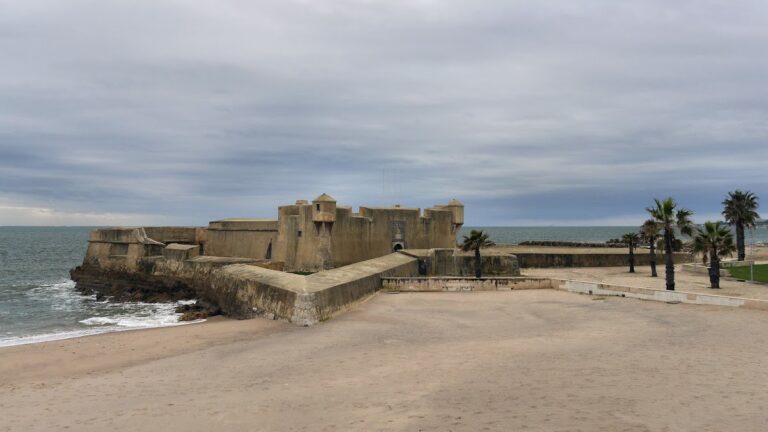
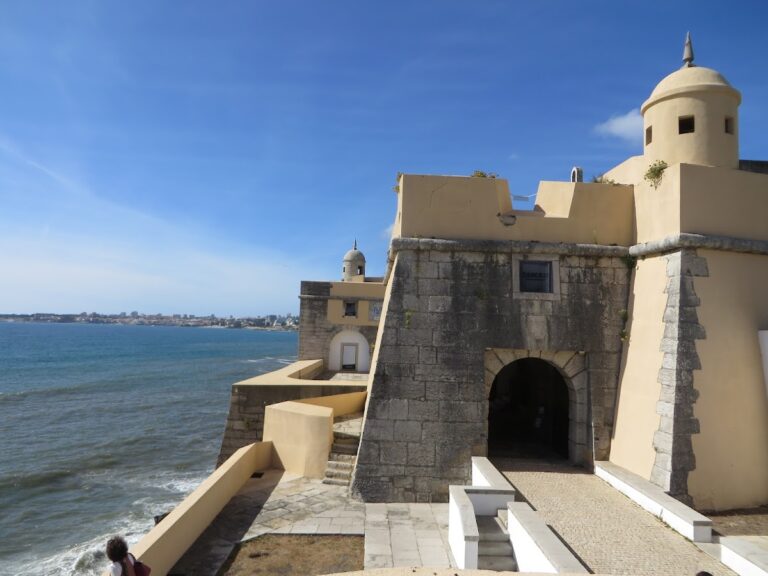
São Julião da Barra occupies the Point of São Gião at the western end of Oeiras, on the right bank of the Tagus estuary. Its approximately pentagonal plan is irregular, and its construction combines basalt with stone masonry covered in render. The surviving defensive system includes walls, artillery esplanades, covered watchtowers, walkways, ramps, bastions, and a ravelin. Two moats protect the landward side. A drawbridge once crossed them, while the present crossing is built of steel and masonry.
Eastern and western bastions
The eastern side contains the Bastion of the Prince, also known as the Bastion of King Dom Fernando. On the seaward western side are several bastions, including the Bastion of Santo António. Their angular projections formed part of the bastioned system associated with Sébastien Le Prestre de Vauban, the French engineer whose method used angular bastions, artillery platforms, moats, and layered defenses to withstand and return cannon fire.
Interior buildings and lighthouse
Inside the walls, the military and service buildings included the Governor’s House, troop barracks, powder magazines, warehouses, a chapel, vaulted casemates, and a vaulted cistern built with wedge-shaped stones known as voussoirs. The cistern now serves as an auditorium. The lighthouse tower rises three storeys at the center of the parade square and is flanked by the garrison barracks. Watchtowers occupy its corners.
Memorials and interior decoration
Above the tower entrance are a commemorative plaque and a tiled stone panel bearing the likeness of Gomes Freire de Andrade. The fort also contains tapestries depicting the Infante Dom Henrique and Vasco da Gama’s arrival in Calicut, signed by Jaime Martins Barata.
Underwater archaeological material
Underwater archaeological surveys in the waters bordering the fort in 1989 recovered two iron cuirasses dating from the seventeenth century. They may have been contemporary with the Portuguese Restoration War, the conflict associated with Portugal’s break from Spanish Habsburg rule in 1640.
Nearby sites