Fort of Cresmina: A Coastal Military Fortification in Portugal


Site at a Glance
- Rating
- 4.6
- Popularity
- Low
- Country
- Portugal
- Primary era
- Early Modern
- Eras represented
- Early Modern, Modern
- Civilizations
- Portuguese
- Site type
- Military
- Remains
- Fort
On this page6 sections
History
Fort of Cresmina is a small coastal military fortification in Portugal, near Cascais, built in 1762 in the Baroque military tradition during the Fantastic War. It formed the southernmost of three batteries established along the approximately 2-kilometre coastline between Cresmina and Guincho beaches.
Construction during the Fantastic War
The Fantastic War was Portugal’s conflict with Spain from 1762 to 1763, fought within the wider Seven Years’ War, a major European struggle involving several powers. The three coastal batteries were built under the guidance of the Count of Schaumburg-Lippe, a German military commander serving Portugal. Each was intended to hold a small garrison and delay a landing by Franco-Spanish forces.
The defences were designed to slow an attack long enough for alarms to be raised and the fortifications of Lisbon, about 30 kilometres away, to receive reinforcements. The Cresmina battery also worked with the Fort of São Brás de Sanxete, whose fire overlapped with its own to protect the beaches.
Rebuilding, abandonment, and renewed military use
The fort was rebuilt in 1793. It was not used during the Peninsular War, the 1807–1814 campaign in Portugal and Spain against Napoleonic French forces and their allies. It was gradually abandoned and deactivated in the early 1820s.
During the Portuguese Civil War of 1828–1834, Miguel I, the Portuguese monarch whose supporters fought in the conflict, ordered the fort to be restored and enlarged. The work took place between 1830 and 1832. On 24 July 1833, after Miguel I’s army withdrew, the fort was disarmed and abandoned. It subsequently fell into ruins.
Private ownership and conservation
Funds were assigned for repairs in 1850, but the work did not take place. By 1854, the fort was in an advanced state of ruin. It passed into private ownership in 1889 and was offered at auction in 1895. Ownership changed several times before António Augusto Carvalho Monteiro, a Portuguese businessman and collector, purchased it in 1908. His descendants inherited the property after his death.
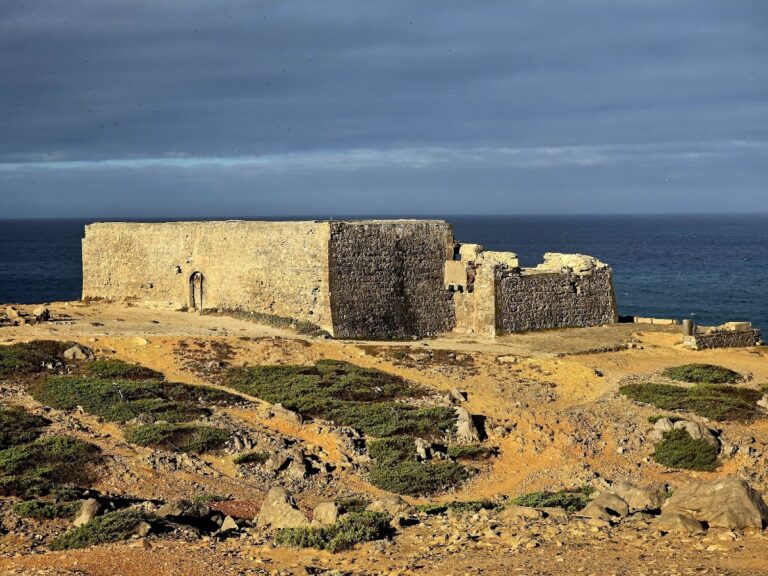
The structure remained standing, although in a visibly ruined condition, until conversion work began in 2020. By 2021, it was being converted into a restaurant. The Fort of Cresmina is privately owned and has been classified as a Property of Public Interest under Decree-Law No. 95/78 of 29 September 1978. This Portuguese designation protects cultural-heritage properties.
Remains
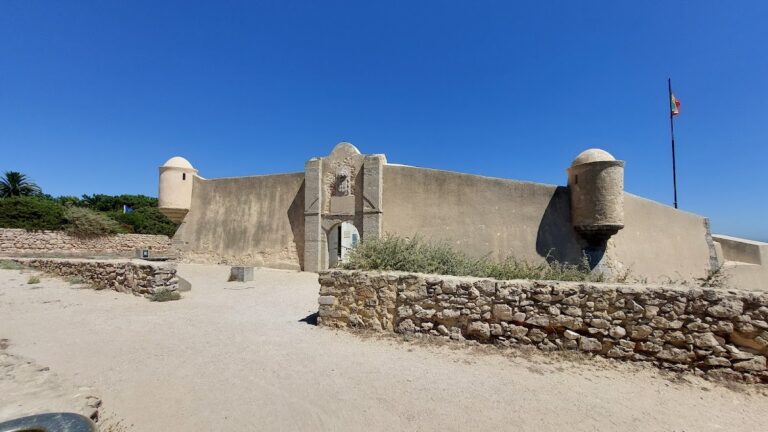
The fort occupies the coast at the southern end of Cresmina Beach, between the Marginal Road and the sea, near National Road 247. It is also described as lying north of Água Doce Beach. Built as a compact masonry defence, it has an irregular hexagonal plan and a single storey. Only parts of its walls remain standing, reflecting the deterioration that followed its military abandonment and later conversion.
Surviving entrance and walls
The front elevation retains a slightly arched doorway with a plaque above it. Together with the surviving wall sections, this entrance preserves the principal visible elements of the small battery’s original defensive form. The remaining masonry conveys its compact coastal layout, while later work has adapted the structure for a different use.
Nearby sites