Fort of Joux: A Medieval Castle and Frontier Fortress in France


Site at a Glance
- Rating
- 4.6
- Popularity
- Medium
- Country
- France
- Primary era
- Early Modern
- External website
- Open
- Eras represented
- Medieval, Early Modern, Modern
- Civilizations
- French, Holy Roman Empire
- Site type
- Military
- Remains
- Fort
On this page20 sections
History
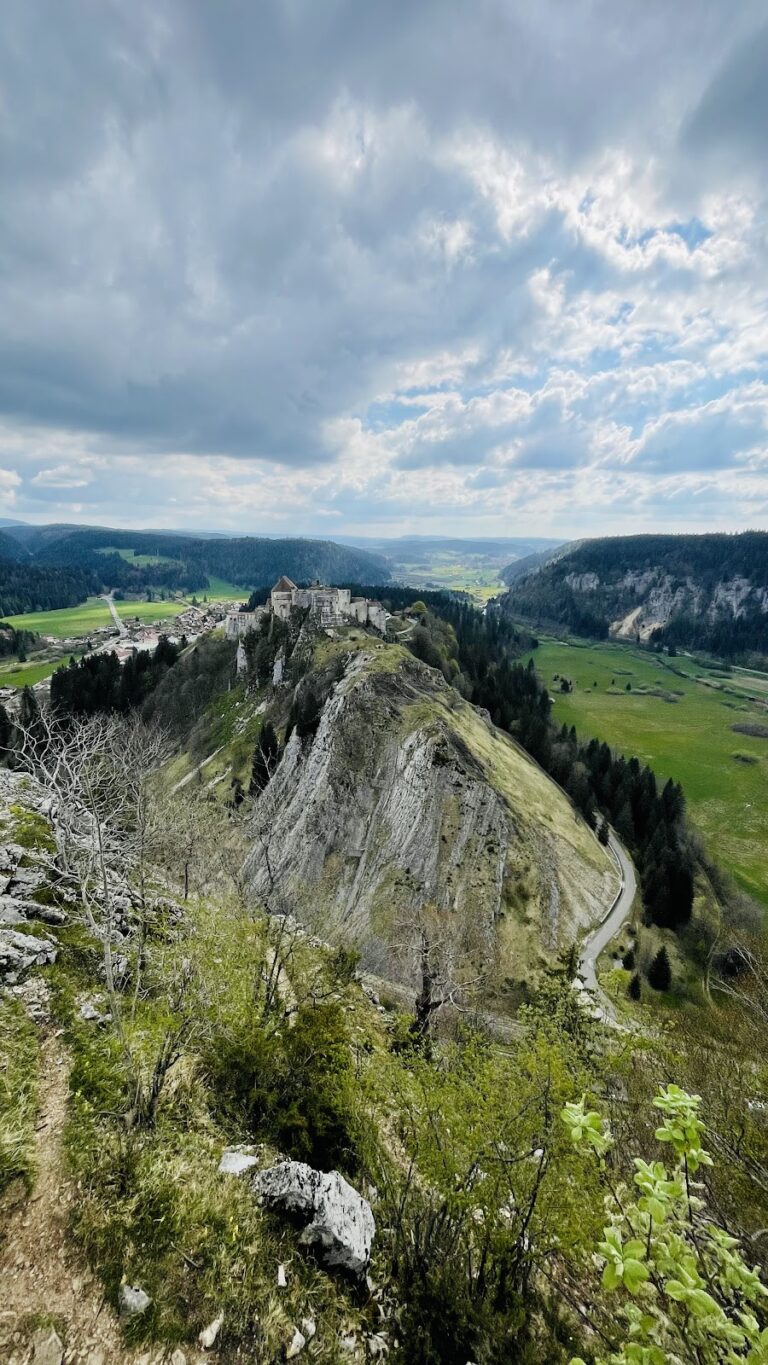
Fort of Joux is a medieval castle and later frontier fortress in France, at La Cluse-et-Mijoux, overlooking the Cluse de Pontarlier, a mountain passage toward Switzerland. Its stone keep and first enclosure were built in 1039, and the site controlled a route used for salt transport, trade, and pilgrimage during the medieval period. The pass also formed part of the Via Francigena, a major route linking northern Europe with Rome.
Early fortification and the lords of Joux
A wooden lookout and toll station stood on the Rochette plateau in antiquity. Julius Caesar described a high mountain defended by fifty men, a position that may have been Joux, while the Helvetii passed through the area in 58 BC as they fled before Caesar. The early defensive works were probably wooden. In 1039, a stone keep and first enclosure were constructed, traditionally under the authority of the lords of Joux.
The castle was first recorded in 1039 as Miroaltum. In 1227, Henri de Joux referred to it as the castle of Joux, also calling it Miroaz. The family, probably descended from Burgundian princes, expanded its lordship between the tenth and thirteenth centuries across the areas around Mouthe, Pontarlier, Montbenoît, Cicon, Lièvremont, Naisey, and the Val d’Usie.
The lords of Joux gained substantial income from tolls on routes between Burgundy, Switzerland, and Lombardy. Their resources also included salt production at Salins-les-Bains, iron and silver mines, lime kilns, glassworks, timber, and smoked meat. People dependent on Montbenoît Abbey, Pontarlier, or Joux fiefs were exempt from the tolls.
The castle’s expansion brought conflict with imperial authorities. In 1039, Aldric of Joux and the people in the castle were mutilated by Boniface III of Tuscany and his Lombard troops after the fortification had been strengthened without imperial permission. The lords of Joux subsequently tended to support the imperial, or Ghibelline, side in conflicts with the Lombard Guelphs, who generally supported the papacy.
Imperial allegiance and medieval conflicts
Amaury III of Joux swore allegiance to Frederick Barbarossa in 1168 and remained his supporter until 1183. Frederick rewarded him with the Val d’Usie and much of the Arlier plain. Amaury also fortified positions above the Doubs at Pontarlier, including the place later known as Molar.
In 1246, Amaury IV’s dispute with Jean I de Chalon involved forest rights, wine taxes, and the privileges of Pontarlier’s free townsmen. Amaury responded by imposing exceptionally high tolls on travellers going to Salins for salt. The dispute contributed to a major conflict that devastated the lands of Joux. In 1282, Henri II of Joux joined the Ghibellines during the Sicilian Vespers, an uprising that challenged Angevin and papal power in Sicily. Jean de Joux later died fighting Philip the Fair at Mons-en-Pévèle.
The fief eventually passed by marriage to the houses of Blonay and Vienne. Jeanne de Blonay sold the castle and lordship to Guillaume de Vienne in 1410. Financial difficulties and inheritance disputes followed, and Guillaume’s family sold Joux to Philip the Good, Duke and Count of Burgundy, in 1454.
Burgundian frontier post
Philip the Good made Joux a guarded frontier position. Repairs were financed through the fairs of Saint Luke and Saint George at Pontarlier. The heirs of Hochberg repeatedly tried to recover the castle, leading to armed confrontations and lengthy litigation with the Burgundian dukes.
Joux resisted Bernese forces in 1475 and helped cover Charles the Bold’s retreat after the battles of Grandson and Morat in 1476. Mary of Burgundy later appointed Katherin Bouchet castellan for life. Rival appointments by supporters of Louis XI and by Burgundian authorities created a period in which competing captains claimed control of the fortress.
In 1492, the Parliament of Dole assigned Joux to Margaret of Austria. The Hochbergs and the counts of Neuchâtel continued to press their claims to the castle and fief. Francis I arbitrated one dispute in 1529, but the question was not finally settled until Talleyrand’s negotiations at the Congress of Vienna.
French annexation and Vauban’s fortress
French forces commanded by Bernard of Saxe-Weimar captured Joux in 1639, during the Ten Years’ War, after a fifteen-day siege. The fort returned to France under the Treaty of the Pyrenees in 1659, following disputes involving France, Spain, and the Duke of Longueville.
Louis XIV’s forces captured Joux again in 1668, but France returned Franche-Comté to Spain under the Treaty of Aix-la-Chapelle. During the second French conquest in 1674, the Marquis de Duras took the fort after its garrison withdrew. The Treaty of Nijmegen in 1678 confirmed France’s permanent annexation of Franche-Comté and ended the lordship of Joux.
Louis XIV spared Joux as one of three Franche-Comté castles that were not demolished. Between 1678 and 1690, Vauban, France’s leading seventeenth-century military engineer, transformed the medieval stronghold into a modern frontier fortress. His work introduced layered defensive lines, artillery positions, ditches, hornworks, a covered way, and a glacis, a sloping surface intended to expose attackers to fire. Further construction between 1690 and 1693 added the second enclosure, the honour court, barracks, lodging beside Grammont Tower, and additional gun ports.
Under Louis XV, the fortress served mainly as a refuge for soldiers and invalids before becoming a state prison in the middle of the eighteenth century. From the end of Louis XV’s reign until Napoleon’s fall in 1815, Joux held political, military, and religious prisoners.
Joux as a state prison
Among the prisoners were Mirabeau, Toussaint Louverture, Heinrich von Kleist, the Marquis de Rivière, Chouan royalist insurgents, refractory priests who refused the revolutionary oath, and officers from the Spanish War of Independence. The cells were cold and damp, and prisoners had to pay for heating.
Mirabeau, whose full name was Honoré Gabriel Riqueti, was imprisoned in May 1775 in the tower that now bears his name. He soon received permission from the governor, the Marquis de Saint-Mauris-Montbarrey, to stay in Pontarlier. There he met Sophie de Ruffey, and the two later escaped together to the Netherlands.
Toussaint Louverture, a leading figure in the Haitian Revolution and in the struggle that ended French colonial slavery in Saint-Domingue, was secretly confined at Joux from August 1802. His cell had a window that was almost completely blocked with masonry. He was stripped of his ranks, denied medical care, and died at the fort on 7 April 1803. Napoleon also imprisoned André Rigaud, who had fought against Toussaint Louverture.
Heinrich von Kleist, a German poet and dramatist, was mistakenly held from 5 March to 9 April 1807. The experience inspired his play The Betrothal in Santo Domingo. The Marquis de Rivière was imprisoned in 1814 for opposing Bonaparte. Cardinal Calvachini was nominally detained at Joux in 1812, although he was actually confined near the parish church of Saint-Bénigne at Pontarlier.
Several prisoners escaped. D’Andigné and Suzannet obtained files from cantiniers and used them to get away. In January 1805, Girod, Allier de Hauteroche, Michelot Moulin, and Charles de Frotté escaped together using sheets from the snow-covered Rochette plateau. In 1813, four Spanish prisoners escaped through the latrines with knotted sheets. One died in the fall, while the others reached Switzerland.
Sieges, occupation, and nineteenth-century defence
Austrian forces began besieging and bombarding Joux on 27 December 1813. The garrison numbered 100 soldiers, including 60 veterans, and resisted until Governor Roubeau accepted 942 francs on 17 January 1814 and withdrew with his troops. General Marulaz persuaded Prince John I of Liechtenstein not to destroy the fort.
In March 1815, 40,000 armed Swiss entered the region. Their forces occupied Joux without a fight on 7 July, and the fort was later returned after Talleyrand’s negotiations at the Congress of Vienna. The bombardment and subsequent occupation damaged the physical fabric of the site. Cannons were sold, metal was removed, doors were destroyed, and furniture and archives were thrown into the large well.
Joux and the newly built Fort Mahler helped defend the retreat of Clinchant’s Army of the East during fighting on the Swiss frontier on 1 February 1871. The engagement was won by France. It coincided with an early large-scale Red Cross operation, which treated French and Prussian wounded at Verrières-de-Joux.
After 1871, Captain Joseph Joffre modernized Joux according to the Séré de Rivières system, a French network of forts and batteries created to protect the eastern frontier after the Franco-Prussian War. Joux formed part of the eastern defensive network with Fort Mahler and Fort Catinat. The new artillery positions soon became obsolete after the development of the torpedo shell between 1885 and 1889.
Twentieth century and cultural use
During the First World War, Joux served mainly as a deterrent. Between the world wars and the Battle of France, it formed part of the Maginot Line, France’s interwar system of fortified sectors and defensive installations along its eastern borders. The fort served as an artillery platform within the fortified sector of the Jura.
In June 1940, Joux, Mahler, and Catinat halted a German column advancing from Besançon toward the pass. Fighting ended with the armistice of 22 June 1940. German forces then occupied the forts, built a heavy-gun casemate at Fort Mahler, and left only a small garrison at Joux. After the war, the army retained a reduced presence because the fort had become obsolete.
Official visits began in 1958 after the army transferred Joux and Fort Mahler to the tourist office. Since the late 1990s, the Communauté de communes du Larmont has overseen interpretation, restoration, and cultural use. The site is now owned by the Communauté de communes du Grand Pontarlier. Fort de Joux and the Rochette battery have been protected as French historic monuments since 18 July 1996.
The theatre festival Nuits de Joux was founded in 1973 by the Comédiens des Nuits de Joux on the initiative of director Pierre Louis. It later became associated with the Centre d’animation du Haut-Doubs and helped launch the theatrical careers of Jean-Luc Lagarce and Hervé Pierre. In 2015, nearly all of the weapons and military objects formerly displayed in the keep were transferred to the museum at Pontarlier. On 27 April 2023, President Emmanuel Macron visited the castle for a commemoration marking 175 years since the abolition of slavery in France.
Local traditions include the story of Berthe de Joux. The legend says that Amaury III killed her alleged lover and confined Berthe in a tiny cell. Berthe’s existence and residence at Montbenoît in 1228 are documented, but the adultery, murder, and supernatural elements belong to the legend. Another tradition concerns the Dames d’Entreportes, three stone figures said to have formed when three daughters of a lord of Joux escaped unwanted marriages. The rock formation bears that name, while the accompanying story is legendary.
Remains
Mountain setting and medieval enclosures
The fortress occupies the Pelouse, the central zone of the Joux mountain. La Rochette lies to the north above La Cluse-et-Mijoux, while the Géran lies to the south and southwest. The Rochette plateau was connected to the toll station by fortifications and a stairway. The toll point stood at the narrowest part of the pass, near the later Chauffaud blockhouse.
The earliest works were probably wooden. The medieval stone complex included the keep and first enclosure built in 1039, with square towers and masonry from the Chaffois quarries. The western wall of the third enclosure is also among the oldest surviving elements. By about the thirteenth century, circular towers and a stairway had been added on La Rochette, connecting the fortifications with the toll station.
First enclosure and towers
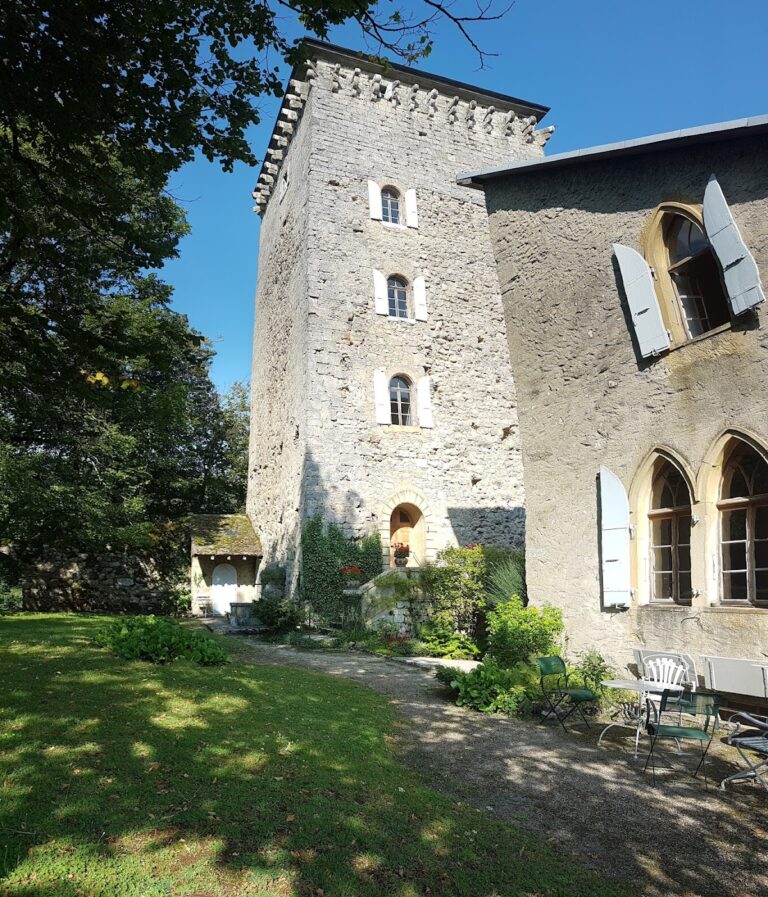
The first enclosure contains Mirabeau Tower and Grammont Tower. Grammont has a lower section faced with bossed masonry and an upper section made from tuff quarried at Fontaine Ronde. The second enclosure originally stood about 1.20 metres below its present floor level. It formed a balcony beneath the keep, whose entrance could be reached only by ladder. A gently sloping path led to the keep courtyard.
Horseshoe tower and third enclosure
Between 1393 and 1405, workers from Pontarlier built the horseshoe tower, then called the Rondelle, together with the third enclosure and its dry ditch. The work was financed through the Saint Luke and Saint George fairs established under Burgundian patronage. The horseshoe tower later received additional gun ports and a removable roof.
Vauban’s defensive works
Fourth and fifth enclosures
Vauban’s works between 1678 and 1690 removed the southern medieval defences and created the fourth enclosure, two hornworks, a new ditch, a covered way, and the glacis south of the fort. A hornwork is an outlying angular fortification projecting from the main defensive line. Stone came from the Géran. The fourth enclosure includes an eastern sentry box bearing intertwined L monograms associated with Louis XIV and a sun emblem.
The fourth and fifth enclosures contain artillery and service areas from the seventeenth and eighteenth centuries. Vauban’s later works of 1690 to 1693 added the second enclosure, the honour court, barracks, lodging beside Grammont Tower, and further gun ports in the western towers, keep courtyard, and horseshoe tower.
Gates, bridges, and covered passages
The entrance system combines several periods of construction. A seventeenth-century honour gate has a drawbridge operated by two people, while a nineteenth-century retractable drawbridge and a fifteenth-century medieval counterweight drawbridge also survive. The medieval bridge could not be raised in winter or wet weather. A fourteenth-century Burgundian loophole stands beside the approach.
The honour gate is carved from Vuillecin limestone, which can be worked like plaster before hardening. Its surviving decoration includes trophies representing French light cavalry and Swiss pikemen, fragments of Louis XIV’s intertwined-L monogram, and reliefs associated with Spanish Franche-Comté, the arms of Salins, archery equipment, and newer French military arms such as early bayonets.
The main defensive circulation system includes seventeenth-century covered ways, dry ditches, a nineteenth-century ha-ha before the entrance, and steep or irregular stairs in the outer defences. The fifth enclosure contains the steep pas de canard stair, the ditch has a seventeenth-century pas de souris, and a pas d’âne leads to the honour court. On the western side of the barracks, Vauban’s covered defended passage is roofed and lined with latrines. An exterior eighteenth-century fireplace at the entrance to the honour court warmed soldiers on guard duty.
Vauban’s gun ports had wooden shutters that closed the openings toward the ditch while artillerymen reloaded. Wooden panels in the honour court helped vent smoke from barracks facing the third-enclosure ditch. The mined stair between the honour court and the second enclosure was hollow for powder bags and had a hole for a saucisse, a tarred-cloth powder fuse ignited by a wick. Its removable landing could be taken away to delay attackers.
Nineteenth-century fortifications
Rochette battery and underground works
Joffre substantially rebuilt the fifth enclosure and Rochette plateau between 1879 and 1881. The works included the Rochette battery, a spiral stair, a double-ramp stair to Rochette, casemates and barracks in the fifth-enclosure ditch, an underground gallery, a powder magazine, a small underground store, and a shelter cut into the rock.
The western part of the keep courtyard, including the grey stair facing La Rochette, the stone sentry box in the second enclosure, and the mined stair with its removable trapdoor, belongs to this nineteenth-century defensive phase. The Devil’s Tower, built in 1843 in a neo-Gothic style, reused the stairway descending from La Rochette to the medieval toll point.
Mougin casemates
Two Mougin casemates were protected by four cast-iron plates, each weighing 20 tonnes, and covered with turf. They housed 155 mm Bange guns. One gun has been reconstructed. Counterweighted mechanisms opened the casemates for firing, while large vents expelled smoke, gases, and dust. One casemate has been restored to working order and is described as the only functioning Mougin casemate.
Water systems and the great well
Water installations include a collection system and cistern at the bottom of the third-enclosure ditch, additional cisterns in the honour court, and a medieval cistern with a rim in the keep courtyard. These installations formed part of the fortress’s internal infrastructure.
Vauban’s large well originally measured 147 metres and reached about 10 metres below the level of the Doubs. Two people died during its excavation, contrary to the later tradition that many condemned serfs perished there. Water was raised by a wheel mechanism. Joffre’s gallery shortened the well, and the surviving section can be seen from the underground gallery. Fluorescein experiments indicated that its water drains toward the Loue through the Fontaine Ronde network rather than directly into the Doubs.
Prison and later military remains
The keep contains the tower associated with Mirabeau and the cell in which Toussaint Louverture was confined. The cell’s almost completely blocked window reflects the conditions of his secret imprisonment. The former weapons museum occupied the first floor of the medieval keep and displayed nearly 600 items, including helmets, bayonets, sabres, cuirasses, a rare 1717 rifle, and First Empire bearskins. Almost the entire collection was moved to Pontarlier in 2015, so it is not treated as a surviving on-site collection.
The fortifications of La Rochette were destroyed during the 1815 bombardment, while several towers and walls were damaged. The nineteenth-century layout that followed included the La Rochette battery, underground galleries, stores, and shelters. Electricity was added during the interwar period, with few other alterations before the site opened for official visits.