Champvent Castle: A Medieval Fortified Residence in Switzerland


Site at a Glance
- Rating
- 4.5
- Popularity
- Very Low
- Country
- Switzerland
- Primary era
- Medieval
- Eras represented
- Medieval, Early Modern
- Civilizations
- Duchy of Savoy
- Site type
- Military
- Remains
- Castle
On this page7 sections
History
Champvent Castle is a medieval fortified residence in Switzerland, built during the 13th century as part of the lordship of Grandson. Its construction is dated to around 1250, and its Savoyard-square plan reflects the castle architecture of that period. Henri de Grandson, the son of Ebal IV de Grandson, is credited with beginning the works, although the precise origins of the building are uncertain.
From Grandson to Champvent
After Henri de Grandson died in 1266, construction continued under Guillaume de Champvent, bishop of Lausanne. He completed the castle shortly before his death in 1301. The Champvent family then succeeded the Grandson family as occupants and gradually loosened its dependence on Grandson authority. This line ended in 1336, when the lordship passed to the House of Neuchâtel.
In 1373, the lordship passed to Marguerite de Vufflens. Through her marriage, it later came to the Burgundian family of Vergy. The lordship included Champvent and the settlements of Mathod, Suscévaz, Essert, Villars-sous-Champvent, Orges, Vugelles-La Mothe, Vuiteboeuf, Sainte-Croix, and Bullet.
War, administration, and private ownership
During the Burgundian Wars, a series of conflicts involving the duchy of Burgundy and the Swiss Confederacy, Confederate troops burned the castle after the Battle of Grandson in 1475. The destruction has been linked to the castle lord’s connections with Charles the Bold, duke of Burgundy from 1467 to 1477, but that explanation is not securely established. The castle was rebuilt afterward.
Bern conquered Vaud in 1536, and Champvent became part of the bailiwick of Yverdon, an administrative territory governed by a bailiff for a larger political authority. The seigneurial rights, meaning the lordly privileges attached to the territory, were entrusted to the city of Yverdon-les-Bains, while the castle itself became private property.
The Diesbach family owned the lordship from 1611 to 1731. It then passed by marriage to Johann Rudolf Tillier of the Tillier family. Around 1769, Louis-Rodolphe Doxat purchased the castle, which remained with the Doxat family until Roland Doxat sold it in 1932.
Modern ownership and preservation
After 1932, the castle belonged to the Chaux-de-Fonds entrepreneur Ernest Morf. Pierre Morf sold it to Karl Leister in the mid-1980s, and Karl Leister’s widow, Christiane Leister, inherited it after his death in 1993. Following her death in 2025, the current owners are not known. On the night of 7–8 May 1802, the Bourla-Papey, Vaudois insurgents opposed to feudal dues and remnants of the old political order, seized the castle and burned the region’s archives. Champvent Castle is recognized as a Swiss cultural property of national significance.
Remains
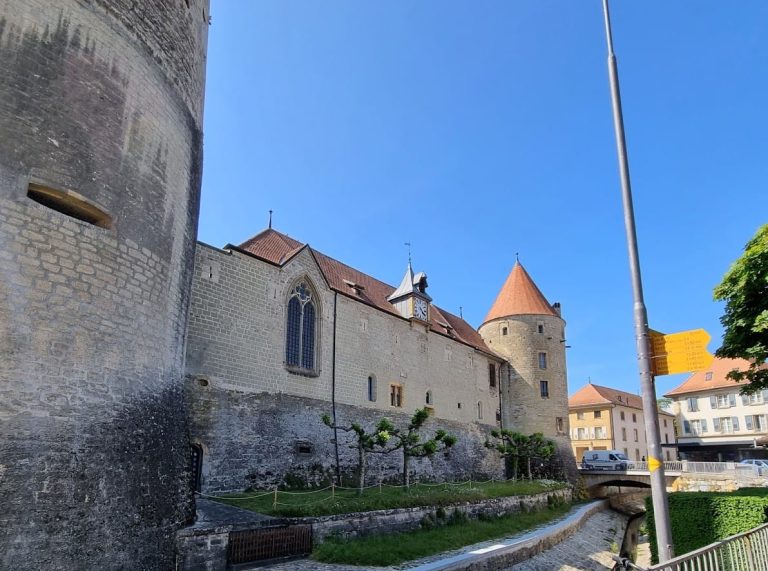
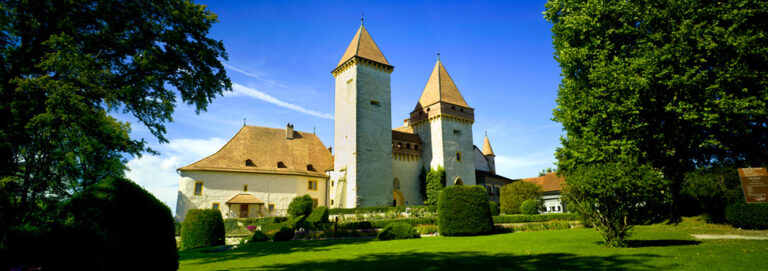
Champvent Castle is arranged as a Savoyard square, a medieval rectangular enclosure strengthened by towers, with residential buildings built against the inner walls around a central courtyard. Four round towers stand at the corners of the enclosure, creating the castle’s principal fortified outline.
Enclosure and courtyard
The rectangular enclosure contains buildings attached along its inner sides, and these structures surround the central courtyard. The castle’s original purpose was residential, a function it retains in its present designated use. Its organization combines domestic accommodation with the defensive form created by the enclosing walls and corner towers.
Towers and lowered keep
One of the four round towers originally served as the keep, the principal residential and defensive tower of the castle. In 1780, it was lowered by 15 metres. The altered tower remains part of the four-towered enclosure that defines Champvent Castle’s surviving architectural form.