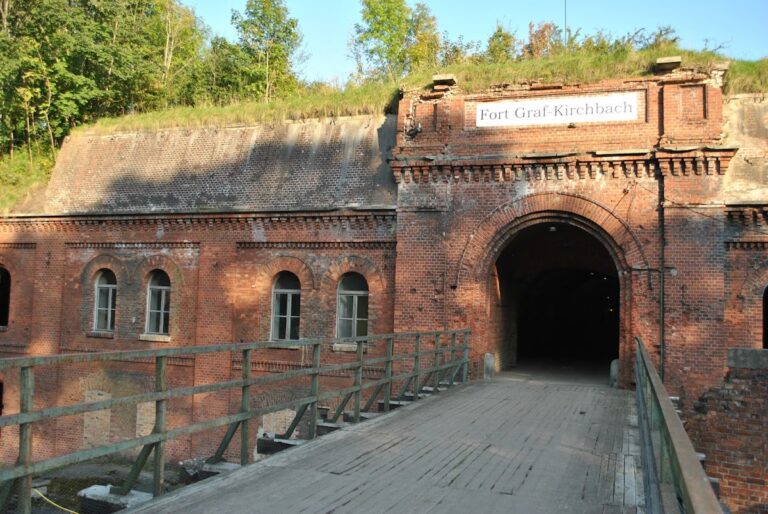
Fort IV w Poznaniu: A Fort of the Poznań Fortress


Site at a Glance
- Rating
- 4.3
- Popularity
- Very Low
- Country
- Poland
- Primary era
- Modern
- External website
- Open
- Eras represented
- Modern
- Civilizations
- German
- Site type
- Military
- Remains
- Fort
On this page8 sections
History
Fort IV w Poznaniu is a nineteenth-century German fort in Poznań, Poland, built between 1879 and 1884 as one of 18 forts in the Poznań Fortress. Designed by the military engineer Hans von Biehler, it formed part of the system surrounding and defending the city during the first stage of the fortress’s construction.
Construction and changing names
The fort was originally called Hake in honour of Karl von Hake, a Prussian military officer. This name had previously been used for the left-bank Fort Hake, which was formerly known as St. Adalbert’s Fort. In 1931, the fort received the Polish patronage name Fort Henryk Dembiński, commemorating the Polish general and military commander Henryk Dembiński.
Modernization took place in 1888 and 1889. The original front caponier, a protected structure in or beside a fortification ditch that provided flanking fire, was demolished and replaced by a reverse caponier serving the rear side of the ditch. Batteries were added to the flanks, including a six-position battery on the left and a ten-position battery on the right.
War service and postwar destruction
During the Battle of Poznań in 1945, the fort functioned as an ammunition depot for German artillery operating in the Citadel area. Deliveries ended after the railway bridge near the Citadel was destroyed on 10 February, followed by the bombing of a ferry on 11 February. German forces evacuated the area around the fort on 17 February 1945.
During the war, artillery ammunition was also stored in the fort’s under-rampart rooms and barracks. After the war, the fort was blown up and almost completely dismantled. Sand extraction further damaged the earthworks, making their original form difficult to understand. The fort and its remains are protected as a monument under entry A-245, dated 25 May 1983, and lie within the Natura 2000 area “Fortifications in Poznań” (PLH300005).
Remains
Fortifications and artillery positions
Front and rear defenses
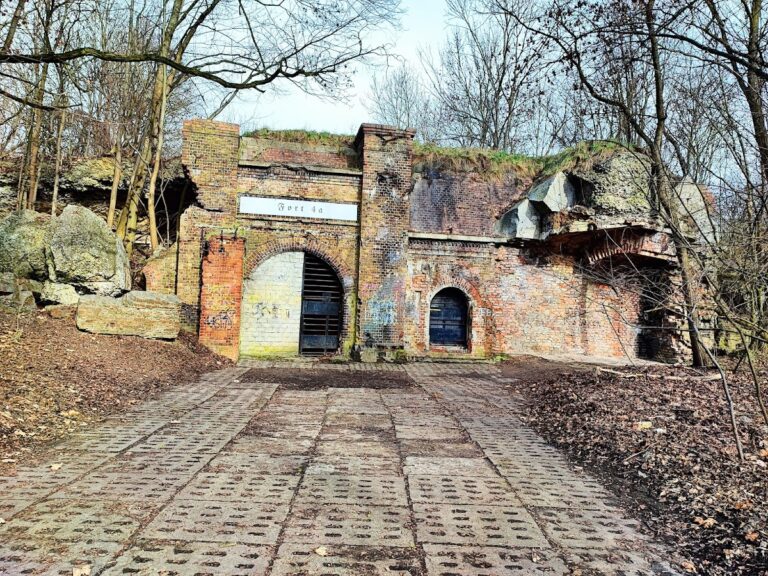
Fort IV was built on the military drill ground known as the Exercier Platz in the Karolin district, on what is now Syrenia Street. The two sections of its front formed an angle of 130 degrees. The surviving defensive remains include a front caponier, artillery exits, and an infantry exit leading onto the main rampart. These elements are fragmentary within earthworks made difficult to read by postwar demolition and sand extraction.
Observation positions and batteries
The central artillery rampart carried a shelter with an observation position designated P.B.St.87. After 1892, two further observation positions of the W.T.90 type were built. The flank batteries added during the 1888–1889 modernization consisted of six positions on the left and ten on the right. Concrete artillery shelters were added to the batteries in 1913 and 1914.
Setting and natural remains
The fort stands beside a power-and-heating plant, factory halls, and detached housing. A railway line runs south of the site, while other railway lines lie to the west and north. Vegetation among the remains includes common sea buckthorn and willows. The site also provides habitat for bats, including the greater mouse-eared bat (Myotis myotis), western barbastelle (Barbastella barbastellus), Daubenton’s bat (Myotis daubentonii), Natterer’s bat (Myotis nattereri), serotine (Eptesicus serotinus), brown long-eared bat (Plecotus auritus), and grey long-eared bat (Plecotus austriacus).
Nearby sites