Episcopal Palace in Poznań: Seat of the Archbishops of Poznań


Site at a Glance
- Rating
- 4.3
- Popularity
- Very Low
- Country
- Poland
- Primary era
- Modern
- Eras represented
- Medieval, Early Modern, Modern
- Civilizations
- German, Kingdom of Poland, Kingdom of Prussia, Polish–Lithuanian Commonwealth
- Site type
- Religious
- Remains
- Palace
On this page8 sections
History
The Episcopal Palace in Poznań, Poland, is an episcopal residence first recorded in 1404 and now presented in a late Neoclassical form. It has served as the seat of the bishops of Poznań, who have held the title of archbishop since 1821, as well as the home of the Metropolitan Ecclesiastical Court, an ecclesiastical tribunal dealing with matters governed by church law.
Fifteenth- and Sixteenth-Century Expansion
The residence was erected by Bishop Wojciech Jastrzębiec. During the episcopate of Andrzej of Bnin, it was enlarged, and Bishop Jan Lubrański funded the construction of a second wing on the Cybina side between 1505 and 1508. Bishop Andrzej Czarnkowski carried out another reconstruction in the middle of the sixteenth century, extending the building’s successive phases of development.
Destruction and Baroque Rebuilding
The Swedish Deluge, the seventeenth-century Swedish invasion and occupation of the Polish–Lithuanian Commonwealth, destroyed the residence. Bishops Wojciech Tolibowski and Stefan Wierzbowski rebuilt it, but the building fell into ruin again during the Great Northern War, an early-eighteenth-century conflict in northern and eastern Europe. In 1730, Bishop Jan Tarło commissioned a further rebuilding and transformed the residence into a Baroque palace, designed by Pompeo Ferrari.
Nineteenth- and Twentieth-Century Changes
Major reconstructions followed in 1827–1830 and during the second half of the nineteenth century. The palace’s present appearance is principally associated with a late Neoclassical reconstruction carried out in 1852–1854 on the initiative of Archbishop Leon Przyłuski. The design is attributed either to Juliusz Salkowski or Gustav Schultz and was modified by Karl Heinrich Schinkel. One wing destroyed in the 1760 flood was rebuilt during the interwar period.
The palace was entered in the register of historic monuments on 22 February 1960 under registration number A-026. Its continuing institutional role is tied to the archiepiscopal residence and to the Metropolitan Ecclesiastical Court.
Remains
Palace and Courtyard
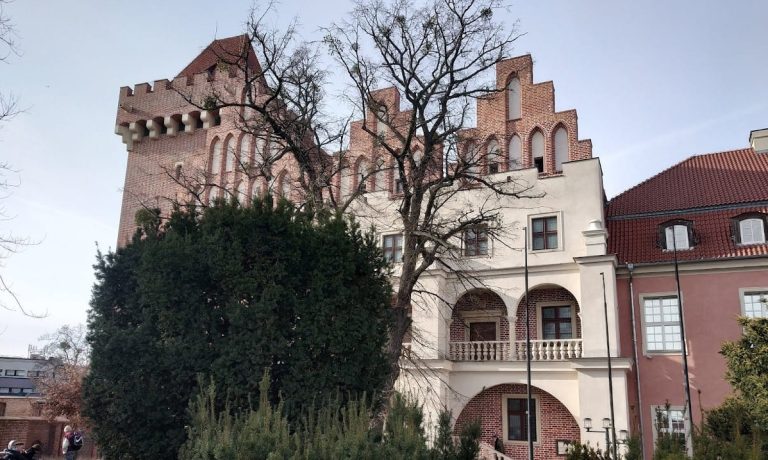
The palace occupies the western wing of an archiepiscopal residence on Ostrów Tumski. A representative courtyard lies west of the building, while former service buildings are connected to it on the east and south. A garden extends along the southern side of the complex. The main entrance is approached through a portico, a columned entrance porch, carrying a balcony. Its Ionic columns, identified by their scroll-shaped capitals, were reused from 1829.
Two marble sculptures of Saint Peter and Saint Paul stand beneath the portico. Oskar Sosnowski made them in Rome in 1864–1865. Until 1945, the sculptures stood beside the high altar in Poznań Cathedral before being placed at the palace.
Wings and Ecclesiastical Court
The northern wing was built on the remains of fifteenth- and sixteenth-century walls. It contains a Neoclassical gate with a large two-column portico dating from the late eighteenth century and houses the Metropolitan Ecclesiastical Court.
The short eastern wing was constructed at the beginning of the twentieth century. Together with the former service buildings and the garden, it forms part of the wider residence surrounding the palace.
Statue of Saint John of Nepomuk
A late Baroque statue of Saint John of Nepomuk stands in the square before the palace on a Rococo pedestal. Made of sandstone in 1694, the statue was funded by Franciszek Skaławski. Count Józef Mycielski, then owner of Kobylepole, restored it in 1890. The statue was transferred to the palace in 1957 from Kobylepole, where it had stood before the Mycielski Palace, which was destroyed during the Second World War. Saint John of Nepomuk was a fourteenth-century Bohemian saint traditionally associated with the protection of confession and bridges.
Nearby sites