Fort IIa w Poznaniu: A Detached Fort of the Poznań Fortress


Site at a Glance
- Rating
- 4.6
- Popularity
- Very Low
- Country
- Poland
- Primary era
- Modern
- External website
- Open
- Eras represented
- Modern
- Civilizations
- German
- Site type
- Military
- Remains
- Fort
On this page7 sections
History
Fort IIa w Poznaniu is a detached fort in Poland, built between 1887 and 1890 as part of the second construction stage of the nineteenth-century Poznań Fortress. One of 18 forts in the defensive system, it was designed by the Engineering Committee of the Main Inspectorate of Fortresses and cost approximately 1 million marks.
Construction and names
The fort was originally called Zwischenwerk IIa and named Thümen in honor of Heinrich Thümen, a Prussian military officer. In 1931, its commemorative patronage was changed, and it received the name Fort Kazimierz Więckowski after Captain Kazimierz Więckowski, a Polish military officer.
Military and storage use
Before the Second World War, the military assigned the fort’s facilities to storage. The site continued to serve as a warehouse during the German occupation. On 6 February 1945, during the Battle of Poznań, units of the 117th Infantry Division broke through between Fort IIa and Fort III, in the area now occupied by the Zodiak housing development. Chartowo, Rataje, and Żegrze were captured during the night of 8 to 9 February, after which the garrisons of the forts evacuated to Fort Rocha.
After the war, units of the Polish People’s Army and the Internal Security Corps used the fort until the end of the 1940s. It then became a warehouse for the pharmaceutical company Cefarm, which used it until the 1990s. Repair and adaptation works have left the fort in a very well-preserved condition. The City of Poznań owns the site, and since 1998 it has been used by PTOP Salamandra. The fort entered the heritage register as monument A-245 on 25 May 1983. Its grounds also form part of the Natura 2000 special area of conservation “Fortifications in Poznań,” a protected European network site for habitats and species of ecological importance.
Remains
Layout and earthworks
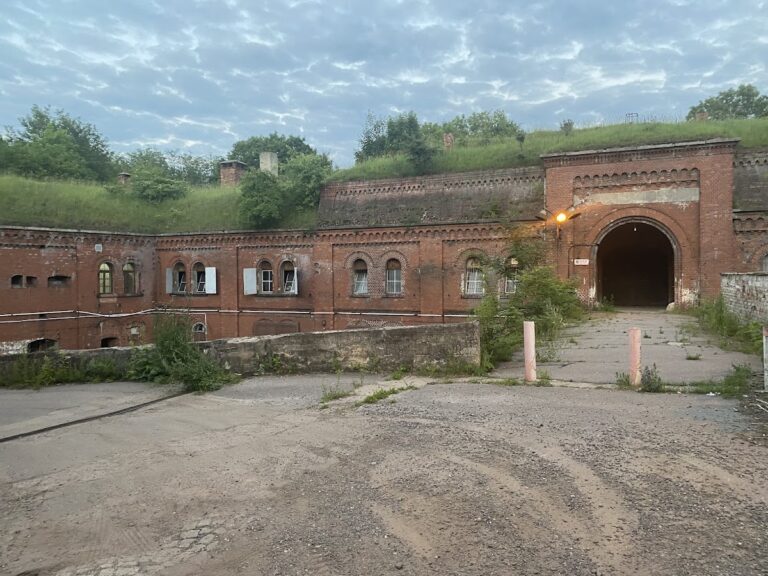
The fort stands in Chartowo on Kurlandzka Street, in an organized park beside the Osiedle Czecha and Osiedle Rusa housing developments. Its plan follows a trapezoidal outline on an east-west axis of symmetry. The rampart contains five traverses, three across the front and one on each flank. These raised sections of earth or masonry limited the effects of artillery fire and protected movement along the fort. An additional earthwork was built along the gorge, the rear side of the fort.
A fort road protected by earth embankments once led to the entrance, but it has not survived. A lateral military road followed the line of present-day Chartowo Street, Reverend Radziejewski Avenue, and Inflancka Street. The fort was enclosed by a moat described as 10 meters wide and 6 meters deep. Originally dry, it is now filled with water that penetrates into the interior, and excess vegetation has been cleared.
Moat defenses and access
Three caponiers formed part of the defenses: two frontal structures in the counterscarp, the outer slope or retaining side of the ditch, and one gorge caponier in the scarp. Corridors in the counterscarp connected with the caponiers. A protected passage or tunnel, known as the main postern, provided access through the fortification. Its walls have been sandblasted, and electricity is connected inside the fort.
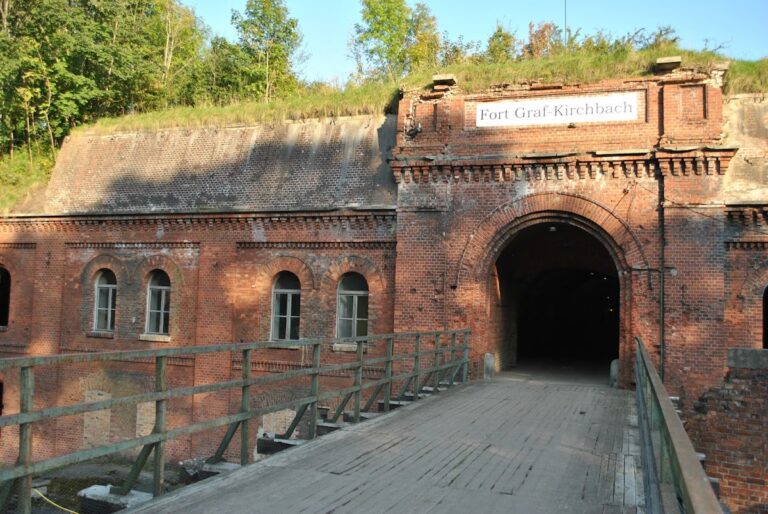
At the end of the nineteenth century, the entrance opening was changed from an arched form to a rectangular one. Several entrances were rebuilt and fitted with new doors in 1913 and 1914, while two small concrete shelters were added in the counterscarp. The drawbridge leading to the fort was destroyed by fire in 1997.
Interior and ecological features
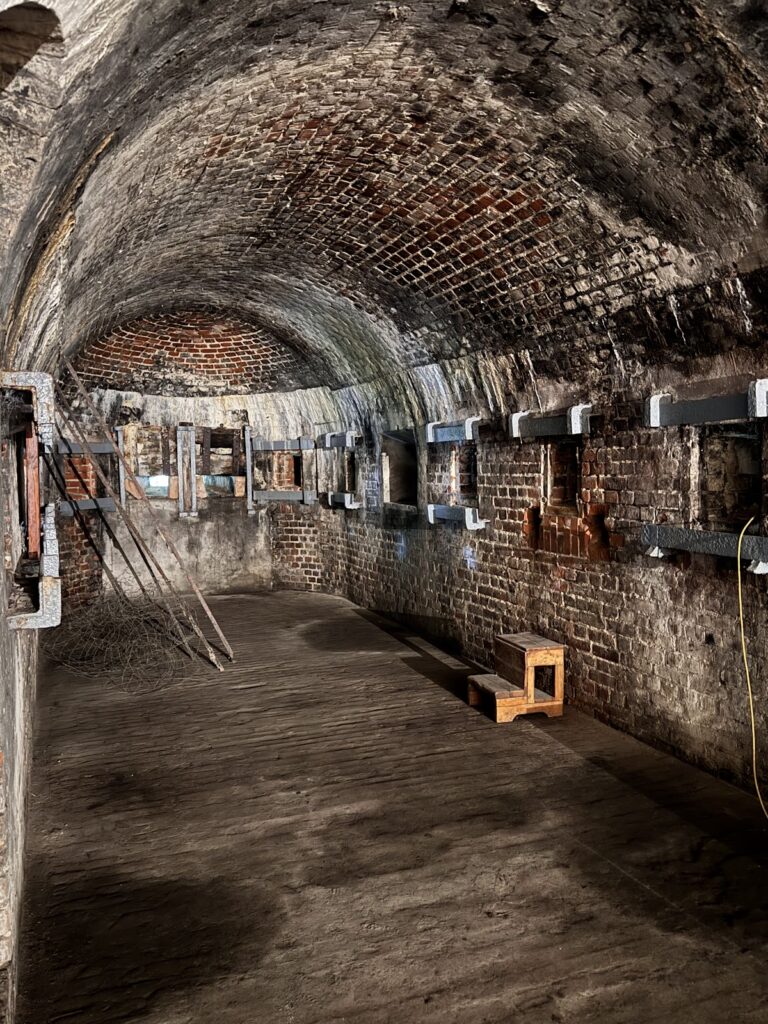
During the 1960s, several partition walls were installed inside the rooms. The brick vaults were then covered with lime paint and plaster, altering the appearance of the interior while leaving the principal fort structure preserved.
During a preliminary inventory of Poznań’s fortifications in the late 1990s, the first recorded Polish site of the lichen Peltigera monticola was discovered on the grounds. The species subsequently received the Polish name pawężnica forteczna; a second Polish site lies at a neighboring fort.
Nearby sites