Fort Gwiaździsty: A Historic Fortress in Głogów, Poland


Site at a Glance
- Rating
- 4
- Popularity
- Very Low
- Country
- Poland
- Primary era
- Early Modern
- External website
- Open
- Eras represented
- Early Modern, Modern
- Civilizations
- Kingdom of Prussia
- Site type
- Military
- Remains
- Fort
On this page7 sections
History
Fort Gwiaździsty, also known as Fort Stern, is a historic fort in Głogów, Poland. After Prussian forces captured Głogów in 1741 during the Silesian Wars, Frederick II, the king of Prussia, initiated the modernization and strengthening of the existing bastion fortress.
Prussian Reconstruction
The fort was reconstructed between 1747 and 1749 according to a design by Gerhard Cornelius van Wallrawe, a military engineer associated with Prussian fortress construction. During the 1770s and 1780s, its defensive system was expanded with a drawbridge, dams, sluices, and flood embankments. These installations allowed the surrounding forefield to be flooded during a threatened attack.
Nineteenth-Century Changes and Wartime Use
In 1830, the fort underwent its final reconstruction, which included the construction of a semicircular place of arms, an area where troops could assemble and operate defensively. The fortification was renamed Fort Stern in 1832. It was used by German forces in 1945 during the final phase of the Second World War.
Archaeological Work and Protection
In December 2016, the Pamięć Foundation, representing the German War Graves Commission in Kassel, carried out exploratory work in the fort’s moat with permission from the regional governor. The work formed part of an exhumation of German soldiers who had died during the Second World War. In May 2019, the remains of 19 soldiers were recovered, along with identity tags, several hundred items of ammunition, and cubes of pressed TNT. The caponier, a fortified work beside a moat that provided defensive fire along the ditch, was entered in Poland’s register of historic monuments on 31 July 2008 under registration number A/148 and inventory number 089F3.
Remains
Fortifications and Defensive Infrastructure
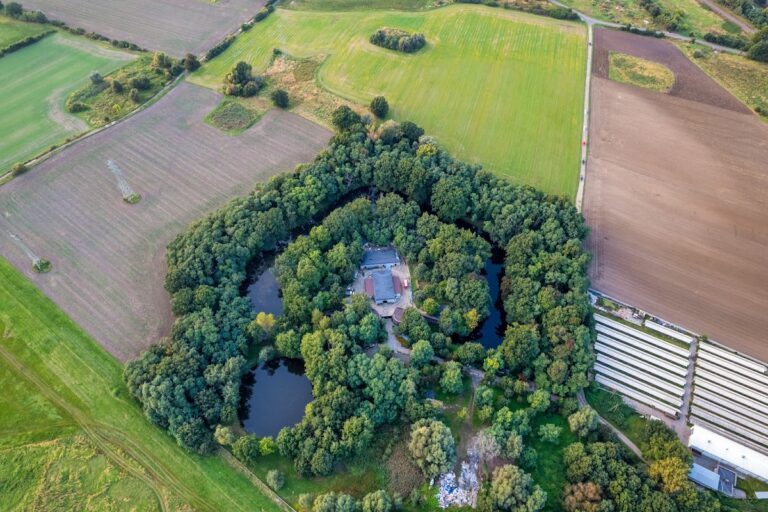
Fort Gwiaździsty is a defensive work with a moat and a two-storey railway blockhouse. The blockhouse sheltered troops and weapons while rifle and artillery positions protected the railway entrance into the fortifications. The drawbridge, dams, sluices, and flood embankments formed a linked defensive infrastructure designed to flood the forefield. A semicircular place of arms, added during the 1830 reconstruction, is also part of the fort’s physical arrangement. The fort is shown on a map dating from 1806.
Caponier and Moat Finds
The caponier is a separately identified component of the complex, projecting into or beside the moat to support defensive fire along the ditch. The moat was also the setting for the 2016–2019 exhumation work, which produced the remains of 19 German soldiers and associated military materials, including identity tags, ammunition, and pressed TNT cubes.
Nearby sites