Fort Fryderyka: A Prussian Alarm Fort in Poland


Site at a Glance
- Rating
- 4.2
- Popularity
- Very Low
- Country
- Poland
- Primary era
- Early Modern
- Eras represented
- Early Modern
- Civilizations
- Kingdom of Prussia
- Site type
- Military
- Remains
- Fort
On this page8 sections
History
Fort Fryderyka is a former Prussian fort in Poland, built from 1790 to 1795 on the western summit of Kamienna Góra near Pokrzywno. Ordered by King Frederick William II of Prussia, it formed part of a defensive system created in the aftermath of the Silesian Wars, eighteenth-century conflicts between Prussia and Habsburg Austria over Silesia and nearby territories.
Construction and purpose
The fort was one of five installations in Kłodzko Land, within a wider system associated with the fortresses of Srebrna Góra and Kłodzko. This network was intended to prepare Prussia for a possible Austrian attack on its territories in Silesia and Kłodzko Land.
Major Bonaventura von Rauch directed the construction. In a letter dated 18 May 1790, written on the king’s orders, he requested 1,000 workers, including between 150 and 200 carpenters, together with 7,000 to 8,000 logs and boards for the fort system. His son Gustav von Rauch, who had recently graduated from the Military Engineering Academy in Potsdam and later became a Prussian general and minister of war, assisted him. Captain Ludwig Müller supervised the work directly from Bystrzyca Kłodzka.
Fort Fryderyka was not designed to defend a particular military sector. Its task was to warn of an invasion by lighting a signal fire. The fort never took part in military operations.
Dismantling after the Napoleonic defeat
Prussia’s defeat by Napoleon in 1806 changed the fate of the fortifications. Frederick William III, the successor of Frederick William II, ordered their dismantling under the Treaty of Tilsit, the 1807 settlement that followed Prussia’s defeat and imposed major territorial and military terms on the kingdom. Work at Fort Fryderyka began in 1807, while the remaining parts were removed during the second half of the nineteenth century.
Changing names and local memory
The name Fort Friedrich soon fell out of use. Later German names included Steinburg and Fort Nesselgrund, the latter deriving from the German name for Pokrzywno. After 1945, the site was also called Fort Blockhaus and Fort on Kamienna Góra. The name Blockhaus referred to a fortified structure traditionally associated with heavy timber construction and to the word “BLOCKHAUS,” once displayed on a stone plaque above an entrance. Fort Fryderyka was revived in an editorial note to the 2006 book Polanica-Zdrój Yesterday and Today.
A local commemorative story known as “Ponzel’s Daring Leap” is tied to the summit. In 1887, August Ponzel, a local eccentric who made wooden butter whisks and had served in the Franco-Prussian War of 1870–1871, reportedly bet his friend Karol that he would jump into a ravine several metres deep while imagining himself surrounded by enemies. He survived after landing on the branches of a tall spruce. Injured and wearing a torn Sunday suit, he went to an inn to claim his wager, a bottle of Urian vodka and a length of sausage. In the early 1920s, he later retold the incident to people who congratulated him on his eightieth birthday.
Remains
Buried fortifications on Kamienna Góra
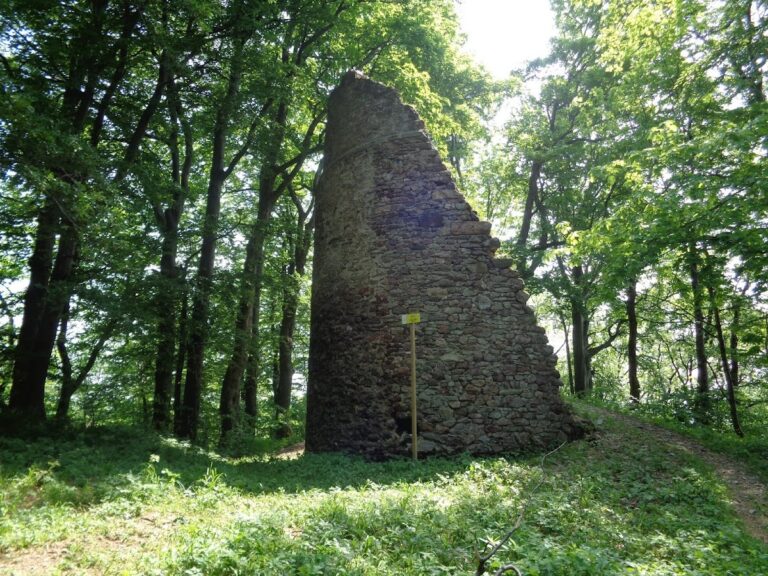
Fort Fryderyka occupied the summit of Kamienna Góra, a western high point in the northeastern Bystrzyckie Mountains. The above-ground fort disappeared during the nineteenth-century dismantling, and the underground section was almost completely filled in. Fragments of masonry from the fort’s sandstone walls survive within the buried remains.
Underground approach
On the western side, a relatively visible flight of steps leads to a small underground corridor that is itself largely filled. Walls and several buried entrances to the underground spaces can still be seen, preserving limited evidence of the fort’s former subterranean arrangement.
Ponzel memorial plaque
A heavily moss-covered stone plaque remains on the summit. It carries the inscription “Ponzel’s Daring Leap 1887” and a drawing of a hand pointing toward the direction of the jump, commemorating August Ponzel’s reported leap into the ravine.