Fort Fareham: A Nineteenth-Century Defensive Fort
Site at a Glance
- Popularity
- Medium
- Country
- United Kingdom
- Primary era
- Modern
- Eras represented
- Modern
- Civilizations
- British
- Site type
- Military
- Remains
- Fort
On this page12 sections
History
Fort Fareham, immediately west of Salterns Creek in the United Kingdom, is a British Palmerston fort built from 1861 to 1868. Palmerston forts were nineteenth-century British defensive works associated with coastal defence and named for Prime Minister Lord Palmerston, who promoted the fortifications.
Construction and strategic purpose
After the Royal Commission on the Defence of the United Kingdom, a British inquiry into national defences, approved the Gosport Advanced Line, planners proposed three more forts about two miles ahead of it. Fort Fareham was the only one built, after cost-cutting halted the other proposals. It was intended to connect the Gosport forts with the Portsdown Hill forts, defend the gap at Fareham, and protect routes by road and railway between Gosport and the Portsdown forts. Its position meant that an attack on the Gosport line would be hazardous until the fort had been captured or disabled.
A Defence Committee report in 1869 praised the fort’s construction for its stability and durability, while noting that its resistance would partly depend on water filling the surrounding ditch.
Armament and defensive service
The planned weapons changed during the fort’s active defensive period, from 1868 to 1902. The original scheme called for forty-nine 7-inch rifled breech-loaders, guns with spiral grooves loaded from the rear, and five 64-pounder rifled muzzle-loaders, loaded from the barrel’s front. The 64-pounders were to be replaced by 7-inch guns on Moncrieff counterweight carriages, which used a counterweight to raise a gun for firing, along the west rampart. The plan also included three rifled howitzers and fifteen smooth-bore guns for ditch defence. On completion, the fort had sixty-four 7-inch breech-loaders, five 40-pounder breech-loaders, five 64-pounder muzzle-loaders and three rifled howitzers. Its caponiers held fifteen 32-pounder smooth-bore breech-loaders; a pounder’s designation referred to the nominal weight of its shot.
The mounted armament had fallen to one 7-inch breech-loader and two 6.3-inch rifled muzzle-loading howitzers by 1886. By 1891, fifteen 7-inch breech-loaders were in place: ten on the main and south ramparts and five in Moncrieff gun pits. Ten mobile guns were assigned to cover the Fareham Gap, comprising four 4-inch breech-loaders on siege carriages and six 40-pounder breech-loaders on travelling carriages.
From barracks to wartime headquarters
By 1902, most forts on the landward defensive line had ceased to operate as fighting works, and Fort Fareham’s armament was withdrawn. It continued as a barracks until the end of the Second World War. Under the 1905 Portsmouth Fortress Defence Scheme, forty-four men from No. 23 Company, Royal Garrison Artillery, a British Army arm responsible for garrison and siege artillery, and members of the 3rd Battalion, Oxfordshire Light Infantry Militia, were to occupy it during a precautionary period. They were to prepare for an attack from the west if an enemy captured or bypassed Southampton. Mobilisation would bring three officers and sixty-six men from the 2nd Hampshire Royal Garrison Artillery (Volunteers); the 1st Volunteer Brigade, Hampshire Regiment, had administrative duties only. Mobile guns assigned to the Fareham Gap were stored at the fort.
The 108th (Heavy) Battery, Royal Garrison Artillery, was based there in April 1907, followed by the 1st Heavy Brigade by 1908. In 1914, the 35th (Heavy) Battery left with the British Expeditionary Force, the British field force sent to the First World War’s Western Front, attached to the 2nd Division. The VI and VII Siege Brigades, Royal Garrison Artillery, were formed at the fort in December that year.
From 1928 to 1945, the Officers’ Mess housed the headquarters of the 35th Anti-Aircraft Brigade, Royal Artillery, and a Gun Operation Room. In 1941, the fort also served as headquarters for the 124th Heavy Anti-Aircraft Regiment and for three batteries from other anti-aircraft brigades. It later operated as an Anti-Aircraft Operations Room from 1947 or 1948 until 1957. During the Cold War, the main magazine and adjoining south-west caponier briefly formed Fareham Borough’s Emergency Centre, intended for selected councillors in the event of nuclear attack. The fort was also intended to contribute to the Anti-Aircraft Operations Room for the Portsmouth and Southampton Gun Defended Area.
Closure and damage
The Ministry of Defence declared Fort Fareham surplus in 1965 and sold it to Fareham Urban District Council. In 1974, a contractor working for a company leasing the site cleared vegetation from the ramparts, removed earth covering gun positions and ammunition stores, and took out one Haxo casemate. The guard room, gateway, stables, several storage sheds, vehicle shed and parts of the rear defensive work were demolished. A court injunction stopped further damage. The fort has been a Grade II listed building since 1976. A serious fire damaged the interior roof arches of the main west caponier in 1989.
Remains
Setting and plan
The fort stands west of Salterns Creek, with the Fareham–Gosport railway passing its north-east corner. Fort Elson, the northernmost fort of the Gosport Advanced Line, lies 3,500 yards away; Fort Wallington is 2,500 yards to the north-east and was visible from Fort Fareham, with Fareham and Fareham Creek between them. Designed as an isolated work capable of resisting an assault, Fort Fareham has a five-sided plan. Its west-facing rampart carried the main armament, while the north-facing flank commanded the Fareham Gap towards Fort Wallington. The south ramparts were exposed to fire directed along their length, so their guns were placed in protected Haxo casemates. Fort Fareham had more of these casemates than any other Palmerston fort.
Ditch and defensive works
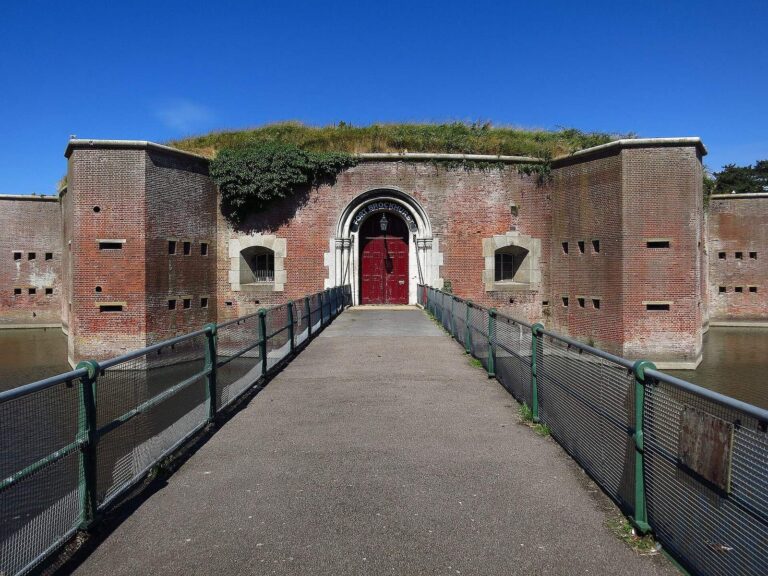
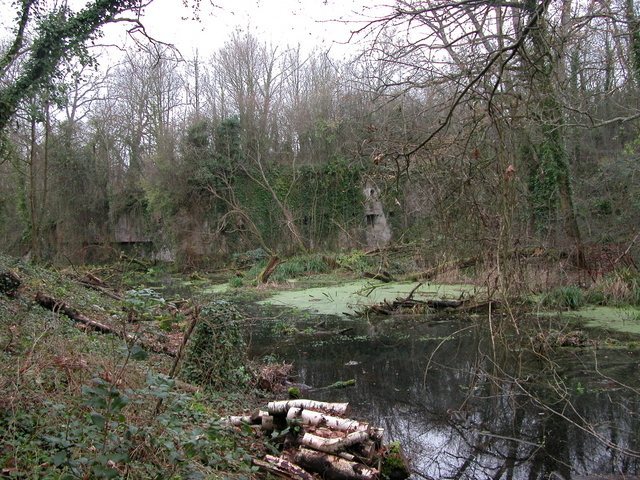
A ditch encircles the fort. It was intended to hold water, but difficulties in obtaining and retaining a supply left its northern section dry for much of the fort’s working life. A large caponier, a protected position for firing along a ditch, defended the western side; smaller demi-caponiers guarded the north, south-west and southern outward angles. An angled work called a redan closed the rear side, or gorge, of the fort.
Surviving features
Ramparts and casemates
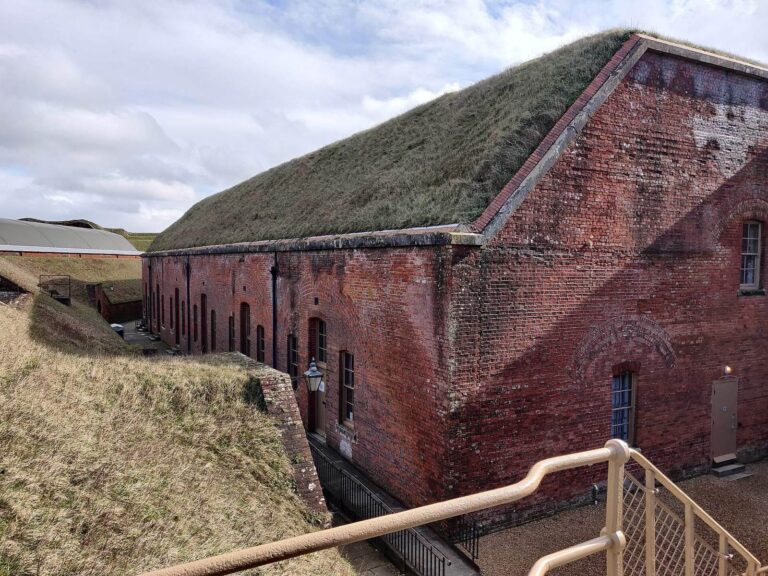
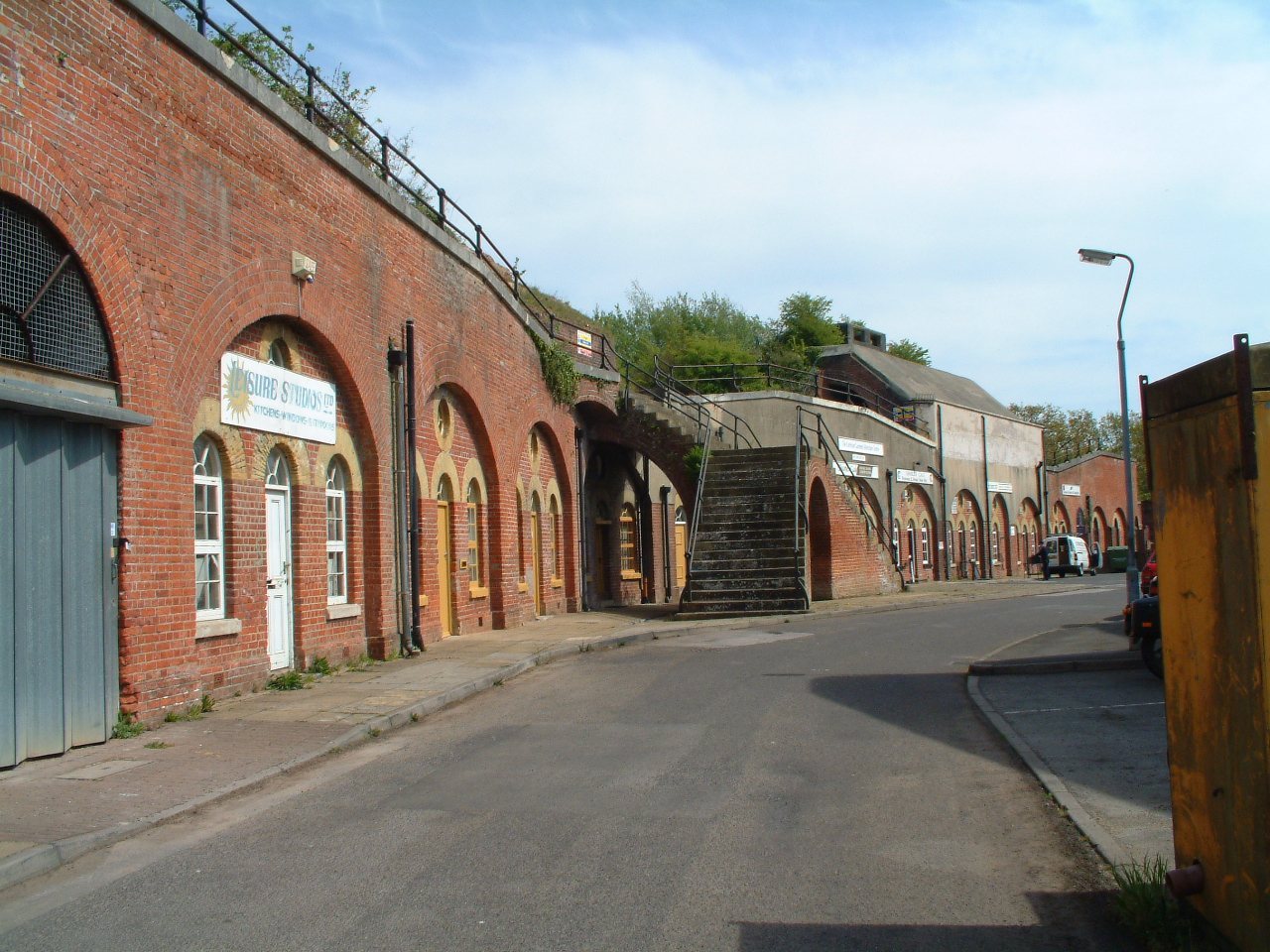
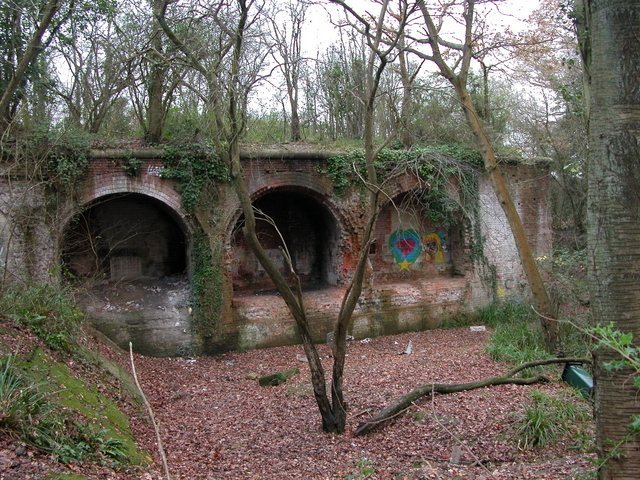
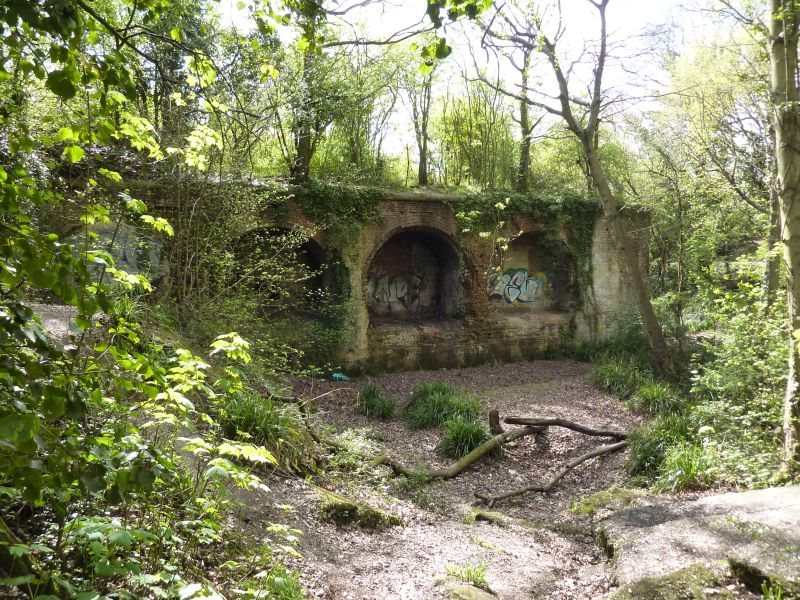
By 2012, the ramparts were overgrown and inaccessible, and their parapets and gun positions had been removed. Five Moncrieff pits survived. Haxo casemates on the south and south-west ramparts remained intact but were bricked up. The parade ground is now covered by Fort Fareham Business Park, and casemates have been converted into industrial units.
Caponier and ditch features
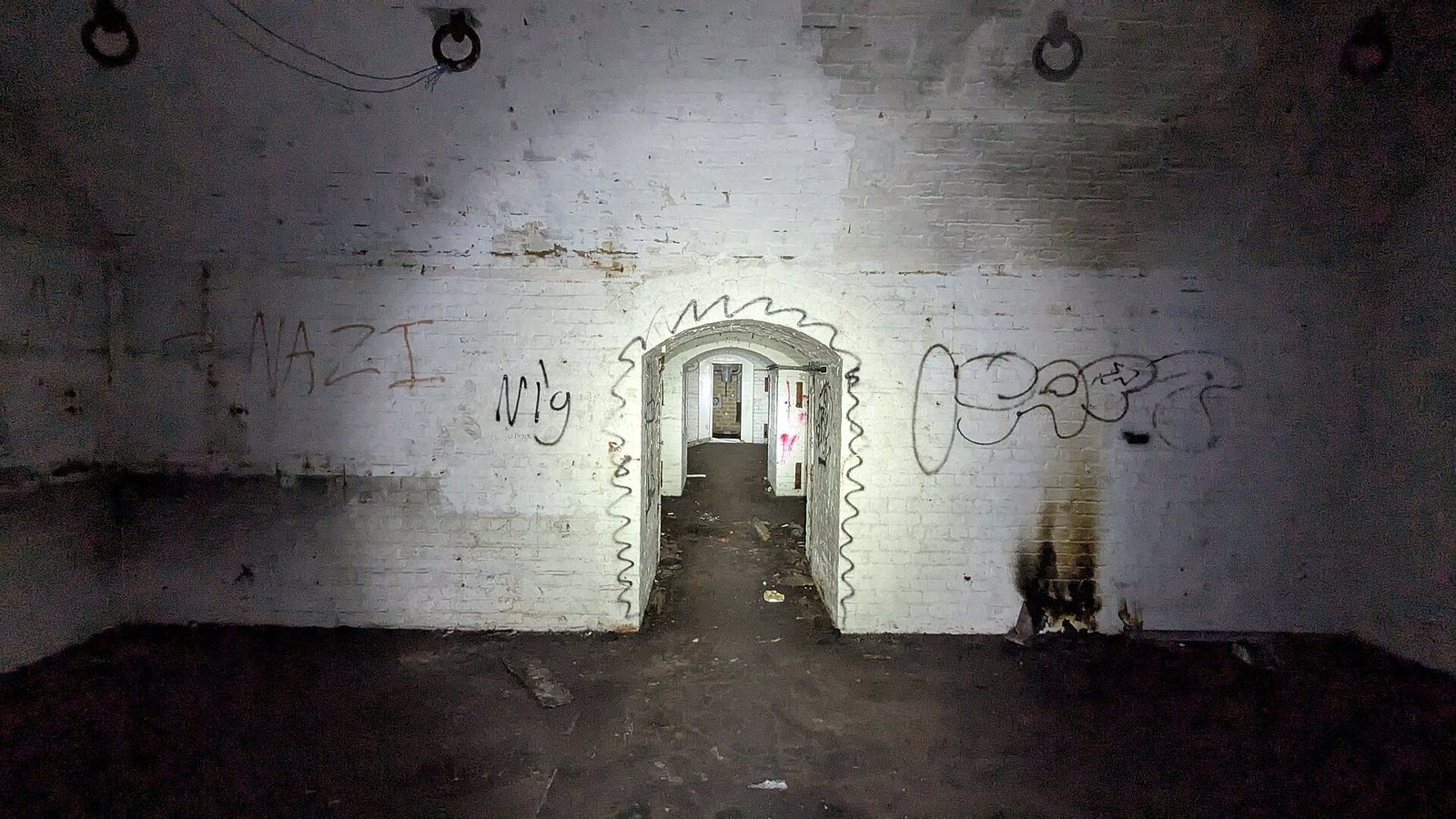
The mortar battery and caponiers were mostly derelict and overgrown, with extensive damage to their brickwork. The west caponier had substantial damage to its outer brickwork, and its interior roof arches showed spalling. Gun openings, loopholes and sally ports, defended passages through the fort, had been blocked to prevent access.
Bridge and outer ground
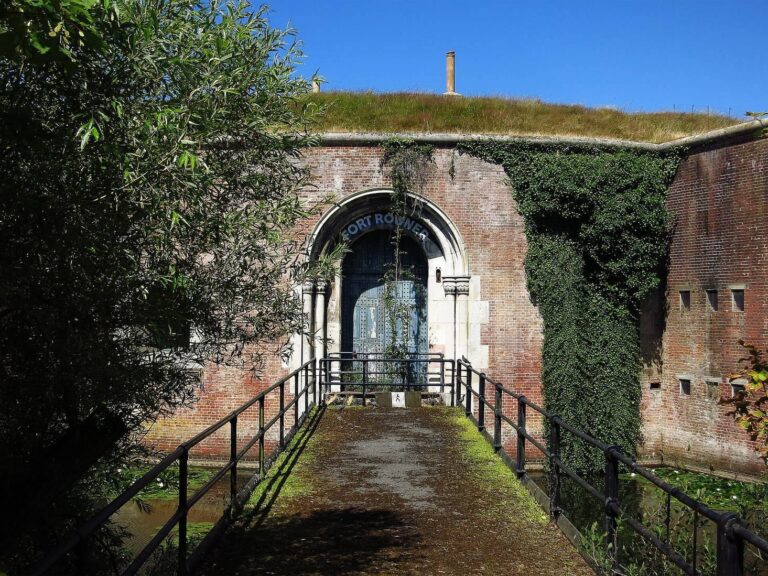
Iron railings remained on the access bridge. The road beside it had been widened to two lanes by filling part of the ditch. Fareham Council and volunteers from a neighbouring housing estate partly cleared the ditch in the late 1980s. By 2012, the wooded inner face of the ditch, the covered way beyond it and the sloping outer bank formed an area of wild ground. Paths with seats at intervals followed the ditch’s outer perimeter.