Fort Nelson: A Palmerston Fort Protecting Portsmouth


Site at a Glance
- Rating
- 4.7
- Popularity
- Medium
- Country
- United Kingdom
- Primary era
- Modern
- External website
- Open
- Eras represented
- Modern
- Civilizations
- British
- Site type
- Military
- Remains
- Fort
On this page13 sections
History
Fort Nelson is a six-sided Palmerston fort in the United Kingdom, built at Boarhunt on Portsdown Hill between 1860 and 1867. It formed part of Britain’s nineteenth-century defensive response to the perceived threat of a French land attack on Portsmouth dockyard, about 8 kilometres away.
The Palmerston defensive line
The fort was one of several works promoted by Lord Palmerston, the British statesman and prime minister associated with the defensive programme developed after the 1859 Royal Commission. The older Hilsea Lines were considered inadequate, so a new defensive line was established along the approximately 7-mile ridge of Portsdown Hill.
Fort Nelson belonged to a group that also included Fareham, Wallington, Southwick, Widley, and Purbrook. Crookhorn Redoubt and Farlington Redoubt, each a small enclosed fortification, supplemented the line at its eastern end. In wartime, Fort Nelson was intended to accommodate about 200 volunteers under the direction of regular army officers.
Arming, reuse, and abandonment
Construction took longer than planned, and the fort was not fully armed until the 1890s. It was disarmed in 1907 and later used as accommodation. In 1938, the site became an area anti-aircraft ammunition store, and ten large magazines were built on the parade ground for that purpose.
Fort Nelson was abandoned in the 1950s. After years of neglect and vandalism, Hampshire County Council bought it in 1979. With help from volunteers from the Palmerston Forts Society, the council carried out a restoration programme costing approximately £3–4 million. The fort opened to the public in 1994 and became part of the Royal Armouries in 1995.
Hampshire County Council owns Fort Nelson, while the Royal Armouries occupies it as a museum and uses it to house artillery from the United Kingdom’s national collection of arms and armour. The fort is a Grade I Listed Building, designated under the official name Fort Nelson, Boarhunt, on 22 December 1971. Its position on Portsdown Hill overlooks Portsmouth and is associated with views toward the Solent, Hayling Island, Gosport, and the Isle of Wight.
Remains
Fort Nelson covers approximately 19 acres, or 77,000 square metres, and follows the polygonal plan typical of a Palmerston fort. Six sides enclose a deep defensive ditch, while ramparts, artillery positions, underground magazines, and tunnels form a connected defensive layout. The restored site also contains displays illustrating the living and working conditions of the soldiers who defended the fort.
Defensive works and entrance
Ditch and caponiers
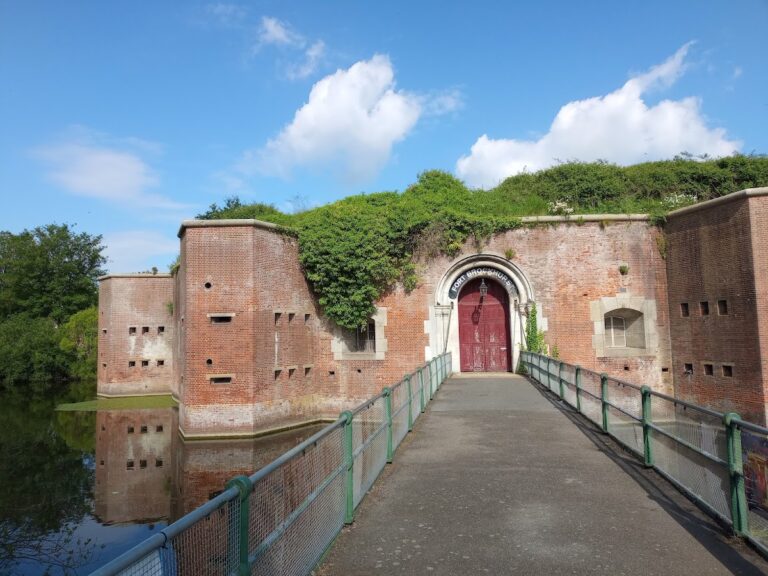
The deep ditch surrounding the fort is protected by three caponiers, fortified structures projecting into a ditch so defenders could fire along or across it. Each caponier is topped by a protected emplacement for a 13-inch mortar, adding artillery positions directly to the ditch defences.
Entrance and barrack defence
The original entrance was reached by two Guthrie rolling bridges. Inside the defences, a barrack block designed for 172 officers and other ranks was protected by a redan, a V-shaped defensive work.
Artillery positions and underground spaces
Ramparts and casemates
The ramparts contain open emplacements for 64-pounder rifled muzzle-loading guns and 6.6-inch rifled muzzle-loading howitzers. These were loaded from the front, and their internally grooved barrels were designed to improve the accuracy of their projectiles. Three Haxo casemates, protected artillery emplacements, accommodated 7-inch rifled breech-loading guns loaded through the rear of the barrel.
Parade ground and magazines
A large open parade ground provides access to magazines approximately 40 feet below ground level. The same area later held ten large magazines constructed in 1938 for anti-aircraft ammunition storage. Tunnels beneath the fort linked the magazines with the gun emplacements.
Artillery collection
Historic guns
The Royal Armouries collection at Fort Nelson includes the Boxted Bombard, an English wrought-iron cannon dating from around 1450 that could fire a 60-kilogram granite ball. It also includes the Dardanelles Gun, an Ottoman bronze cannon dated 1464 and capable of firing stone balls 63 centimetres in diameter.
Later artillery and associated weapons
Other holdings include French field guns captured at the Battle of Waterloo, fortress guns from India and China, parts of the Iraqi Project Babylon Gulf War-era supergun, one of Mallet’s Mortars, and several SBBL 32-pounders. The adjacent Nelson Monument, which commemorates the British admiral associated with the Royal Navy victory at the Battle of Trafalgar in 1805, provided the fort with its name.
Nearby sites