Portchester Castle: A Roman Fort and Medieval Royal Fortress in England


Site at a Glance
- Rating
- 4.6
- Popularity
- Medium
- Country
- United Kingdom
- Primary era
- Medieval
- External website
- Open
- Eras represented
- Classical, Medieval, Early Modern
- Civilizations
- Anglo-Saxon, English, Norman, Roman
- Site type
- Military
- Remains
- Castle
On this page19 sections
History
Portchester Castle is a medieval castle in the United Kingdom, built within a Roman fort established around AD 285–290 as part of the late Roman coastal defence system. The site stands at the head of Portsmouth Harbour near Fareham, where its position controlled the harbour and supported an important medieval port.
Roman and Anglo-Saxon origins
Portchester’s strategic value was recognized by at least the third century, when the Romans established the fort of Portus Adurni. Its precise foundation date is uncertain, but tradition associates its construction with Marcus Aurelius Carausius under the instructions of Emperor Diocletian. The fort formed part of the Saxon Shore, a late Roman network defending British ports and settlements from maritime raiders and attacks across the Channel. It probably also served as a base for the Classis Britannica, the Roman fleet responsible for naval operations and the defence of Britain.
After the Roman army withdrew from Britain in the early fifth century, activity at the fort became less intensive, although the site was probably not entirely abandoned. A hall and tower built in the tenth century indicate that Portchester later functioned as a high-status Anglo-Saxon residence. In 904, King Edward the Elder brought the fort under his authority and developed it into a burh, an Anglo-Saxon fortified settlement intended to help defend England against Viking armies. Portchester is listed among these defensive settlements in the Burghal Hidage.
The Norman castle and royal possession
The medieval castle probably originated in the late eleventh century, though its first form and exact date remain uncertain. After the Norman Conquest, the manor of Portchester was granted to William Maudit, a powerful landholder associated with William the Conqueror. Maudit probably founded the castle, initially creating an inner ward in the north-west corner of the Roman fort while using the Roman walls to protect the outer bailey.
William Maudit died around 1100, and the property passed to his son Robert Maudit, who died in 1120. Several years later the estates passed through marriage to William Pont de l’Arche, who probably held Portchester until his death in 1148. The earliest surviving explicit reference to the castle is a grant of 1153, when Henry Plantagenet, later King Henry II, granted it to Henry Maudit. After Henry became king in 1154, Portchester entered royal possession and remained under royal control for several centuries.
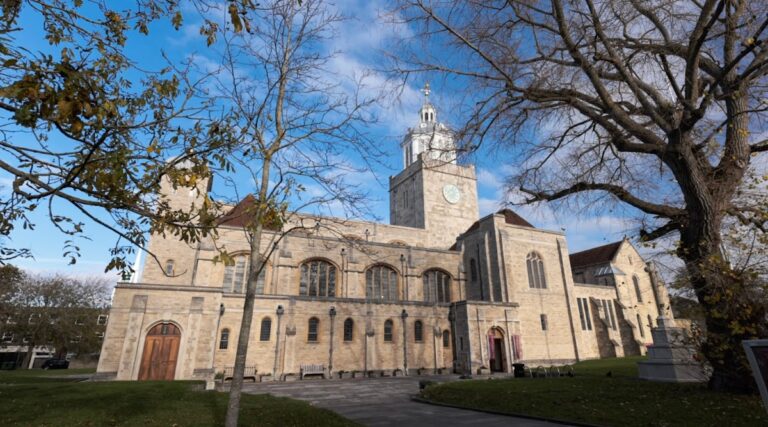
Pont de l’Arche founded an Augustinian priory inside the castle in 1128. Augustinian priories were religious communities following the rule and institutional traditions associated with St. Augustine of Hippo, often combining communal worship with pastoral work. The community moved to Southwick between 1147 and 1150, so the buildings intended for the priory at Portchester may never have been completed. St. Mary’s parish church, built in the outer bailey during the 1130s, survives as the principal physical reminder of this religious foundation.
A royal fortress in the twelfth and thirteenth centuries
By the twelfth century, Portchester was already a substantial royal fortress. Henry II visited regularly, and the castle became associated with his dispute with Thomas Becket when Henry met there with the Bishop of Evreux, who spoke on Becket’s behalf. The castle also held important prisoners, including the Earl of Leicester.
Portchester was prepared for war during the Revolt of 1173–1174, when Henry II’s sons rebelled with support from leading barons. Catapults were manufactured for the defence, and the garrison consisted first of ten knights before rising to twenty. The keep was probably largely complete during this early period of royal control, while royal apartments separate from it were recorded in 1183.
King John frequently stayed at Portchester, partly because the nearby Forest of Bere offered a favoured setting for hunting and recreation. He was at the castle when he learned that Normandy had been lost in 1204. English forces departed from Portchester for campaigns in France in 1205 and 1213, continuing the castle’s role as a military base and embarkation point.
After the sealing of Magna Carta in 1215, Prince Louis of France captured Portchester in June 1216 after taking London and Winchester. The castle returned to English control in the spring of 1217. Henry III ordered its destruction in April that year, but the order was not carried out. Portchester continued to serve as a departure point for English expeditions to France during the thirteenth century.
War, rebuilding, and royal residence
During the reign of Edward II, from 1307 to 1327, the Crown expected a French invasion and strengthened the castle’s defences. More than £1,100 was spent on repairs and reinforcement between 1320 and 1326. The buildings of the inner ward were remodelled, and the outer gatehouses were enlarged. A wooden tower was also built toward the end of the thirteenth century to reinforce the eastern Roman wall.
A survey in 1335 found many buildings in poor condition and noted that the sea had damaged the southern wall of the Roman fort. Further work during the 1350s and 1360s reordered the domestic buildings and repaired the wall facing the sea. In June 1346, Edward III assembled an army of 15,000 men at Portchester before beginning the French campaign that ended in the English victory at Crécy.
Between 1396 and 1399, royal apartments were built for Richard II under the direction of the master mason Walter Walton. Their construction reflects the continuing use of Portchester as a royal residence as well as a military stronghold. In 1415, Henry V prepared at the castle for a campaign in France during the Hundred Years’ War, the prolonged series of conflicts between the English and French crowns. While he was there in July, the Southampton Plot was uncovered. Richard of Conisburgh, Earl of Cambridge, Henry Scrope, Baron Scrope of Masham, and Sir Thomas Grey were arrested at Portchester and executed in early August.
Decline, military reuse, and imprisonment
During the fifteenth century, Portsmouth, about 10 kilometres away, developed into a major economic centre and port. It replaced Portchester as the area’s principal military installation, and Portchester entered a period of decline. A survey of 1441 described the castle as “right ruinous and feeble,” although it remained important enough to receive Margaret of Anjou, the wife of Henry VI, when she landed there in 1445. Repairs were attempted during the final decade of the century.
Henry VIII visited Portchester with Anne Boleyn in October 1535, the first visit by a reigning monarch for more than a century. From October 1562 to June 1563, while England occupied Le Havre, the castle served as a military hospital for soldiers involved in the conflict with France. Later, as relations with Spain deteriorated, Elizabeth I prepared Portchester for a possible Spanish invasion. Henry Radcliffe, later Earl of Sussex, was constable, the official responsible for the administration and defence of the castle.
Elizabeth visited on 30 August 1591, when the floors of the state chambers were rotten and she dined in the keeper’s bedchamber. By 1603, the castle had been improved enough for her to hold court there. Sir Thomas Cornwallis became constable that year and remodelled buildings along the eastern side of the inner bailey. A royal survey in 1609 described the improved condition of the castle and recorded four lodging chambers above four office rooms in Cornwallis’s buildings.
Charles I sold Portchester Castle to Sir William Uvedale in 1632, ending its royal ownership. The property later passed through Uvedale’s successors, the Thistlethwaite family. Portchester saw no fighting during the English Civil War, although Parliamentarian dragoons briefly occupied it as a garrison in 1644.
From the late seventeenth century, imprisonment became the castle’s principal function. In 1665, 500 prisoners from the Second Anglo-Dutch War were held there. Some were housed in St. Mary’s Church and set it on fire, leaving the building unrepaired for about forty years. The Crown leased the castle from the Uvedales between 1702 and 1712 to imprison captives from the War of the Spanish Succession.
Napoleonic prisoners and modern guardianship
During the nineteenth century, Portchester became a prison for more than 7,000 French prisoners captured during the Napoleonic Wars. The prisoners staged theatrical performances at the castle during the 1810s. Those who died in captivity were often buried on the tidal mudflats south of the castle, where storms sometimes disturbed the remains. The former prison hospital beside the castle later became Portchester House, a private residence.
The castle has belonged to the Southwick Estate since the seventeenth century. English Heritage manages the site, which has Scheduled Monument and Grade I listed-building status. These designations recognize its archaeological and historical importance and its exceptional architectural and historic interest. A local legend also claims that Pontius Pilate, the Roman governor of Judaea in Christian tradition, was brought to Portchester by galley late in life as a final refuge.
Remains
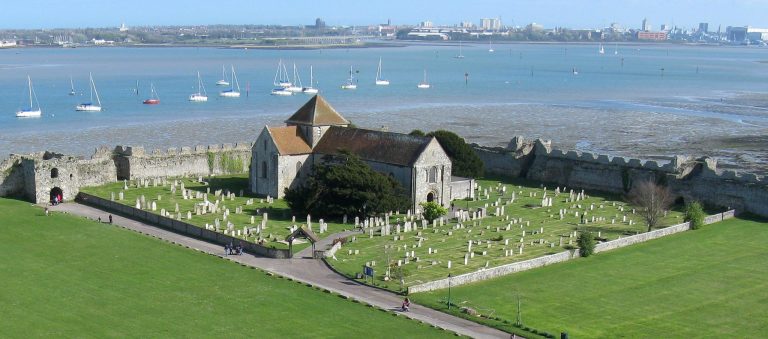
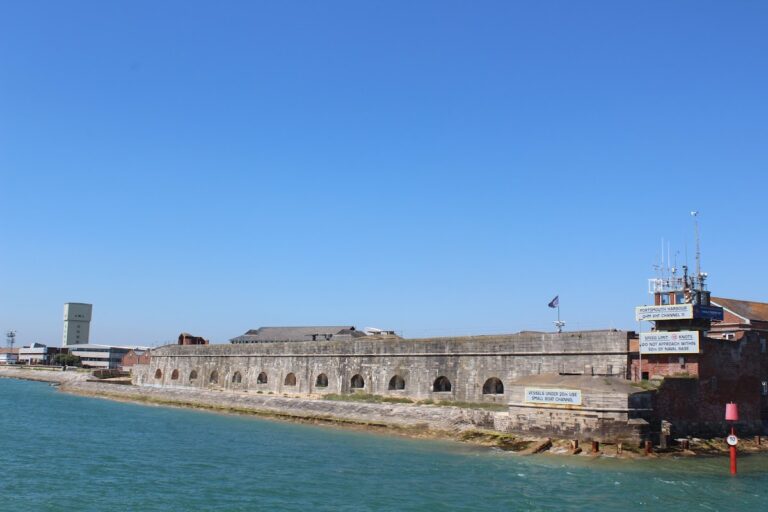
Portchester Castle occupies the walls of the Roman fort of Portus Adurni at the head of Portsmouth Harbour. The Roman fort is described as the best-preserved Roman fort north of the Alps, and its surviving stone walls became the principal defences of the medieval outer bailey. Within this large enclosure, the castle’s inner ward occupies the north-west corner, while St. Mary’s Church stands in the south-eastern part of the grounds. The sea-facing southern wall and the tidal mudflats beyond it remain closely associated with the site’s military and prison history.
Roman fort and early residence
Roman fortifications
The Roman fort is a substantial stone enclosure whose walls survive as the main defensive boundary of the later castle. Its position at the harbour gave it control of an important coastal location. The southern wall suffered damage from the sea by 1335 and was later repaired, preserving part of the defensive circuit that medieval builders continued to use.
Anglo-Saxon hall and tower
Remains of a hall and tower from the tenth century lie within the Roman fort. Together they indicate that Portchester served as a high-status Anglo-Saxon residence before Edward the Elder converted it into a burh in 904.
Medieval castle defences and royal buildings
Inner ward and gatehouses
The earliest medieval castle probably occupied an inner ward enclosed by a wooden palisade and moat. The Roman walls protected the outer bailey, creating a larger fortified area around the central stronghold. The castle was probably rebuilt in stone during the period associated with William Pont de l’Arche, whose masonry resembles that of St. Mary’s Church. The keep was probably largely complete during the first period of royal control. The inner-ward buildings were remodelled between 1320 and 1326, when the outer gatehouses were also enlarged.
Keep and royal apartments
The keep served as the principal fortified tower, containing the castle’s strongest residential and defensive spaces. Royal apartments separate from the keep were recorded in 1183. New apartments built for Richard II between 1396 and 1399 survive in a ruined condition and were constructed under the direction of Walter Walton. Later work in the 1350s and 1360s reordered the domestic buildings, while buildings along the eastern side of the inner bailey were remodelled under Sir Thomas Cornwallis. In 1609, these contained four lodging chambers on the upper floor and four office rooms below.
Sea-facing defences
The wall facing the harbour formed part of the castle’s defensive circuit and required repair after damage by the sea. The southern Roman wall had already suffered coastal damage by 1335, and later repairs maintained the sea-facing boundary as Portchester continued to serve military and prison functions.
Religious and prison buildings
St. Mary’s Church
St. Mary’s is a Norman parish church in the south-eastern corner of the grounds. It was built in the outer bailey during the 1130s for the Augustinian priory founded by William Pont de l’Arche. The church belongs to the Anglican Diocese of Portsmouth. In 1665, prisoners from the Second Anglo-Dutch War were housed inside it and set it on fire. The resulting damage left the church unrepaired for about forty years.
Portchester House
The former prison hospital stood along the western side of the castle beside Hospital Lane, formerly called Seagates Lane. The building survives as Portchester House and is now a private residence.
Tidal burial ground
The tidal mudflats south of the castle contain burial remains associated with prisoners who died in captivity during the nineteenth-century prison period. Storms have sometimes exposed these remains, linking the coastal landscape directly with Portchester’s later use as a detention site.
The inner section of the castle now contains exhibitions and displays, while the surviving walls, gatehouses, royal buildings, church, hospital, and coastal remains preserve the successive military, religious, residential, and penal uses of the site.