Fort Ducrot: A Biehler-Type Fort in Strasbourg’s Fortified Belt


Site at a Glance
- Rating
- 4.6
- Popularity
- Low
- Country
- France
- Primary era
- Modern
- External website
- Open
- Eras represented
- Modern
- Civilizations
- French, German
- Site type
- Military
- Remains
- Fort
On this page9 sections
History
Fort Ducrot is a Prussian Biehler-type fort in France, at Mundolsheim, built between 1879 and 1882 as part of the fortified belt around Strasbourg. Its construction followed the city’s fall in 1870 and formed part of a fourteen-fort program designed to protect Strasbourg after the Franco-Prussian War.
The Strasbourg fortified belt
The program was ordered by Helmuth Karl Bernhard von Moltke, the senior Prussian military commander, who initially proposed thirty-six forts before the plan was reduced to fourteen. Eleven were built in Alsace and three in Baden. The works followed Hans Alexis von Biehler’s system of separated artillery forts, positioned at approximately cannon range from one another rather than joined in a continuous ring of walls.
Fort Ducrot was first known as Feste Mundolsheimer Kopf. On 29 August 1882, it was renamed Feste Podbielski in honour of the Prussian general Theophil von Podbielski, who had served as quartermaster general during the wars of 1866 and 1870.
French renaming and twentieth-century military use
After Germany’s defeat in 1918 and the return of Strasbourg to France, the fort received the name Fort Ducrot. It honoured the French general Auguste Alexandre Ducrot, who had commanded the division mobilized at Strasbourg in 1870.
In 1936, France incorporated the fort into the Maginot Line, the interwar system of fortified defenses, and strengthened it for modern military use. Its theoretical garrison capacity was between 200 and 300 men. The fort remained operational from 3 September 1939, during the early phase of the Second World War known as the Phoney War, until an evacuation order toward Mutzig was issued on 18 June 1940.
Municipal ownership and rehabilitation
After the army abandoned the fort, the municipality of Mundolsheim purchased it during the 1990s. Since 6 March 2010, the association Les Amis du Fort Ducrot has undertaken rehabilitation and renovation work. The fort remains under restoration.
Remains
Fort structure and defenses
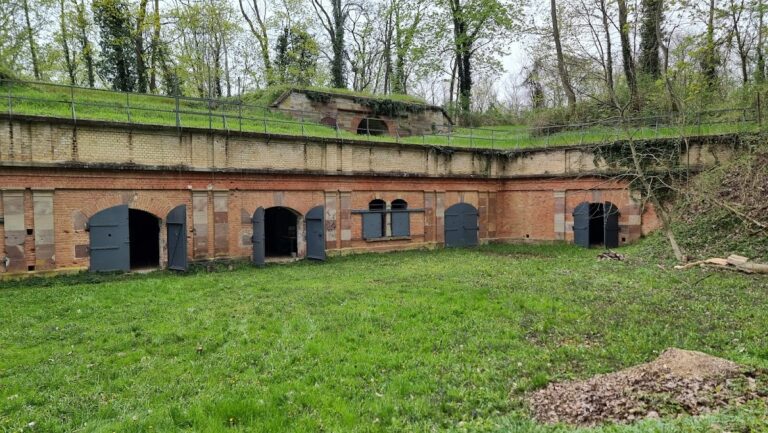
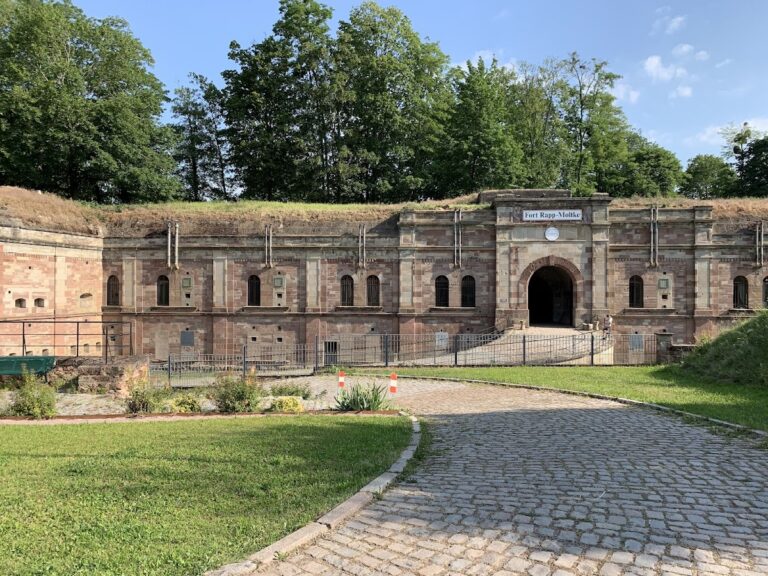
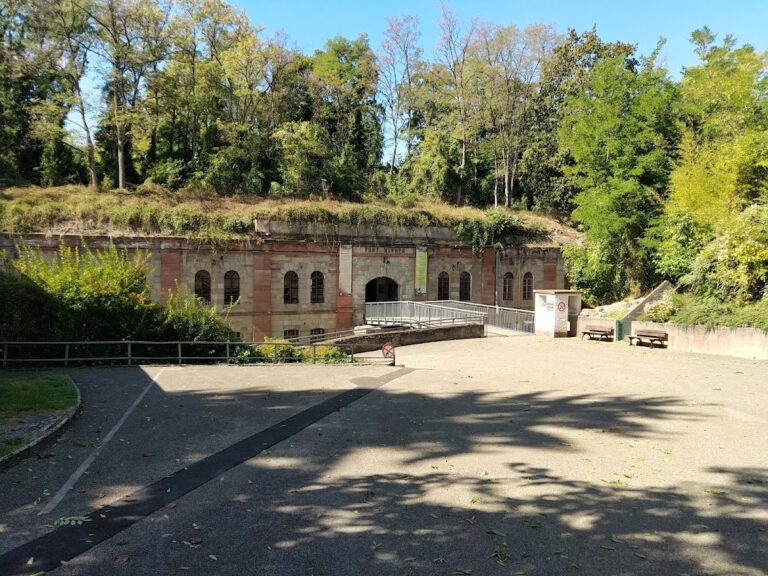
Fort Ducrot retains the basic form of a Biehler-type fort, including a dry ditch and the defensive structures of the Strasbourg fortified belt. During the 1936 modernization, the rear façade was covered by a 2.50-metre-thick shell of reinforced concrete. The front façade also received concrete protection, but the work was carried out by military labour, was of inferior quality, and remained unfinished when German troops arrived in 1940.
Interior evidence of military use
Command post
The former German artillery laboratory was converted into the command post of the 103rd Fortress Infantry Division. This adaptation formed part of the fort’s integration into the modern defensive system in 1936.
Wall frescoes
Wall frescoes survive inside the fort and provide evidence of its occupation during the Phoney War. They remain among the physical traces of the garrison’s use before the evacuation of 1940.
Nearby sites