Saint-Pierre-le-Jeune Protestant Church: A Lutheran Heritage Church in Strasbourg


Site at a Glance
- Rating
- 4.7
- Popularity
- Medium
- Country
- France
- Primary era
- Medieval
- External website
- Open
- Eras represented
- Medieval, Early Modern, Modern
- Civilizations
- French, German, Holy Roman Empire, Irish, Merovingian
- Site type
- Religious
- Remains
- Church
On this page13 sections
History
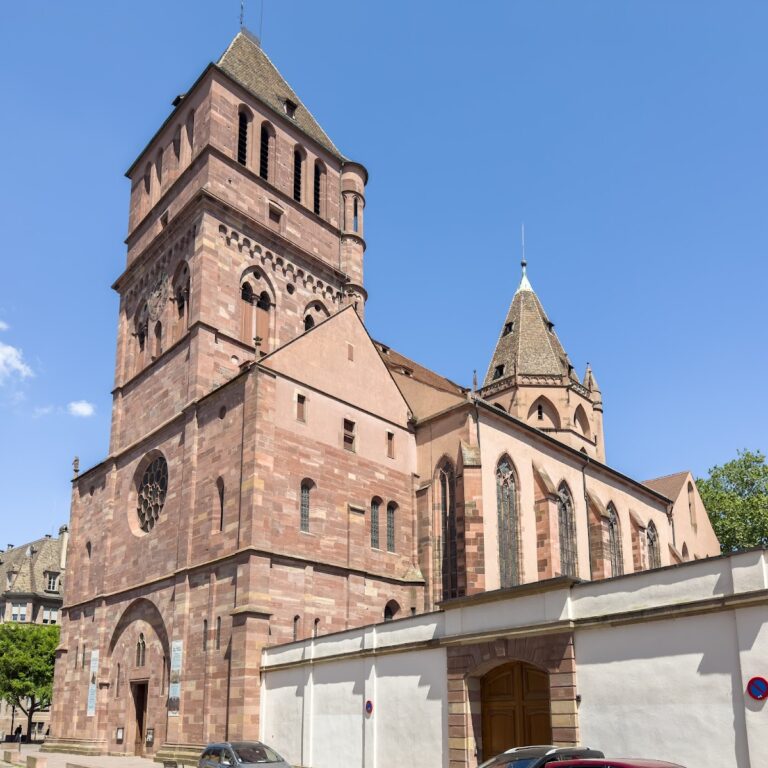
Saint-Pierre-le-Jeune Protestant Church is a Lutheran church in Strasbourg, France, whose principal building is a fourteenth-century Gothic church developed from an early medieval foundation. It belongs to the Protestant Church of the Augsburg Confession of Alsace and Lorraine and forms part of the Route Romane d’Alsace. Its history reflects the changing religious life of Strasbourg, from a charitable Columban community and collegiate chapter to a Reformation parish and, for several centuries, a church shared by Lutherans and Catholics.
The Columban foundation and Romanesque chapter
By the late seventh century, Irish monks had probably built a wooden chapel here, in a cemetery outside Strasbourg’s walls. Dedicated to Saint Columban of Bangor, an Irish missionary and founder of monasteries, it served artisans, horticultural workers, and servants living beside the Roman road toward Trier. Buildings associated with the chapel offered lodging and assistance to pilgrims, homeless people, orphans, and impoverished sick people. A second church appears to have been established around the year 1000.
In 1031, Bishop William I founded a collegiate chapter on the site. This body of clergy, governed through its own offices and property, replaced the Columban foundation with a Romanesque collegiate church. Pope Leo IX consecrated the church in 1049 or 1053 and dedicated it to Saint Peter. Because Strasbourg already had another Saint Peter’s Church, the new foundation became known as “Young Saint Peter.”
The chapter grew from the monks’ charitable and social confraternity. It initially had eight canons, rising to fourteen under William’s successor and fifteen by the end of the Middle Ages. Fourteen vicariates and nineteen chaplaincies were later added. The canons first lived together under the Rule of Saint Chrodegang, but communal life was gradually abandoned about a century after the chapter was founded. The provost managed the chapter’s property and represented it before civic and religious authorities; the dean oversaw discipline and services, while the custodian administered the parish. The pleban served as priest, the cantor directed worship and taught music, and the scholasticus headed the chapter school.
Medieval religious and educational life
The chapter observed the canonical hours each day and celebrated anniversary masses for benefactors, including prayers for their souls and release from purgatory. Its school first prepared future canons and later admitted parishioners, including poor children supported by scholarships. Members of the chapter also acted as ambassadors, arbitrators, mediators, and executors of wills.
At the end of the fifteenth century, the chapter reached its greatest prosperity. Its property, educated members, school, and library placed it among the leading chapters of the diocese. Peter Schott, a humanist canon associated with the Strasbourg preacher Geiler, promoted reform and sincere piety. At the same time, abuses included the accumulation of several prebends, irregular attendance at services, and moral scandals. In 1518, a cardinal staying for four weeks at the provost’s residence offered indulgences to the faithful in front of the church.
The Reformation in Strasbourg
Martin Luther’s writings reached Strasbourg from 1519, and religious tensions soon affected Saint-Pierre-le-Jeune. In 1524, parishioners dissatisfied with the preaching of the pleban Veit Kumbach asked Wolfgang Capiton, provost of the Saint Thomas Chapter, to become their pastor. The city magistrate appointed Capiton despite opposition from the canons. The canons then secretly left Strasbourg, taking valuable objects from the chapter treasury with them.
The church became Lutheran in 1524. Worship was conducted in the language of the congregation and centred on preaching and communal singing, while the Lord’s Supper was celebrated every two weeks. Capiton taught children’s catechism each Sunday and published the first Strasbourg catechism in 1527. He died during the plague in 1541.
The chapter itself remained Catholic and retained ownership of the church walls. It continued to use the choir for solemn ceremonies and the installation of canons. Paul Fagius followed Capiton as pastor and, in 1545 and 1546, formed a short-lived circle of professing Christians. Its members accepted stricter discipline, more advanced doctrinal teaching, and a limited form of shared property.
Shared use and the French period
From 1549, a parish of about 4,000 people was served by three pastors, with a Sunday-evening preacher added in 1661. Daily morning prayer supplemented the Sunday services. The Interim of 1549 to 1559, an attempt to restore Catholic practices temporarily within the Holy Roman Empire, forced Fagius to leave Strasbourg and brought Catholic worship back into the church for a time. Protestant services resumed in 1561.
After Strasbourg became part of the French kingdom in 1681, the Catholic chapter and a Catholic parish received the choir, while the nave remained Lutheran. A dividing wall was erected at the beginning of 1683. The chapter had taken refuge in Molsheim, but later returned to Strasbourg and resumed its activities. The arrangement made Saint-Pierre-le-Jeune a simultaneum, a church building shared by different Christian confessions, with a Lutheran nave and Catholic choir.
During the eighteenth century, Lutheran orthodoxy faced growing challenges from Pietism, which stressed personal devotion, and rationalism, which subjected religious belief to reason. Jean-Sigismond Lorenz, pastor from 1771 to 1782 and professor of theology, promoted a personal, Christ-centred “religion of the heart” while opposing both strict orthodoxy and reductive rationalism. Within the chapter, Jean-Baptiste Denis de Règemorte served as royal praetor from 1752 to 1761.
The French Revolution brought a severe interruption. In 1793 the church was closed and converted into a depot for straw and hay. Its bells and other liturgical objects were requisitioned, the chapter was dissolved, and its canons dispersed. Protestant worship continued at the Charrue inn until January 1796.
Renewal, restoration, and twentieth-century change
In the nineteenth century, the parish was influenced by liberalism, the Revival associated with François Haerter, and confessional Lutheran renewal. Frédéric Horning, pastor from 1846 to 1882, reshaped worship, religious instruction, and charitable work by stressing the church as a confessional community. He restored older hymns and promoted devotion centred on justification by faith. Two deaconesses began working in the parish in 1847, and several parish choirs were founded during the last third of the century.
Wilhelm Horning, Frédéric’s son and a historian, founded the Bethléhem retirement home in connection with the parish, operated an orphanage for several years in Cronenbourg, and directed the late-nineteenth-century restoration of the church. From 1897 to 1901, Carl Schäfer of the Karlsruhe Technical University oversaw extensive restoration and partial remodelling. The wall dividing the choir from the nave was removed, enabling Protestants to regain the whole building.
The separate Saint-Pierre-le-Jeune Catholic Church was built by 1893 on the site of the demolished Finkmatt Barracks. Its construction provided the growing Catholic congregation with a larger church and ended the practical need for shared worship in the older building. Saint-Pierre-le-Jeune Protestant Church had consequently returned entirely to Protestant use.
Until the twentieth century, three parish communities coexisted within the Protestant church. After 1918, when German-origin parishioners and one pastor left Strasbourg, two personal parishes remained, one mainly Pietist or centrist and the other confessional Lutheran. They maintained separate newsletters, deaconesses, sewing groups, youth groups, and Sunday schools. The Second World War affected the congregation directly, and thirty parishioners died during the bombing of Strasbourg on 25 December 1944. After the war, membership declined and the formerly divided parish gradually reduced its activities to one sewing group, one youth group, and one pastor.
The church has been protected as a historic monument since 1862, and the cloister received separate protection in 1999. After 2000, the cloister was restored, electrical installations were renewed, and the portal doors were repainted. A conservation campaign begun in 2014 addressed deteriorating interior paintings, humidity, and heating while taking account of the overlapping medieval and Carl Schäfer layers.
Remains
The surviving complex brings together a small subterranean burial church, fragments of the Romanesque collegiate foundation, a fourteenth-century Gothic building, later Baroque elements, and the neo-Gothic work of the nineteenth-century restoration. The cloister and church preserve evidence of changing construction campaigns, religious functions, artistic programmes, and musical installations.
Early remains and medieval structure
The oldest surviving element is a small underground church used as a burial crypt. It is identified with the seventh-century Columban church. Fragments of the Romanesque collegiate complex include the lower part of the tower and some cloister columns. Three of the cloister’s four arcaded galleries date from the eleventh century, while the fourth was built in the fourteenth century. The cloister was later covered with polychrome painting modelled on the Hortus Deliciarum, a richly illustrated medieval Christian manuscript associated with the Alsatian convent of Hohenburg.
Gothic church and chapels
The principal building is a fourteenth-century Gothic church with numerous chapels and an elaborate rib vault, whose framework is formed by intersecting stone ribs. Its Gothic fabric includes an Alsatian choir screen, a substantial division between choir and nave described as unique, together with a late-Gothic baptismal font, funerary slabs and monuments, and the central painting of the high altar. The interior also contains a Baroque choir, formerly the Catholic section of the shared church, the Chapel of the Angel with its baptismal font, and the Chapel of the Trinity with a fifteenth-century font.
The tower was replaced in 1784 after becoming structurally unsafe, and a telegraph was installed on it in 1799. The baptistery is associated with the baptism of Charles de Foucauld, a French Catholic religious figure and missionary. These features belong to the building’s later physical history, which also includes an eighteenth-century pulpit and another altar, medieval and later frescoes, and a life-sized baptismal angel with its chapel from the 1897 to 1901 restoration.
Portal and painted decoration
Schäfer moved the former main entrance to the side and created a monumental neo-Gothic principal portal inspired by the north portal of Strasbourg Cathedral. Under his direction, the portal was enlarged and decorated, with sculpture by Ferdinand Riedel. Fragments recovered from rubble were reworked into the new construction. The entrance has a funnel-shaped opening, a richly traceried gable, concentric mouldings leading to the tympanum, and triangular piers topped by pinnacles.
The portal sculpture presents the child Samuel with his mother, Jephthah, Gideon, and the prophetess Hannah, representing four stages of human life. Figures on the entrance-porch consoles hold models of a church and a synagogue; other carvings show John the Baptist, scenes of Paradise, and symbols of the twelve months. Sandstone foliage fills the archivolts, while sheltered figures occupy the arches between them.
Christ stands on the central pier, flanked on either side by five wise and five foolish virgins. Moses, David, and Solomon appear on the right, while John, Paul, and Peter appear on the left. The tympanum combines the Last Supper, the Crucifixion, and Christ as Saviour of the World surrounded by the four Evangelists’ symbols. The archivolt contains the four major prophets, musical angels, and the twelve minor prophets. Saint Peter occupies the central opening of the gable, which is crowned by a symbol of the Holy Trinity.
When the church adopted the Reformation, its interior paintings were covered with thick whitewash. The coating was renewed in 1707, 1753, and 1822. At the end of the nineteenth century, the whitewash was removed and earlier decoration was reconstructed. Schäfer’s neo-Gothic work drew partly on the illuminated Codex Manesse, a medieval German manuscript known for images of aristocratic life and mounted figures. The result includes or reconstructs frescoes of Saint John the Baptist, Saint Columban, and Saint Peter in the north transept. The medieval and Schäfer layers remain superimposed, creating a central challenge for conservation.
High on the west wall of the nave, the Navicella fresco shows the apostles in a boat on the Sea of Galilee as they see Christ walking on the water. The surviving painting is entirely neo-Gothic, although an image of this subject may already have existed at Strasbourg in the early fourteenth century. On the rear wall of the south aisle, the neo-Gothic Procession of the Nations, also called the March of the Nations toward the Cross, shows thirteen mounted figures and two people on foot moving toward a hill bearing a cross. The inscription reads “O Crux ave, spes unica.” Germania leads the procession, whose figures represent European lands and regions. Changes to the preparatory drawing, including the movement of Gallia and the substitution of Italia, reflected the nationalism of the late nineteenth century. The central section, interrupted by a doorway, was reconstructed fictionally from imagery associated with the Codex Manesse.
Beside the cloister door in the north aisle, the Weighing of Souls presents a medieval Western image of judgment. The Devil presses down one pan of a scale to condemn a soul to Hell while an angel tries to counter his weight. The choir’s stained-glass windows also belong to Schäfer’s restoration of 1897 to 1901.
Organs
The principal organ
The first recorded organ dates from 1404 and stood in a swallow’s-nest gallery, a projecting gallery attached to the north wall in the third bay of the nave. Hans Klein repaired it in 1591 after damage during the German Peasants’ War. In 1608, Dietrich Wagner rebuilt its wind chests and bellows and part of its pipework. Hans Jacob Baldner reconstructed it in 1642 with one manual, a pedalboard, and fifteen stops, meaning fifteen sets of pipes controlled by the instrument’s stop mechanism.
The chapter refused to finance further maintenance, so the Protestant parish rented a positive organ from André Silbermann in 1719. Silbermann reclaimed it in 1725 and transferred it to Rosheim; Jean André Silbermann later moved it to Grendelbruch in 1760, after which its whereabouts became unknown. Joseph Waltrin built a replacement in 1725 with one manual, pedal, and fifteen stops. Johann Peter Toussaint transformed it in 1771 and moved it from the wall gallery to a wooden gallery at the west end. In 1779 it was transferred to Temple-Neuf and in 1805 to Vendenheim, where it served the Protestant congregation until 1895.
The present principal organ was commissioned from Jean André Silbermann by the chapter on 31 July 1779 and installed in 1780 on the rear gallery. It began with one manual, pedal, and sixteen stops. Johann Conrad Sauer added a second manual, the Positif de dos, in 1820, and Martin Wetzel repaired it in 1850, 1852, and 1859. The case carries the inscription “Vive la République démocratique et sociale 1852.” Lightning damaged the instrument in 1868, while bombardment during the Franco-Prussian War in 1870 required two display pipes to be remade.
Between 1897 and 1902, Edmond Alexandre Roethinger moved the organ from the rear gallery to the choir screen, added a choir-side facade copied from the old one, and covered the case with polychrome painting. German military authorities requisitioned display pipes in 1917, but those on the eastern facade escaped. Georges Schwenkedel carried out major work in 1925 and 1926, converting the instrument to pneumatic action, adding a side console and an electric blower. Ernest Muhleisen rebuilt it with mechanical action in 1949 and 1950, restored the Positif de dos, and added an expressive Récit. Alfred Kern harmonised the instrument and altered it again in 1966 for Helmut Walcha’s recordings of Bach’s organ works. Quentin Blumenroeder overhauled it between 2012 and 2014 and installed an electronic combination system. It now has forty-two stops on three manuals and pedal.
Chapel and former choir organs
Martin Wetzel installed a new organ in the Saint John Chapel in 1837, with one manual and six stops and a pedal with two stops. It was placed on a gallery supported by two iron pillars in 1854. Charles Wetzel connected its wind supply to the Silbermann organ in 1884. Roethinger dismantled it in 1897, and its materials were reused in 1900 to help finance a new blower for the principal organ. Alfred Kern and Daniel Kern installed a movable positive organ in 1980, with four stops, one manual, and a pedal coupled to the manual.
Three organs successively served the Catholic choir. Joseph Waltrin built the first in 1711 with Grand Orgue, Echo, and pedal divisions and ten stops. It moved to the Protestant church at Blaesheim in 1762. Jean André Silbermann then supplied a sixteen-stop replacement, later altered by George Wegman in 1837 and Stiehr and Mockers in 1848. It was sold in 1865 to the Catholic parish of Soultz-les-Bains, where it remains and was restored in 2007. A Stiehr and Mockers organ replaced it in 1865, moved to the Sainte-Famille parish in Schiltigheim in 1899, and transferred in 1968 to a Catholic parish near Caen. A new Roethinger organ then took its place.
The choir-screen organ has a regional reputation, and Helmut Walcha recorded many performances of Bach’s organ works there. Together with the baptistery associated with Charles de Foucauld, the surviving instruments and furnishings connect the church’s medieval fabric with its later Protestant musical and religious life.
Nearby sites