Fort Du Guesclin: A Coastal Fortification in Brittany


Site at a Glance
- Rating
- 4.6
- Popularity
- Very Low
- Country
- France
- Primary era
- Early Modern
- Eras represented
- Early Modern, Modern
- Civilizations
- French, German
- Site type
- Military
- Remains
- Fort
On this page10 sections
History
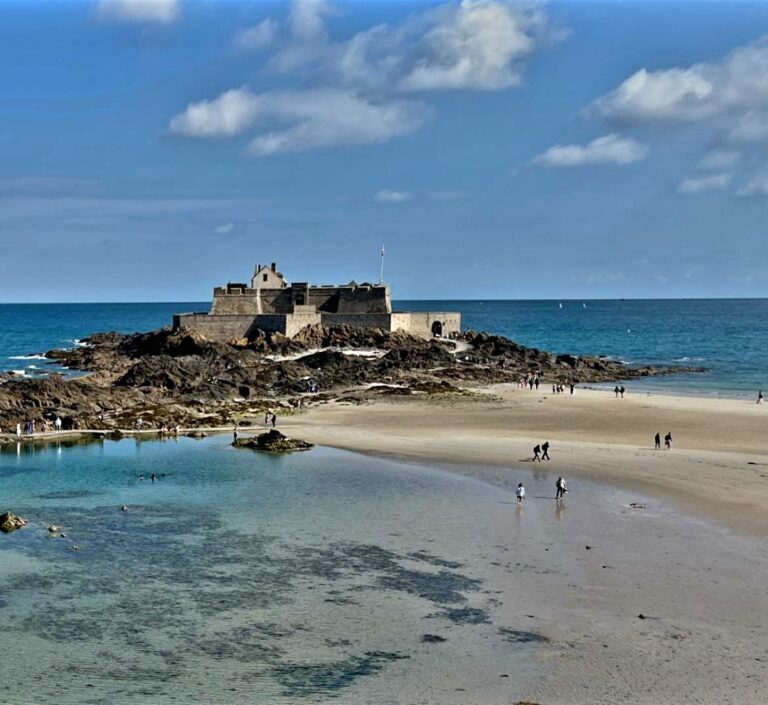
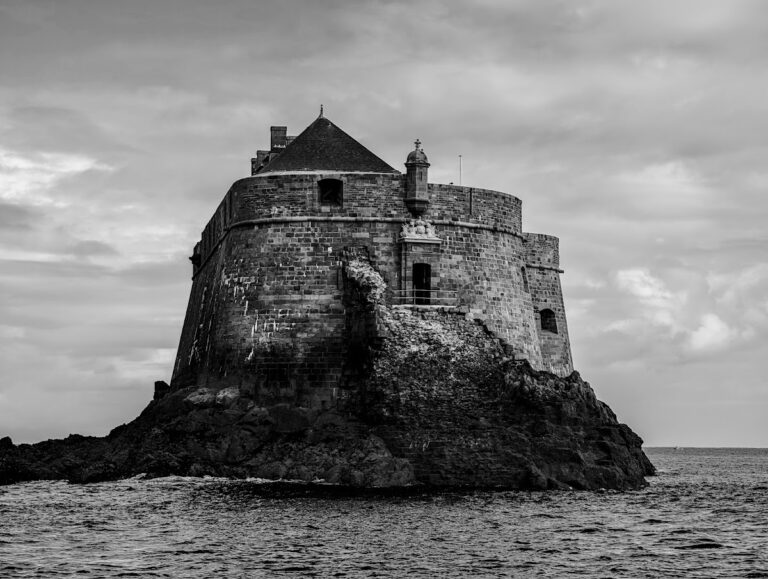
Fort Du Guesclin is a coastal fortification on the Île du Guesclin near Saint-Coulomb, France, between Saint-Malo and Cancale. The site lies in the English Channel and becomes accessible from the mainland at low tide. Its earliest fortification date is uncertain, with proposed dates of 1026 or 1206, and the stronghold was associated with the du Guesclin family.
Medieval stronghold
The early castle-fort comprised a keep, the principal fortified tower of a medieval castle, three towers, two concentric defensive enclosures, and a deep cistern. The cistern is described as 33 metres deep, while the enclosure walls are also said to have reached up to 33 metres in places. The relationship between these two measurements remains uncertain.
In 1207, John Lackland, king of England, occupied the fort. Juhel III of Mayenne expelled the English after heavy fighting. Around 1259, the du Guesclin family abandoned the exposed island and settled inland at Plessis-Bertrand, which had been built by an ancestor of Bertrand du Guesclin. The earlier fort was later dismantled.
Ownership and eighteenth-century rebuilding
Guillaume de Châteaubriant acquired the dismantled fort in 1500 and sold it to the House of Rieux in 1589. Between 1757 and 1759, the earlier construction was demolished and replaced with a coastal fortification built under the direction of Vauban, the prominent French military engineer Sébastien Le Prestre de Vauban. The new fort was intended to protect the coast against the English.
Its military function ended in 1826, when the fort was sold to private buyers at auction. Civilian owners transformed it into a holiday residence by adding two residential wings to the former garrison. During construction of the Atlantic Wall, the German defensive system established along the western European coast during the Second World War, German forces occupied the fort in 1942. They modified its former loopholes, narrow openings used for observation or firing, and installed an anti-aircraft gun.
Residence and preservation
After the Allied landings in 1944, Fort Du Guesclin returned to civilian ownership. The mayor of Saint-Servan initially owned it and sold it in 1959 to Léo Ferré, a French-Monégasque singer-songwriter, composer, and poet. Ferré lived there until 1968 with his wife Madeleine, Annie, and Pépée, a female guenon, or monkey. He composed numerous songs at the fort, including La Mémoire et la Mer.
Following Ferré’s departure and a difficult division of the estate, the fort was abandoned. The Porcher family bought it from Ferré’s heirs in 1996, restored the building, and has maintained it as a private residence. The association Les Amis de l’Île du Guesclin was founded in 2012 to promote the island’s heritage and participate in its restoration. Fort Du Guesclin is included in France’s General Inventory of Cultural Heritage.
Remains
Fort Du Guesclin occupies an islet in the English Channel that can be reached overland at low tide. Its surviving fabric combines elements of the medieval stronghold, the eighteenth-century coastal fort, and later residential adaptations. The military structures have been altered and partly incorporated into a residential building, while some remaining military features survive in ruins.
Earlier fortified remains
Medieval stronghold
The first fortification was arranged around a keep, three towers, and two concentric defensive enclosures. A cistern supplied the stronghold with stored water and is described as 33 metres deep. The enclosure walls are also said to have measured up to 33 metres in places, although the connection between that figure and the cistern’s depth is uncertain. The earlier fort was later dismantled, and its remains form part of the site’s layered military history.
Eighteenth-century and later structures
Coastal fortification
The fortification rebuilt between 1757 and 1759 included a barracks, a powder magazine for storing gunpowder, and gun platforms for coastal defence. These features belonged to the fort’s renewed military role under Vauban’s direction. The surviving military fabric has since been altered, and some structures remain in ruins.
Residential and wartime adaptations
The former garrison was incorporated into the present residence, whose two residential wings were added by civilian occupants after the fort left military service. In 1942, German forces altered the former loopholes and installed an anti-aircraft gun during the fort’s occupation. These interventions remain part of the building’s later physical history.
Nearby sites