Fort National: Saint-Malo’s Coastal Defense Fort in France


Site at a Glance
- Rating
- 4.5
- Popularity
- Medium
- Country
- France
- Primary era
- Early Modern
- External website
- Open
- Eras represented
- Early Modern, Modern
- Civilizations
- French
- Site type
- Military
- Remains
- Fort
On this page11 sections
History
Fort National is a coastal defense fort in Saint-Malo, France, built for Louis XIV as part of the late seventeenth-century strengthening of the city’s defenses. Designed by the military engineer Vauban, whose work shaped many of the fortified defenses of Louis XIV’s kingdom, it was constructed under the supervision of Siméon Garangeau between 1689 and probably 1693. The fort guarded Saint-Malo’s port and wealth against a possible English invasion and served as an advanced position within the city’s wider defensive system.
Louis XIV’s defensive project
Fort National formed part of a chain of fortifications extending from Fort-la-Latte to Pointe de la Varde. It was also one of five coastal forts protecting Saint-Malo. Its position on Îlette Rock allowed it to support the defenses of the port and the approaches to the walled city. Before the fort was built, the rock carried a nighttime beacon to guide ships through the rocky bay. It was also used for public executions under the former local jurisdiction of Saint-Malo, and a gallows later stood there.
The fort entered active service during the Anglo-Dutch attack on Saint-Malo in 1693. On 26 November, an Anglo-Dutch fleet appeared off Cap Fréhel and then moved toward the city. The attackers later captured Fort de la Conchée and Cézembre, but Fort National was never taken during its earlier military history. Its weapons during the attack comprised 14 guns mounted on naval carriages and three mortars. A vessel carrying gunpowder ran aground before it reached the city, causing no significant damage.
Changing names and later defenses
The fort was first known as Fort Royal. In 1789 it became Fort d’Îlette or Fort Républicain, and during the First and Second Empires it was called Fort Impérial. After 1870, it received the name Fort National. This succession of names produced the nickname “Chameleon Fort,” linking the building’s identity to the political changes that affected France.
Its defenses were altered in 1848. A wall enclosing about three-quarters of the fort was added and pierced for small arms, protecting the position against infantry approaching from land or landing on the surrounding rocks. A small bastion, a projecting section that allowed defenders to fire along adjacent walls, was also built in front of the entrance. Together, these changes brought the fort’s total area to approximately 4,000 square metres.
War, imprisonment, and restoration
German forces controlled the Saint-Malo coast from the end of June 1940, and work associated with the Atlantic Wall, Germany’s system of coastal defenses against an Allied invasion, intensified in 1942. Fort National was used as a German prison and hostage-holding site.
After Allied bombardment of Saint-Malo began on 6 August 1944, the German commander imprisoned 380 men from the city in the fort as hostages. Eighteen prisoners were killed by Allied shellfire during the night of 9 to 10 August. Food supplies ran out on 11 August, and on 13 August another 150 elderly men and women were added to the group. That evening, the prisoners were permitted to leave during a one-hour truce.
The American 83rd Infantry Division liberated Saint-Malo and Fort National on 16 August 1944. Allied shellfire had damaged the structure, although it remained largely intact. The fort was later restored in accordance with Vauban’s plans. A commemorative plaque inside honors the 18 prisoners who died during the bombardment.
Fort National was recognized as a historic monument in May 1906, while its enclosing wall received separate protection in August 1913. The government sold the fort to a private buyer in 1927. It remains privately owned and is also used for accommodation.
Remains
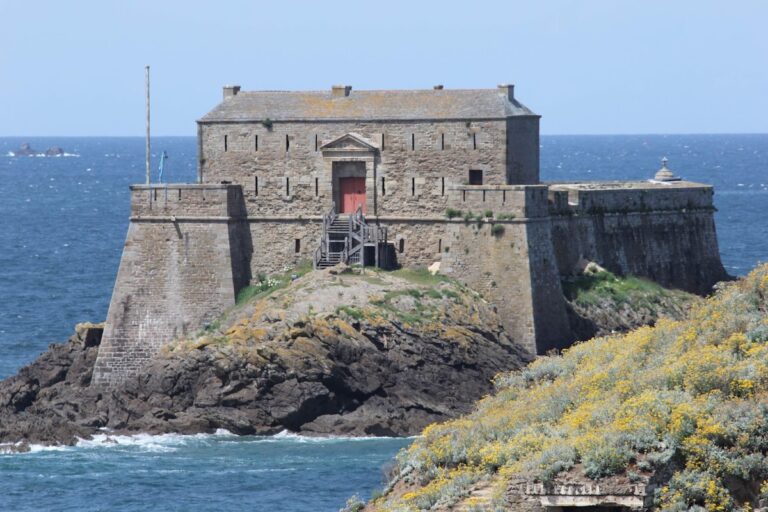
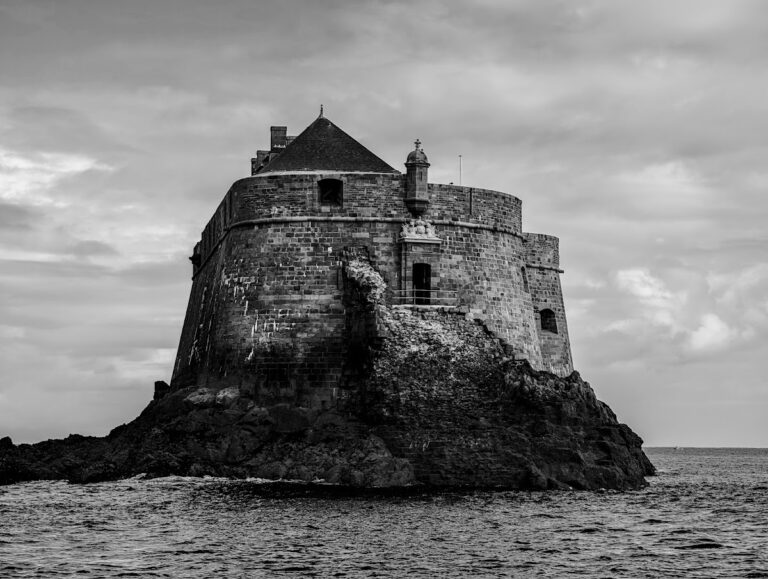
Fort National stands on Îlette Rock, a tidal islet a few hundred metres from Saint-Malo’s walled city, opposite Éventail Beach and the city’s northern walls. The granite fort occupies a position within the rocky bay and can be reached on foot at low tide. Its surviving layout combines the original quadrangular stronghold with later defensive additions, enclosing roughly 4,000 square metres.
Outer defenses and entrance
Original fort and gate
The original fort was a quadrangular granite structure. Two half-bastions protected its southern side, each combining a full flank with a shortened flank so defenders could direct fire along the neighboring walls. A dry moat separated the fort from the approach, and a drawbridge led across it to the gate.
Enclosing wall and 1848 bastion
A double defensive wall surrounds the position. The outer wall was intended to shield the base of the main fort from enemy cannon fire. In 1848, a further wall enclosed about three-quarters of the fort and carried openings for small-arms fire. A small bastion was placed before the gate at the same time, strengthening the landward approach and the rocky approaches around the islet.
Internal buildings and military equipment
Quarters and water supply
Inside the fort, a long building provided quarters for officers and troops and included rooms for equipment. An underground cistern collected water from gutters and held 50,000 litres. It could be reached through both a trapdoor and a well, integrating water storage into the fort’s internal arrangements.
Magazine and lookout structures
Ammunition was kept in an underground bomb-proof magazine, a protected store designed to withstand explosive impact. Its vaulted ceiling and thick masonry formed the principal safeguards, while angled openings supplied light and air. The fort also contains a guardhouse, a sentry post giving access to the powder magazine, and a sentry turret on the outer rampart.
The fort was only slightly damaged during the Second World War and remained largely intact after restoration. The plaque commemorating the 18 prisoners killed in August 1944 forms part of the surviving site and preserves the memory of the fort’s wartime use.
Nearby sites