Kirnburg: A Medieval Spur Castle in Germany


Site at a Glance
- Rating
- 4.5
- Popularity
- Low
- Country
- Germany
- Primary era
- Medieval
- External website
- Open
- Eras represented
- Medieval
- Civilizations
- Habsburg, Holy Roman Empire
- Site type
- Military
- Remains
- Castle
On this page8 sections
History
Kirnburg is a medieval castle ruin near Herbolzheim in Germany, probably built around 1200 by Rudolf I of Üsenberg, a nobleman of the Üsenberg family. Its oldest section belonged to the castle’s initial foundation, and the site was recorded in 1219 as “castro nostro Kvrinberc.” During the thirteenth century, the lords of Üsenberg enlarged the outer bailey.
Üsenberg and Hachberg control
In 1352, Kirnburg and its associated lordship passed to Heinrich IV of Hachberg, who temporarily lived at the castle. Twenty years later, during the Habsburg takeover of the Landgraviate of Breisgau, the lordship of Kürnberg passed to the Habsburg dukes Albrecht and Leopold of Austria. The castle remained a Habsburg fief, a property granted to a subordinate in return for service while certain rights stayed with the superior lord, until the end of Vorderösterreich, the Habsburg possessions in southwestern Germany and nearby regions.
Pledges and final medieval expansion
In later centuries, the castle and lordship were pledged to several regional noble families and individuals. These included the Freiburg family Schnewlin-Landeck, the knight Martin Malterer, and Konrad von Weinsberg. From 1424, the bishops of Strasbourg held Kirnburg as a pledge. They expanded the castle for the final time and strengthened its defenses according to contemporary military practice. Valuable stove tiles from this Strasbourg period have survived.
Destruction and conservation
In 1515, Wolf of Hürnheim zum Tuttenstein acquired Kirnburg as a fief. By the beginning of the Thirty Years’ War, a major European conflict from 1618 to 1648, the castle was already in poor condition. Troops passing through under Duke Bernhard of Weimar captured it quickly and razed it.
The ruin remained a fief of the Counts of Kageneck from 1682 until 1967, when it passed to the state of Baden-Württemberg. The site was cleared in 1938. Safeguarding and conservation work has continued since 1978 to preserve Kirnburg as a historic monument.
Remains
Castle layout and defenses
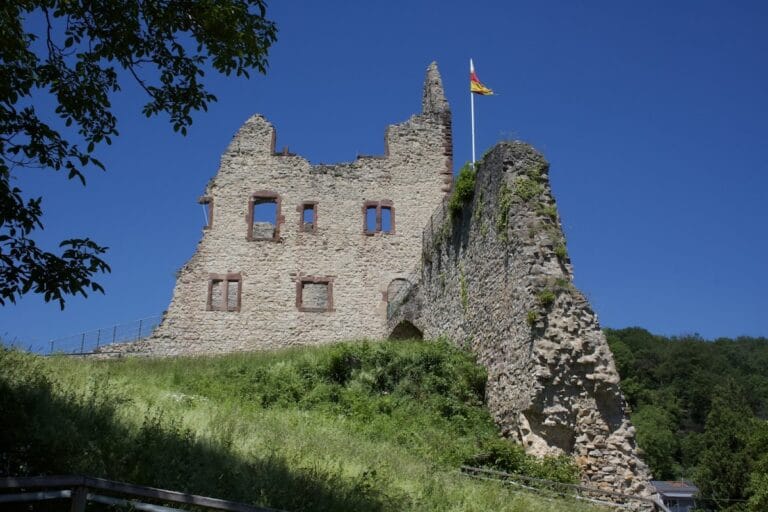
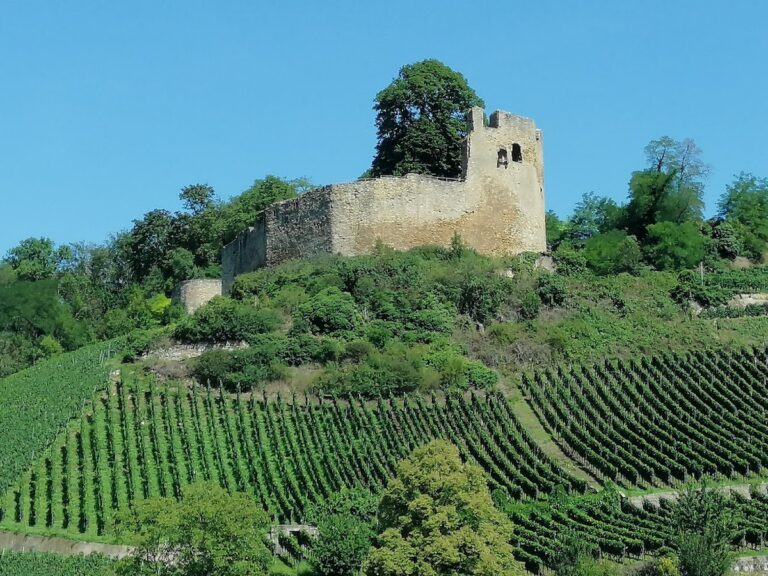
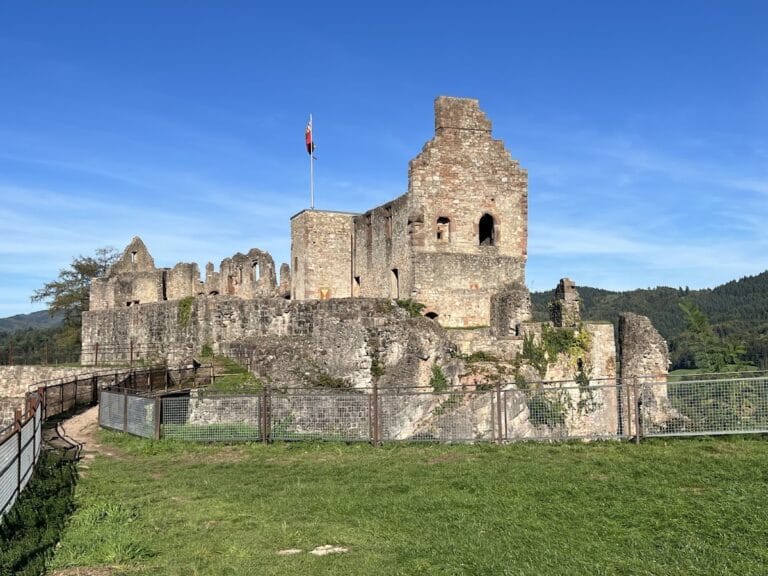
Kirnburg occupies a mountain spur of the Kirnberg at an elevation of 382.5 metres, approximately 500 metres east of Bleichheim, a district of Herbolzheim. The spur castle covered an area of about 60 by 80 metres. Its position shaped the defensive arrangement, with the core castle occupying the main area, an outer bailey extending to the west, and a neck ditch cut across the southern side of the spur to separate and protect the castle.
Core castle
The core castle contained service buildings, a palas, and a shield wall. The palas was the principal residential and representative building of a medieval castle. On the north side, it formed part of the main built complex, while the shield wall, a particularly strong section of curtain wall, was 2.3 metres thick and protected the most vulnerable side of the castle.
Keep
The keep had a ground plan of approximately 10 by 10 metres, with walls about one metre thick. This fortified tower served primarily as a defensive and status-building structure rather than necessarily as a permanent residence. Together with the castle walls and the neck ditch, it formed part of the surviving evidence for Kirnburg’s defensive organization.
Nearby sites