Fort de la Chartreuse: A Dutch Military Fortress in Liège


Site at a Glance
- Rating
- 4.5
- Popularity
- Low
- Country
- Belgium
- Primary era
- Modern
- External website
- Open
- Eras represented
- Early Modern, Modern
- Civilizations
- Dutch, Holy Roman Empire
- Site type
- Military
- Remains
- Fort
On this page12 sections
History
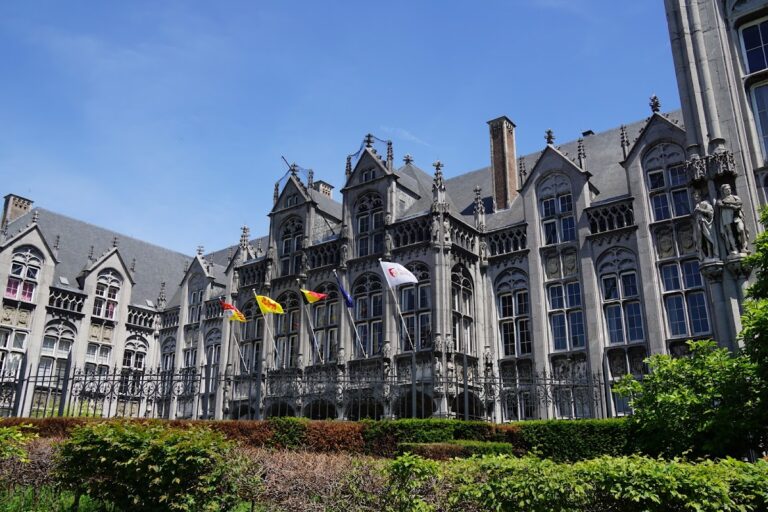
Fort de la Chartreuse is a Dutch-built fortress in Liège, Belgium, constructed between 1817 and 1823 in the military architecture of the United Kingdom of the Netherlands. It occupies Mont Cornillon above the Meuse valley and was built as part of the Wellington Barrier, a system of fortifications established after 1815 to protect the southern Netherlands from French attack. Although it was one of the largest Dutch military works, the fort never assumed an important strategic role.
Monastery and Revolutionary War
Mont Cornillon had been occupied by a Premonstratensian monastery since 1124. Premonstratensians belonged to a religious order founded by Norbert of Xanten. Carthusian monks took over the monastery in 1360, and the later fortress inherited its name from this Carthusian community, whose members followed a contemplative religious order.
The monastery’s position on the hill gave Mont Cornillon military importance during the French bombardment of Liège in 1691. The Carthusians left in 1793. The following year, during the French advance, the Habsburg army used the hill as part of a defensive line along the Meuse and Ourthe.
Dutch Fortress and Belgian Barracks
After the Congress of Vienna in 1815 assigned the former Principality of Liège to the United Kingdom of the Netherlands, Dutch authorities reoccupied Mont Cornillon. King William I ordered the construction of the present fort, completed between 1817 and 1823 to defend Liège and protect the city. The United Kingdom of the Netherlands joined the northern Netherlands with the former Austrian Netherlands, including present-day Belgium, and lasted until the Belgian Revolution of 1830.
After the revolution, the fort passed to the Belgian state. The Belgian army used it as a barracks associated with the Fortified Position of Liège, Belgium’s organized defensive system around the city. Between the two world wars, approximately 2,000 men were stationed in the fort and surrounding buildings. The construction of twelve modern forts around Liège in 1888 reduced Chartreuse’s military importance. A royal decree declassified it as a defensive work in 1891, after which it was converted into a barracks.
War, Prison, and Hospital
During the Battle of Liège in the First World War, the hills east of Chartreuse were captured on 7 August 1914 after heavy fighting at Queue-du-Bois. Chartreuse was occupied the next morning, and German forces entered Liège over two bridges that had not been destroyed.
German forces used the fort as a prison from 1914 to 1918 and again from 1940 to 1944. During the First World War occupation, 48 prisoners were executed and buried on the grounds. After the liberation, the United States Army’s 28th General Hospital occupied the buildings from 26 September 1944 to 5 July 1945, using them as a military hospital.
Demilitarization and Conservation
As the site became less useful to the Belgian Ministry of National Defence, demilitarization began in 1981. Units moved to other barracks from 1982, and the last military personnel left by 1988.
Private associations, including nature-protection and neighborhood groups, had campaigned since 1986 to conserve and renovate the monastery and fort. In 1988, the WWF and Études & Environnement organized a work camp whose first restoration and adaptation projects included the galleries, intended for use as a winter refuge by cave-dwelling species. Later that year, Liège’s municipal council decided to establish an educational reserve on the estate and entrusted its management to Éducation-Environnement.
The Conservation Foundation awarded its national prize in 1990 to the “Aménagement de la Chartreuse” project led by Études & Environnement. In 1991, 40 hectares of the former military estate received legal protection as a site. The City of Liège acquired the complex’s green areas in 1998, supporting the associations involved in its conservation. The fort is abandoned, and its condition has deteriorated rapidly since 2010; its upper floors are no longer safe to enter.
Remains
Fort de la Chartreuse occupies the strategic height of Mont Cornillon above the Meuse valley, overlooking Liège’s Amercœur neighborhood. Built in brick masonry, it follows Dutch military planning and combines a central keep, barracks buildings, a courtyard, ramparts, a glacis, internal galleries, and a redan. A glacis is a gently sloping area outside a fortification, designed to expose attackers to defensive fire, while a redan is a projecting, usually angular defensive work.
Central Fortifications
Central Keep and Barracks
The central keep forms the strongly fortified core of the larger complex. Its bombproof barracks were later enlarged by adding two storeys, creating the principal mass of the surviving fortress. The keep is integrated with the courtyard, ramparts, and other defensive elements that organize the fort’s interior and perimeter.
Ramparts, Glacis, and Galleries
Vegetation covers the ramparts and glacis, while much of the former military estate has become a green area undergoing reforestation. Ash and sycamore maple are well represented in the woodland, with oak also among the notable species; hornbeam and beech are considerably rarer. Internal galleries form another part of the fort’s structure. Restoration and adaptation works carried out in 1988 prepared them for use as a winter refuge for cave-dwelling species.
Earlier and Commemorative Features
Monastery Walkway
A fortified walkway associated with the seventeenth-century monastery survives among the site’s documented features. It preserves a physical connection with the religious occupation of Mont Cornillon that preceded the nineteenth-century fortress.
War Memorials
A monument beside the fort entrance bears the names of the 48 prisoners executed and buried on the grounds during the First World War. The site also contains a monument associated with the 3rd Engineer Regiment.