Fort Carré: A Sixteenth-Century Military Fortification in Antibes


Site at a Glance
- Rating
- 4.3
- Popularity
- Medium
- Country
- France
- Primary era
- Early Modern
- External website
- Open
- Eras represented
- Early Modern
- Civilizations
- French
- Site type
- Military
- Remains
- Fort
On this page8 sections
History
Fort Carré is a sixteenth-century military fortification in Antibes, France, built under Henry II during a period of tension between the French kingdom and the Duchy of Savoy. It was conventionally dated to 1553 and served as a lookout over the Var River frontier, using its elevated position to monitor movement and deter attacks.
Construction on the Savoy frontier
The sack of Antibes by Spanish forces in 1524 and 1536 demonstrated the vulnerability of the southeastern coast. Henry II, king of France from 1547 to 1559, ordered a fort at a strategic position overlooking the frontier with Savoy. Construction began around 1550 or in the early 1550s, although the precise sequence of work remains approximate and has been reconstructed through the study of the building itself.
The fort was probably attributable at least in part to Jean de Renaud, also known as Jean de Saint-Rémy, an artillery official and engineer. Local tradition also connects the work with François de Mandon, a military engineer in Provence. The project began with the central tower, which occupied the site of the demolished chapel of Saint-Laurent. The chapel’s name passed to the tower, which remains known as the Tour Saint-Laurent.
Four bastions were added in 1565, giving Fort Carré its essential star-shaped form. The initial construction extended over about twenty-five years, and the design was altered in 1585 to accommodate sixteen cannon. The fort then became a defensive installation that remained in military service for more than three centuries.
Attacks and military use
Fort Carré was attacked only twice. In 1591, during the Wars of Religion, Charles-Emmanuel I, Duke of Savoy, captured Antibes and its stronghold without a fight. A French army sent by Henry IV besieged the town and fort in 1592, after which the Duke of Épernon retook them.
During the War of the Austrian Succession, a conflict over the Austrian succession that involved several European powers, Austro-Sardinian artillery and the English fleet bombarded Antibes and Fort Carré in 1746 and 1747. The fort withstood the attack. In July 1794, during the French Revolution, Napoleon Bonaparte was held there for ten days as a suspected Jacobin sympathizer after Robespierre was overthrown. He was released through the intervention of Antoine Christophe Saliceti.
After Napoleon’s defeat at Waterloo in 1815, Austro-Sardinian forces occupied Fort Carré without a fight. They used it to bombard Antibes and tried to force the city to open its gates, but Antibes refused and remained loyal to Louis XVIII.
Changing strategic role and preservation
The annexation of Nice to France in 1860 and advances in military technology reduced the fort’s strategic importance. Fort Carré and the wider stronghold of Antibes were decommissioned around the turn of the twentieth century, while parts of the town’s ramparts were demolished. Soldiers were stationed at the fort briefly during the First World War. During the Second World War occupation, it served as a gathering center for foreigners from throughout the Alpes-Maritimes, its last military use.
Fort Carré received historic-monument protection through orders issued on 7 November 1906 and 20 August 1913, later modified in 1937 and 1976. The protection also covers the outer enclosure known as the Fort de la Presqu’île or Fort Reille. In 1967, the fort was assigned to the Ministry of Youth and Sports and managed through the regional youth and sports administration of the Nice academy. Military and sports schools, training activities, and cultural initiatives used the site during the twentieth century.
Between 1979 and 1985, members and volunteers of the Club du Vieux Manoir, a French heritage organization involving young volunteers in the restoration of historic buildings, repaired the façades and roofs and created an access route through the fort. The city of Antibes acquired Fort Carré from the Ministry of Youth and Sports in 1997.
Remains
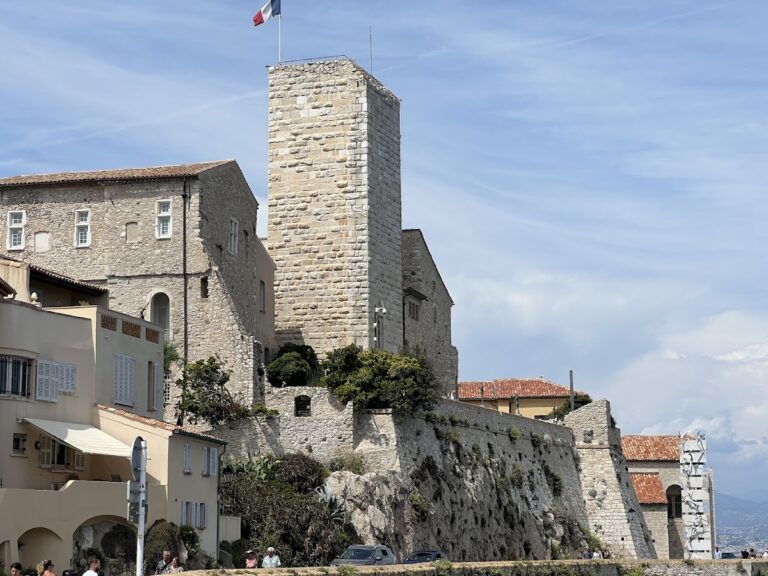
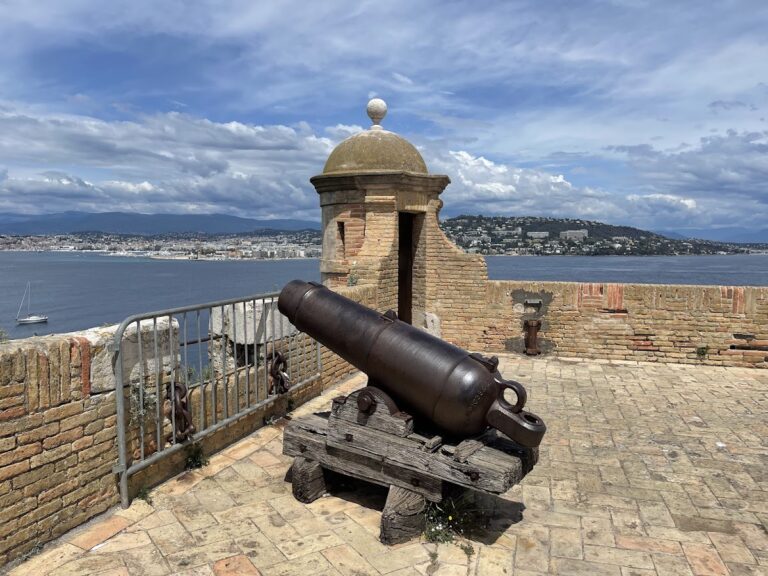
Fort Carré stands on the Saint-Roch peninsula, on a rocky promontory about 26 metres above the sea. Its four-pointed plan consists of a central tower enclosed by a square bastioned fortification and four arrowhead-shaped bastions, projecting structures with two outward-facing sides. The bastions are named Antibes, France, Corsica, and Nice. The fort’s general silhouette remains largely that established in the sixteenth century.
Central tower and bastioned enclosure
The Tour Saint-Laurent occupies the site of the former Saint-Laurent chapel and was probably the first element built. It was later incorporated into the square enclosure. The fort contains barracks for officers and soldiers, while its rampart walkways reach approximately 43 metres above sea level. Together, the tower, enclosure, and four bastions form the principal surviving defensive arrangement.
Entrances and defensive improvements
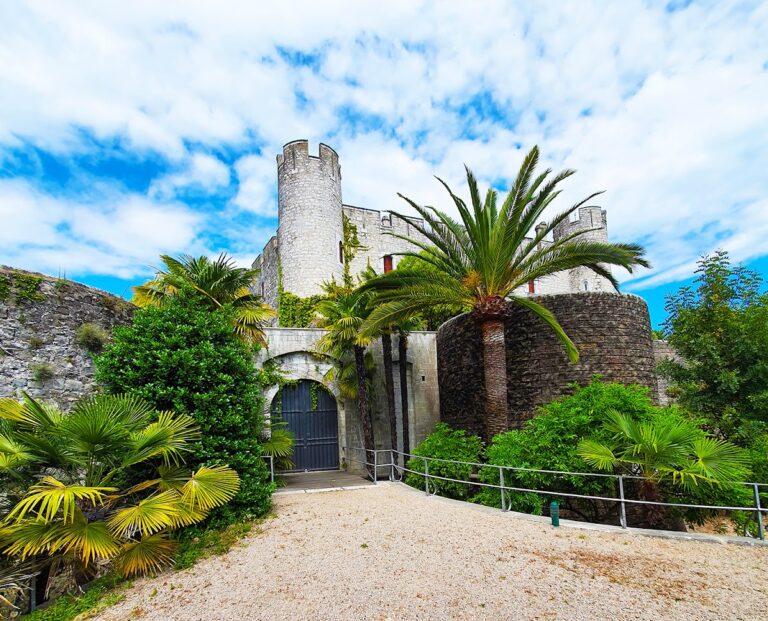
The original entrance retained a medieval character, with an elevated doorway placed beneath the protective fire of the orillons, projecting parts of a bastion that shield its flank. The present approach passes through a projecting triangular work with a heavy wooden door. A narrow bridge then leads into the fort through the flank of one bastion.
Vauban, France’s leading seventeenth-century military engineer, inspected Antibes in 1679 and 1682 and revisited the fort in the early eighteenth century. His program altered the defenses without substantially changing their overall outline. Antoine de Niquet supervised several works, including repairs to rooms, floors, and chimneys, granite reinforcement at bastion angles, traverses, protective walls or mounds that limited ricochet fire, brick replacements for the stone parapet tops, enlarged embrasures, and added outer walls.
Vauban’s plans also proposed better water collection and water quality, the restoration of older window openings, and sentry boxes on the bastions. Only a limited number of these proposals were carried out, but the completed changes remain part of the fort’s later defensive fabric.
Later military and sports complex
A stadium built in 1920 and the Reille barracks formed part of the later military and sports complex associated with Fort Carré. The site also contained an obstacle course and a training course for climbing, balancing, and rappelling exercises. These additions reflect the fort’s twentieth-century use for military and sports instruction after its main role as a frontier stronghold had declined.
The fort lies within a protected natural environment forming part of the Natura 2000 area Baie et Cap d’Antibes–Îles de Lérins and a natural area of ecological, faunal, and floral interest known as a ZNIEFF.
Nearby sites