Fort 44 “Tonie”: An Austro-Hungarian Artillery Fort in Kraków


Site at a Glance
- Rating
- 4.4
- Popularity
- Low
- Country
- Poland
- Primary era
- Modern
- External website
- Open
- Eras represented
- Modern
- Civilizations
- Habsburg
- Site type
- Military
- Remains
- Fort
On this page11 sections
History
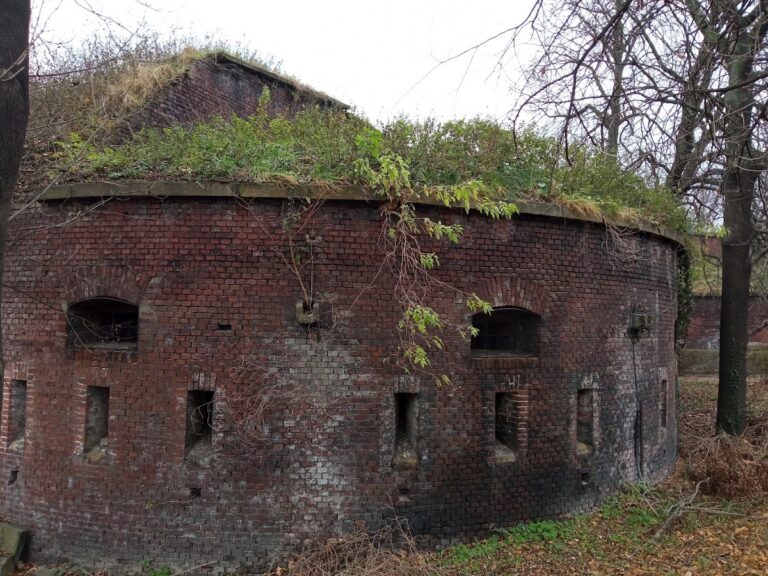
Fort 44 “Tonie” is an Austro-Hungarian artillery fort in Kraków, Poland, built in 1878 and later rebuilt in the Austrian school of fortification. It formed part of Sector IV of Kraków Fortress, the fortified defense system centered on Kraków, and protected the Olkusz route and the hilltop approach from Giebułtów.
Construction and place in Kraków Fortress
The fort began as a provisional earth-and-timber redoubt for the Austro-Hungarian Army. Between 1883 and 1885, it was rebuilt as a permanent artillery fort. Major alteration phases followed in 1881–1883, 1906–1909, and around 1915, while a comprehensive modernization took place from 1902 to 1908.
Fort 44 “Tonie” worked with Fort Marszowiec to block the Prądnik Valley with flanking fire. After 1897, the newly built close-defense armored Fort 44a “Pękowice” took over this latter task. By 1914, despite limitations in its armament, Fort 44 “Tonie” ranked among the most modern and strongest positions in Kraków Fortress. It did not fight during the First World War because the battles took place farther away, beyond the effective range of its guns.
Military use in the twentieth century
During the interwar period, the Polish Army may have used the fort for residential or barracks purposes. In September 1939, units of Colonel Klaczyński’s Fortress Group temporarily occupied it, and the fort helped cover the retreat of the Kraków Army. The alleged destruction of two German armored cars in the foreground has not been confirmed.
During the German occupation, the fort stored captured small arms. In unclear circumstances, blasting and the scrapping of parts of its armor damaged the structure. After the Second World War, it remained in military use for many years and housed magazines for explosive materials. The military abandoned it in the early 1990s, after which it stood unused until 2008 while remaining continuously guarded.
Fort 44 “Tonie” entered the heritage register under number A-1137 on 15 September 2005. Its recorded owners were successively the Austro-Hungarian Army, the Polish Army, and the State Treasury.
Remains
Fortifications and artillery positions
Earthworks and artillery rampart
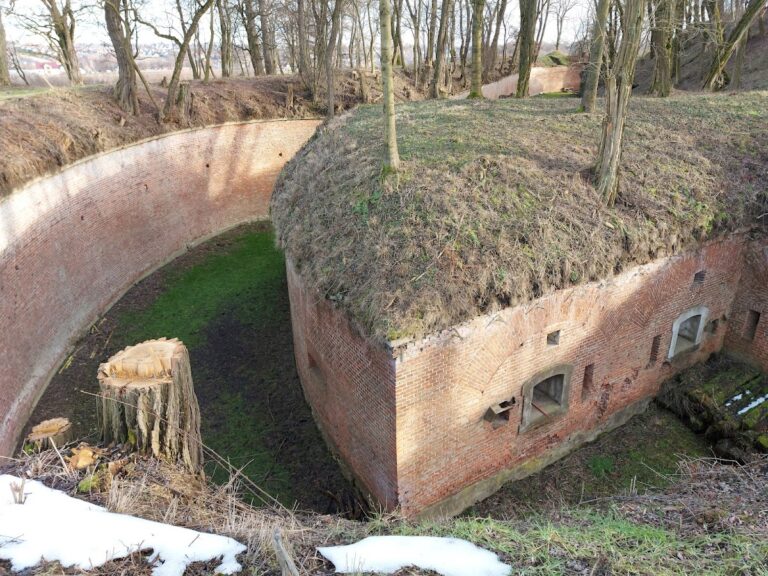
The fort stands on Jurajska Street in Kraków. Its original earth-and-timber form was replaced by a permanent artillery structure in 1883–1885. During the 1902–1908 modernization, the artillery rampart was completely reshaped. Gun emplacements and traverses containing readiness shelters were removed, and the rampart was adapted for infantry use.
Armored batteries
Two armored batteries were installed during the modernization. Each contained two retractable-rotating Senkpanzer M. 2 turrets, armored turrets that could be lowered into the fort, armed with 8-centimeter guns. The fort later lost the body and cover of one turret.
Frontal shelter and traditor
A frontal shelter on the rampart received an armored cupola, an armored dome for observation or weapons, while a traditor, a gun position designed for lateral fire along an approach, carried four 8-centimeter guns. The traditor lost its armored shields. Six 15-centimeter guns stood in open positions in a battery at the center of the fort, and casemate guns defended the moats.
Buildings and internal communications
Shelter blocks and barracks
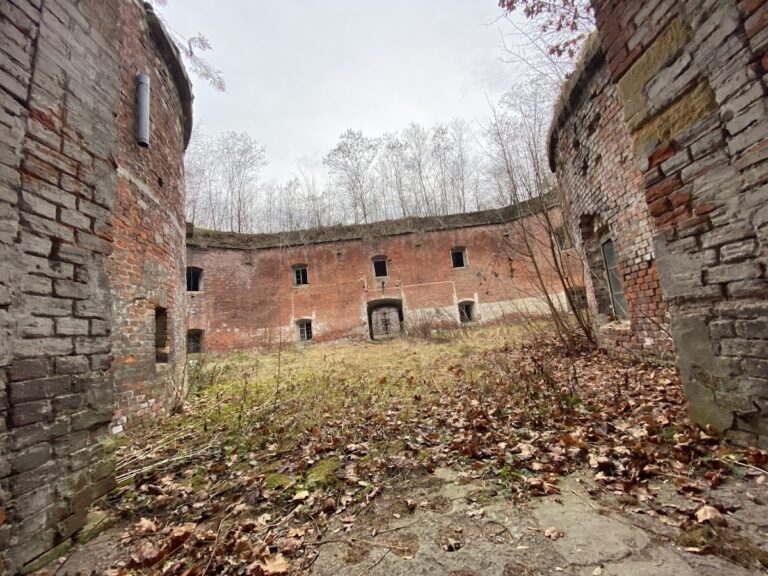
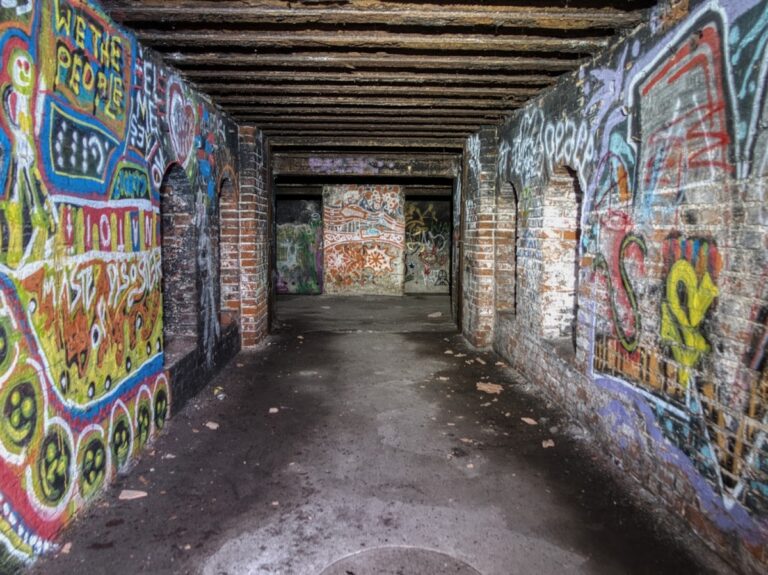
The gorge barracks block and the main shelter block were structurally reinforced. The internal communication system was also altered. A protected passage, or postern, linked the new frontal shelter on the rampart with the central readiness shelter of the open battery and the fort’s main postern.
Observation structures and moat defenses
The fort lost the armored shields of its gorge caponier, a fortified structure beside a moat that provided defensive fire. One observation tower and both observation cupolas were blown up and displaced, but they remained on the fort grounds.