Vilkėnas Manor: A Neo-Renaissance Estate in Lithuania


Site at a Glance
- Rating
- 4.3
- Popularity
- Low
- Country
- Lithuania
- Primary era
- Modern
- External website
- Open
- Eras represented
- Modern
- Civilizations
- Russian
- Site type
- Domestic
- Remains
- Manor House
On this page9 sections
History
Origins and Broël-Plater ownership
Vilkėnas Manor is a nineteenth-century Neo-Renaissance estate in Lithuania, developed by the Broël-Plater family between 1880 and 1897. The Broël-Platers were an influential Polish count family whose earlier known origins lay in Westphalia. In the fourteenth and fifteenth centuries, members of the family served as Livonian Knights, a medieval Catholic military order active in the eastern Baltic, before settling in areas corresponding to present-day Estonia, Latvia, and Lithuania.
Vilkėnas Estate initially formed part of the Švėkšna Estate, which had been mentioned since 1695. Jerzy Broël-Plater, who lived from about 1760 to 1825, divided Švėkšna among his four sons in 1820. Stefan received Švėkšna, Jerzy received Gedminaičiai Manor, Kazimierz received Stemplių Manor, and Franciszek received Vilkėnas. Gedminaičiai Manor no longer survives.
When Franciszek Broël-Plater died in 1867, the estate passed to his son Aleksander. Between 1880 and 1897, Aleksander built the manor house. At the initiative of his wife, Maria, planting in the park also began in 1880. Their daughters were Olga, born in 1889, and Janina, born in 1890. In 1912, Janina married her second cousin Jerzy Broël-Plater, owner of Švėkšna Manor. Their son Aleksander was born in 1913.
War, reunion, and land reform
During the First World War, Jerzy Broël-Plater was mobilized and appointed chief of staff of the Pskov Reserve Brigade. He later served as assistant to the chief of cavalry in Luga, Russia. During the war, the German Baron Weitenhorst lived at both Švėkšna and Vilkėnas. Jerzy returned to Švėkšna in the summer of 1918.
After Aleksander Broël-Plater’s death in 1922, Vilkėnas passed to his daughter Janina. Since she was married to Jerzy, the Švėkšna and Vilkėnas manors were reunited as one estate. The land reforms of 1923 nevertheless reduced the family’s holdings substantially.
Nationalization and later institutional use
In 1940, Vilkėnas was nationalized, meaning that the state took over privately owned property as Soviet rule was established in Lithuania. Units of the Russian Army settled at the estate, and the Broël-Platers were expelled from the manor houses. During the German occupation, Aleksander Broël-Plater, who had been born in 1913, returned to the estates but lived at Švėkšna Manor, while Vilkėnas Manor was left to the Germans.
Several years after Aleksander’s departure, a children’s home was established at Vilkėnas Manor. The property later housed a sanatorium school until 1979, after which it was transferred to the Šilutė hydraulic transmission factory and subsequently abandoned. Buildings erected during the Soviet period damaged the estate’s original design.
In 1993, Vilkėnas Manor, its park, and several other estate buildings were returned to the legitimate heir, Countess Felicija Laimė Broël-Plater, the widow of Aleksander Broël-Plater. She paid for repairs to parts of the Švėkšna and Vilkėnas estates. The manor building is registered in Lithuania’s Registry of Heritage Buildings under unique object code 1016.
Remains
Manor house and grounds
Manor house
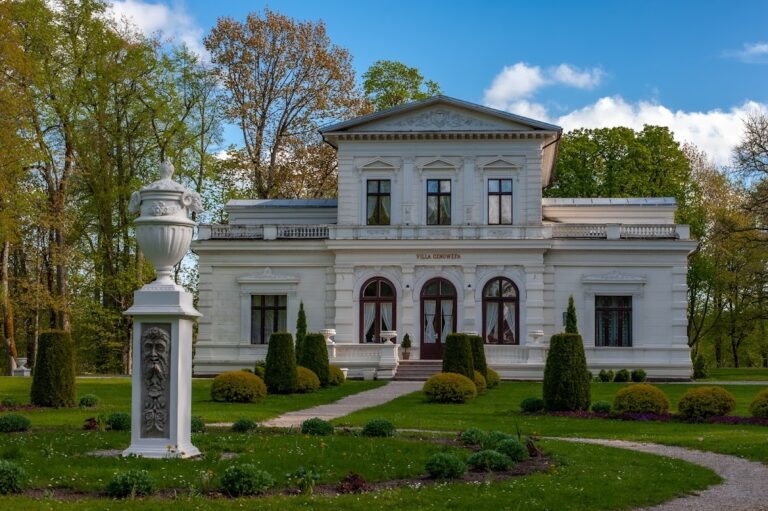
The manor house is a two-storey Neo-Renaissance building constructed on a high terrace between 1880 and 1897. Its design includes a tower, and the building was described as the most impressive of the former Broël-Plater estates in the Švėkšna district. It forms the principal architectural feature of the estate.
Park
The estate park covers 13 hectares and contains about 70 species of trees and shrubs, including rare trees. Planting began in 1880 at Maria Broël-Plater’s initiative, making the park part of the estate’s late nineteenth-century development.
Estate buildings
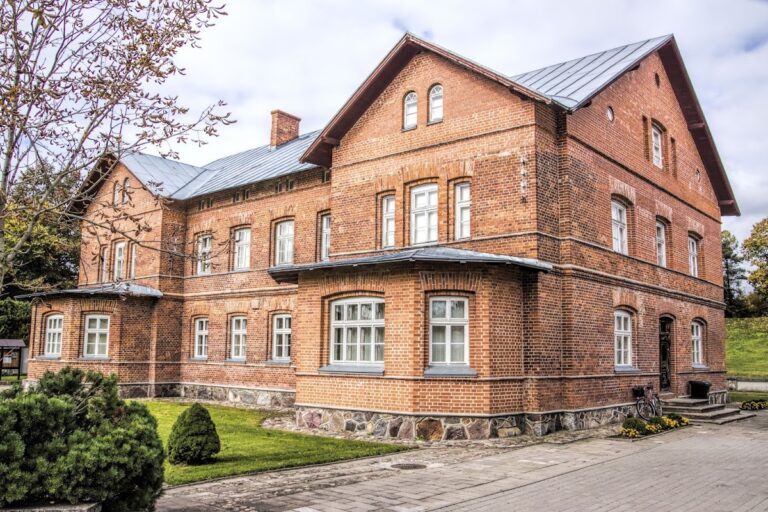
Several other buildings belonged to the estate. Later Soviet-period construction altered the grounds and destroyed the authentic design of the wider estate complex.
Nearby sites