Fort 4: A Brialmont Defensive Fort in Mortsel, Belgium


Site at a Glance
- Rating
- 4.3
- Popularity
- Medium
- Country
- Belgium
- Primary era
- Modern
- External website
- Open
- Eras represented
- Modern
- Civilizations
- Belgian
- Site type
- Military
- Remains
- Fort
On this page8 sections
History
Fort 4 is a nineteenth-century Belgian fort at Mortsel, Belgium, also known as Fort Kapitein Wagner. Built as part of the Brialmont belt, the defensive ring around Antwerp designed by military engineer Henri Alexis Brialmont, it formed part of the wider Antwerp fortress system. Construction began in 1859 and ended in 1864. The same year, Belgium decided to make Antwerp its National Redoubt, a final fortified area intended to shelter the government, army, or population when outer positions could no longer be held. This plan reflected Belgium’s neutrality and the expectation that its field army might not withstand an invading force until allied assistance arrived.
Construction and the Antwerp fortress system
Fort 4 was one element in a defensive network intended to protect Antwerp and preserve the city as Belgium’s last stronghold. Its position at Mortsel connected it to the surrounding forts of the Brialmont belt. The fort’s military design belonged to the nineteenth-century phase of Belgian fortress construction, while later improvements attempted to adapt it to the growing power of modern artillery.
In 1911 and 1912, unreinforced concrete strengthened parts of the fort. This material soon proved inadequate against the heavy artillery developed shortly before the First World War. Fort 4 consequently entered the conflict as an older defensive work whose protective arrangements faced weapons more powerful than those for which it had originally been designed.
Fort 4 during the First World War
During the Siege of Antwerp in 1914, British marines sent to the city were quartered at Fort 4. They travelled from Antwerp’s port to Fort 4 at Mortsel-Oude God in London double-decker buses. The episode survives mainly through written accounts, since no film footage remains and photographic material is scarce. British poet Rupert Brooke served at the fort as a sub-lieutenant with the Naval Brigade and described the confused evacuation that followed the German breakthrough. Winston Churchill, who had travelled to Antwerp to help oversee its defence, narrowly escaped when the city fell.
Fort 4’s direct military involvement was limited. On 8 October 1914, heavy artillery shelled Forts 3, 4, and 5, and a direct hit struck a battery on Fort 4’s terreplein, the level interior platform used for artillery batteries and other military installations. The garrison then left, and British forces took over the defence. Once Forts Walem and Sint-Katelijne-Waver had been disabled, the Antwerp fortress system could no longer be defended. Fort 4 was abandoned during the night of 8–9 October 1914.
Later military use and transfer
The fort’s military role formally ended in 1924, although it continued to serve as a barracks until that time. German forces later used it during the Second World War to store ammunition and aircraft bombs. Aircraft bombs struck the fort several times, and it was hit twice by V-weapons after Antwerp’s liberation. A V-weapon was a German long-range weapon, including the V-1 flying bomb and V-2 rocket.
After 1945, Fort 4 remained a storage facility for many years, including for the 99th Logistics Battalion. This prolonged use helped preserve much of its surviving fabric. The fort was definitively vacated on 30 August 2000, when its keys were formally transferred to the City of Mortsel. It now serves as a green area for sport, recreation, and cultural activities. Fort 4 also forms part of the Historical Fort Belts of Antwerp and is protected as a Natura 2000 habitat for bats under the European Union Habitats Directive. Management involves the Agency for Nature and Forests, Natuurpunt, and private owners.
Remains
Layout and defensive earthworks
Fort 4 follows the trapezoidal plan characteristic of the Brialmont forts. Its total area was approximately 35 hectares, with about 20 hectares enclosed within the moat. The moat is approximately 40 to 50 metres wide, and the Fortloop begins within it before running toward Fort 3, also known as Fort Luitenant Naeyaert, at Borsbeek.
The fort is organized around an outer glacis and an inner glacis. A glacis is a gently sloping bank of earth outside a fortification, designed to expose attackers to defensive fire while shielding the walls. The outer glacis remains permanently accessible, while access to the inner glacis varies. Together, these earthworks form part of the fort’s layered defensive arrangement and help define its relationship with the surrounding moat.
Buildings, materials, and armament
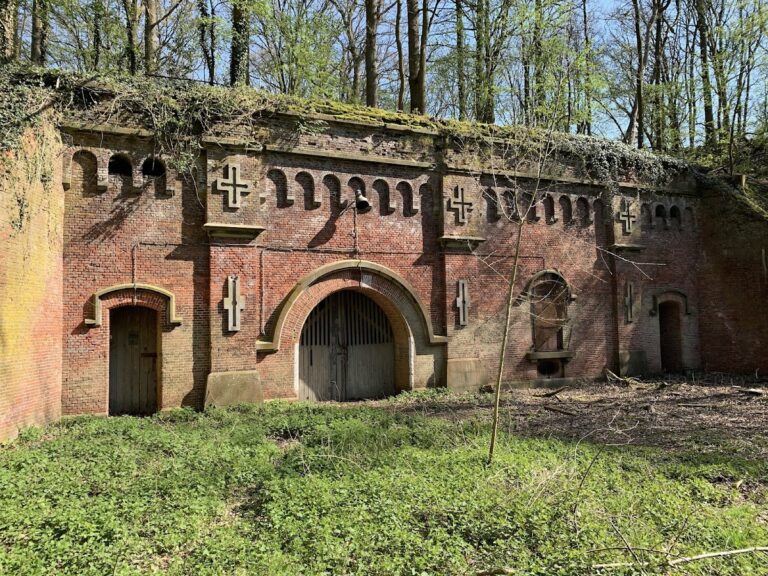
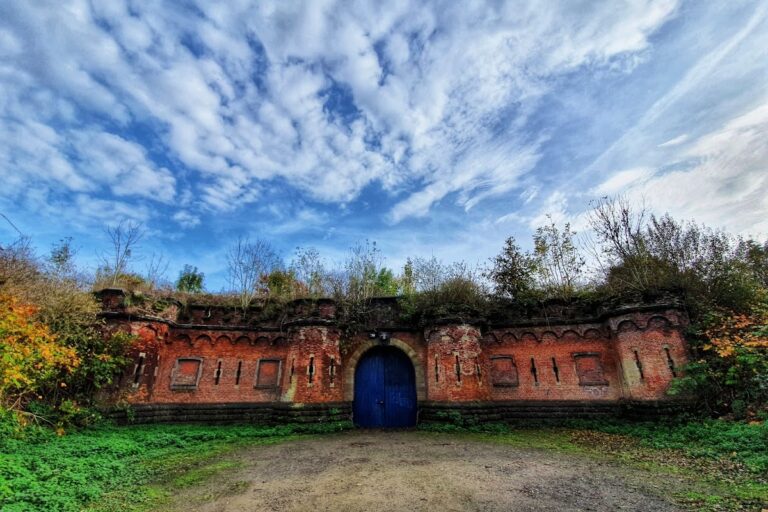
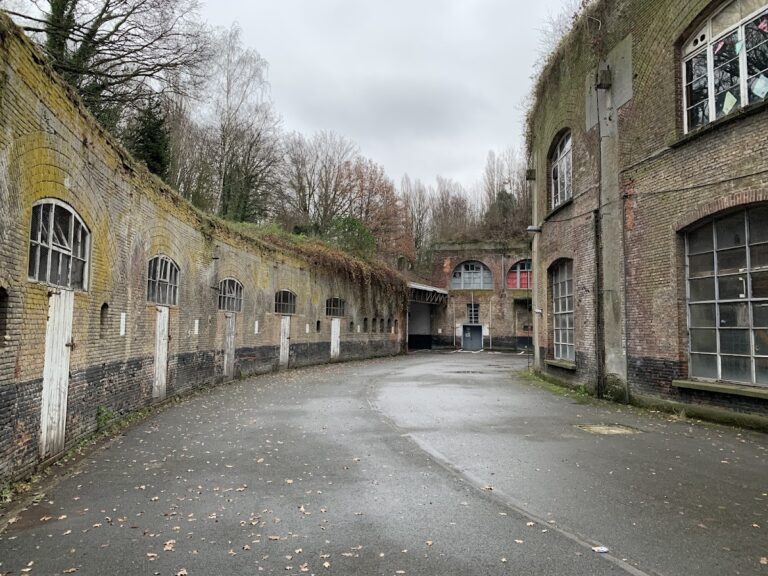
The original fort was built of brick. Unreinforced concrete added in 1911–1912 strengthened the earlier structure, although the material could not withstand the heavy artillery of the period. The surviving fabric is unusually well preserved, a condition linked to the fort’s long postwar storage use. The artillery arrangements also reflect its early place in the Antwerp system. Its guns were movable weapons, including a rifled 15-centimetre cannon and a smooth-bore 29-centimetre mortar.
The battery struck on 8 October 1914 stood on the fort’s terreplein, the level platform where artillery was positioned. That impact forms part of the surviving fort’s wartime history and connects the physical remains with the bombardment that preceded its abandonment. The later concrete strengthening and the continued survival of the brick construction show how the fort’s nineteenth-century fabric was adapted and retained through successive military phases.
Present cultural and natural setting
Fort 4’s preserved spaces now accommodate cultural and recreational activities within the green area managed after its transfer to Mortsel. A seasonal summer bar, Bar Brial, operates as part of this present use. The moat, glacis, surviving structures, and surrounding habitat remain connected to the fort’s earlier defensive design, while the Natura 2000 protection recognizes the importance of the site for bats.
Nearby sites