Saint Bridget Church: A Gothic Basilica and Solidarity Landmark in Gdańsk
Site at a Glance
- Rating
- 4.7
- Popularity
- Medium
- Country
- Poland
- Primary era
- Medieval
- External website
- Open
- Eras represented
- Medieval, Early Modern, Modern
- Civilizations
- Crusader, Kingdom of Poland, Polish–Lithuanian Commonwealth, Teutonic Order
- Site type
- Religious
- Remains
- Church
On this page16 sections
History
From Penitential Chapel to Bridgettine Monastery
Saint Bridget Church is a brick Gothic church in Gdańsk, Poland, founded beside Saint Catherine’s Church as a religious center associated with Saint Bridget of Sweden. Its origins lie in a penitential chapel dedicated to Saint Mary Magdalene, known around 1350. A fourteenth-century tradition held that the Virgin Mary had appeared nearby, encouraging belief in the healing power of water from a monastery well.
The site became closely connected with Saint Bridget in 1374, when the funeral procession carrying her remains from Rome to Vadstena stopped in Gdańsk. Her sarcophagus was first placed in Saint Mary’s Church and then transferred to the penitential chapel. This event helped establish a major devotion to Saint Bridget in Pomerania. Bridget was a fourteenth-century Christian visionary who founded the Order of the Most Holy Savior, commonly called the Bridgettine Order. Vadstena in Sweden served as the order’s principal mother house.
In 1392, several sisters arrived from Vadstena at the request of the grand master of the Teutonic Order, a medieval German religious-military order that controlled territory in parts of the eastern Baltic. Their purpose was to transform the Gdańsk penitential association into a regular Bridgettine monastery. Pope Boniface IX approved the foundation in 1394, and the monastery was formally established on 8 December 1396. Construction of the monastic church began at the same time and continued intermittently until 1512.
The monastery contained separate male and female communities divided by a high wall. Bridgettine fathers celebrated the liturgy, cared for the nuns, and assisted the local bishop in pastoral work. The church and monastery prospered during the fifteenth and sixteenth centuries. At the beginning of the sixteenth century, the convent housed about 80 nuns, while the complex underwent repeated expansions and improvements.
Fire, Rebuilding, and Decline
Fire damaged the church and part of the monastery in 1587. The community then faced conflict with Lutheran members of the city council, at least two looting attacks, and a prohibition on accepting novices. In 1592, Bishop Hieronim Rozdrażewski ordered the monastery’s property to be transferred to the Jesuits, who assumed pastoral care of the Bridgettine nuns in 1606.
The church was rebuilt with assistance from Jan Tarnowski, Primate of Poland and Bishop of Włocławek. The community restored its novitiate and founded a school for girls. A parish was established at the monastic church in 1660. Two Bridgettine fathers served the parish, while the other fathers continued their ministry to the nuns. A new bell turret and organ were installed in 1724, and the monastery library was substantially enlarged.
After the partitions of Poland, Prussia absorbed Gdańsk and confiscated Bridgettine property. Restrictions, followed by a complete ban on accepting novices, reduced the community and contributed to the deterioration of the monastery and church. During the Napoleonic occupation around 1807, French troops used the monastic buildings as barracks and the church as an arms factory. The nuns were temporarily expelled, and many valuable objects and liturgical furnishings disappeared.
King Frederick William III of Prussia secularized the monastery in 1817. A military parish was established at the church in 1840, while the monastery buildings were demolished in 1849–1851 and replaced by the present rectory. The last nun, Anna Maria Netki, died on 26 August 1885 and was buried in the church crypt beside the other sisters.
Parish History and Wartime Destruction
In 1920, Bishop Augustyn Rosentreter established a territorial parish separate from Saint Catherine’s parish. It served parts of the Old Town, Osiek, areas near the Gdańsk shipyards, the Zielony Trójkąt, and territory bordering Nowy Port. After the Diocese of Gdańsk was created in 1925, ministry continued in both German and Polish until the outbreak of the Second World War in 1939. The parish boundaries remained largely unchanged until 1994, when the parish of Saint Catherine of Sweden was separated from it.
Soviet and Polish forces captured Gdańsk on 30 March 1945. Fires and destruction that followed severely damaged Saint Bridget Church. Only the walls and part of the vault over the presbytery, the area reserved for the principal altar and clergy, survived. Much of the roof and vaulting over the north and south aisles collapsed, and the interior furnishings suffered extensive damage. Further fires in 1957 and 1969 deepened the ruin.
On 19 February 1970, the communist authorities transferred the ruins to the Diocese of Gdańsk after sustained efforts by church authorities. Bishop Lech Kaczmarek appointed Henryk Jankowski parish priest. Jankowski began clearing the church before official permission had been granted, and reconstruction began in 1970. Major work between 1972 and 1974 restored the historic exterior under engineers Zenon Sykutera and Kazimierz Macur, while mason Marek Mężyk reconstructed the destroyed vaults. The historic tower was rebuilt completely. The prewar interior, however, could not be recreated in full because detailed plans and documentation were lacking.
Bishop Lech Kaczmarek reconsecrated the rebuilt church on 8 October 1983. In 1988, it became the Sanctuary of Our Lady Queen of the World of Work, reflecting the parish’s connection with an area containing three shipyards and other large industrial workplaces. The church is dedicated to Saint Bridget of Sweden and remains a Roman Catholic parish church.
Saint Bridget Church and Solidarity
During the strikes of August 1980, Saint Bridget Church became a center of pastoral care for striking workers. Solidarity, an independent Polish trade union and broad democratic opposition movement founded in 1980, soon became central to the political challenge against communist rule. After martial law was imposed on 13 December 1981, the church became an important place of opposition to the communist regime and of support for the underground Solidarity movement.
The rectory sheltered figures including Lech Wałęsa, Tadeusz Mazowiecki, Jacek Kuroń, Adam Michnik, Bronisław Geremek, Andrzej Gwiazda, Marek Jurek, and Father Jerzy Popiełuszko. Henryk Jankowski openly supported the strikers and served as Wałęsa’s confessor. Because of this role, Saint Bridget Church became known as the “Solidarity church” and as a meeting place associated with the movement.
Pope John Paul II granted the church the title of Basilica Minor on 23 November 1991. This is an honorific designation for a church of particular historical, religious, or pastoral importance, not a separate architectural form. The title was formally proclaimed in Gdańsk by Bishop Tadeusz Gocłowski on 1 January 1992. Henryk Jankowski was buried in a side-aisle crypt after his funeral on 17 July 2010.
The church is protected as a registered monument under registration number 315, dated 27 February 1967. In 2010, a crypt containing human remains was discovered beneath the baptistery. Restoration of the south-aisle facade and tower began that year, followed in 2011 by restoration of the three exterior sides of the presbytery.
Remains
Church Layout and Gothic Fabric
Three-Nave Church
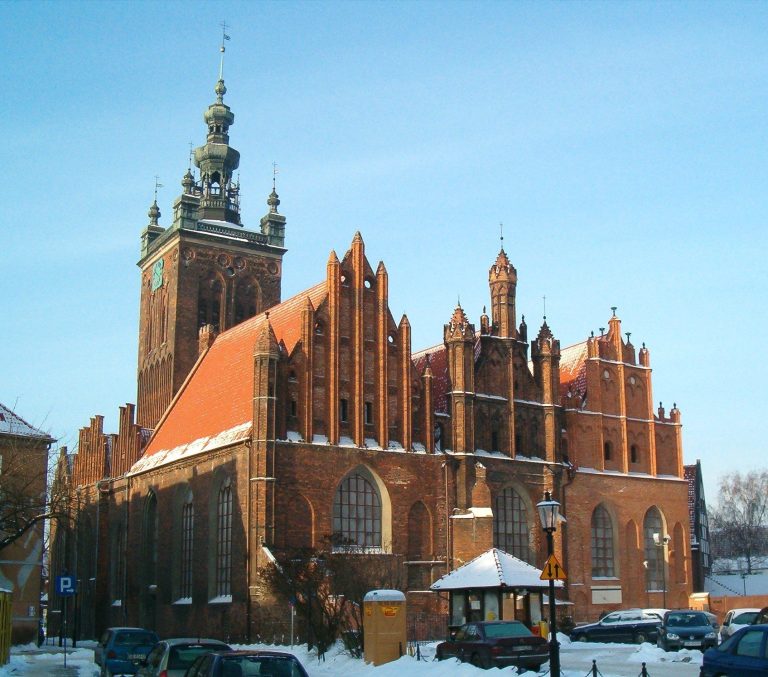
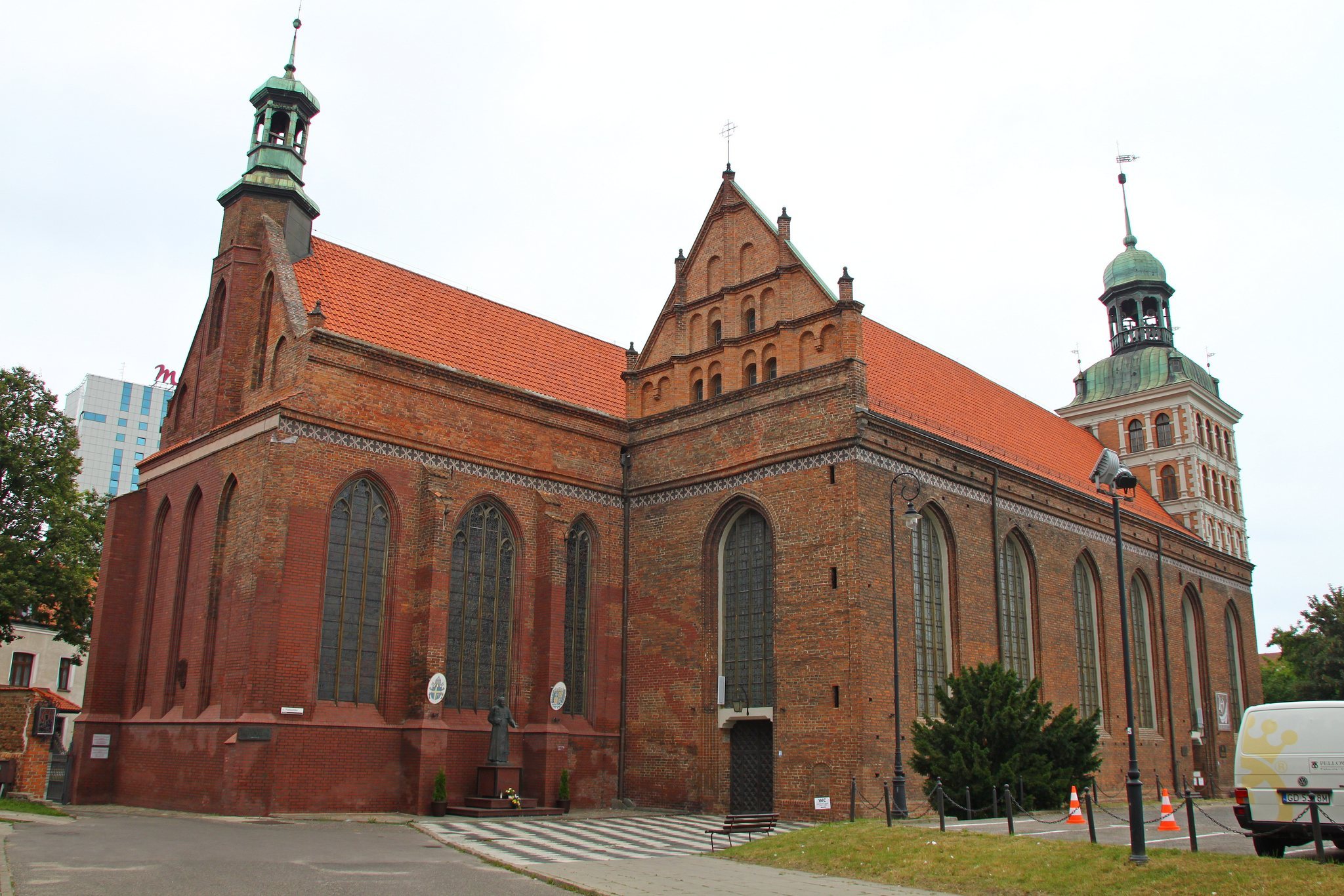
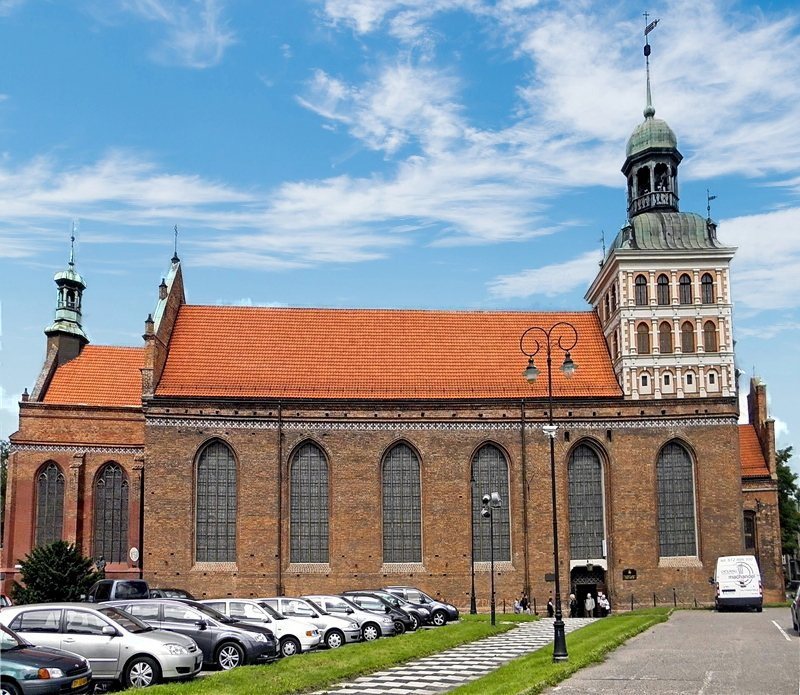
Saint Bridget Church stands in Gdańsk’s Old Town on Profesorska Street, east of the churchyard of Saint Catherine’s Church and beside the Radunia Canal. It is a brick Gothic, or Baltic Gothic, building with three naves and two towers. The present church preserves the exterior massing restored after the Second World War, while its interior decoration combines surviving elements with later additions rather than recreating the prewar arrangement in full.
The first monastic church was consecrated on 4 December 1397 by Bishop Stefan of Chełmża as a six-bay hall church. It was rebuilt in 1514 as a three-nave church. The rebuilt building had eleven altars decorated with paintings by Gdańsk masters. Its presbytery was placed at the western end, contrary to common practice, and the side aisles received Renaissance stellar vaults, whose ribs form star-like patterns modeled on those of the Cistercian church at Oliwa.
Towers, Bells, and Organ
The bell tower stood at the church’s southeastern corner. Designed by Piotr Willer, it received Renaissance decoration and was crowned with a Baroque cupola in 1674. A separate bell turret was built west of the church above the high altar in 1724. Its bells are identified as “Gift of Women,” “Gift of Men,” “Gift of Youth,” and “Gift of Children.” The church also contains an organ with 45 stops and three manuals.
Well and Former Monastery Ground
The original penitential chapel of Saint Mary Magdalene occupied the site of the present church. During clearance work in 1974, a well was found in the former monastery courtyard. It was lined with dressed stones and topped by a crowning brick cornice. Its masonry was assessed as dating from the middle of the twelfth century.
Until the monastery buildings were demolished in 1849, they occupied the area between the church’s north wall and the Radunia Canal. The complex included a cloister, inner courtyard, well, refectory, kitchen, pantry, bakery, laundry, bathhouse, and an ascent to the dormitory and cells. A new cloister and dormitory were built in 1648. The monastery also had a reception room for conversations with outsiders and a separate entrance for servants. The present rectory occupies the former monastic site.
Altars, Artworks, and Relics
Presbytery and Amber Altar
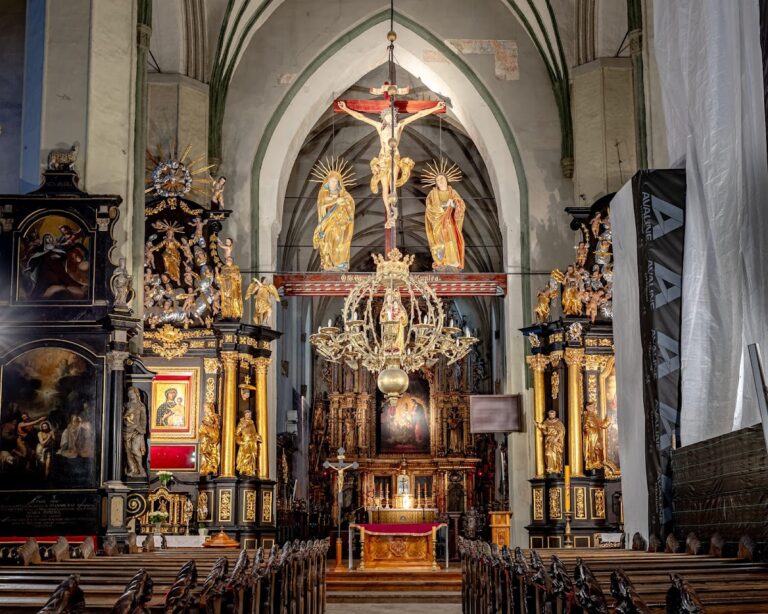
The presbytery contains an approximately 11-meter-high monumental amber altar designed by Stanisław Radwański and amber craftsman Mariusz Drapikowski. Shaped as an ascending lily, it was unveiled on 16 December 2017. The altar includes a copy of the image of Our Lady of Częstochowa and commemorates the 28 shipyard workers killed during the December 1970 protests.
Fatima Altar and Bridgetine Painting
One of the church’s three altars is dedicated to Our Lady of Fatima. Its enclosure bears Polish eagle emblems from different historical periods, with the coat of arms of the Polish-Lithuanian Commonwealth at the center. The sacristy contains H. Hahn’s 1612 painting Apotheosis of Saint Bridget. The church also contains a venerated image of Our Lady of Częstochowa with an amber dress, together with relics of Saint Bridget, Saint Maria Elisabeth Hesselblad, and the Holy Cross.
Memorials of Polish History
Solidarity Memorials
A relief of Blessed Jerzy Popiełuszko appears in a symbolic tomb, while wooden crosses from the Gdańsk shipyards recall the strikes of 1980 and 1988. Bronze doors show 152 figures connected with the history of Solidarity. A relief of the Virgin Mary bears a dress decorated with the coats of arms of Polish cities.
Epitaphs and Commemorative Objects
The church contains an epitaph for Poles murdered during the Volhynia massacre and ethnic cleansing in Eastern Galicia. Another epitaph commemorates the Katyn massacre and incorporates earth from execution sites together with several hundred crosses measuring 17 by 9 centimeters. They symbolize the Soviet invasion of Poland on 17 September 1939.
Further epitaphs commemorate the Home Army, the National Armed Forces, the Secret Military Organization “Gryf Pomorski,” the Freedom and Independence Association, the Cichociemni, and others. The Cichociemni were Polish special-operations paratroopers trained during the Second World War for service in occupied Poland, while the Home Army was the principal Polish underground military organization during that conflict.
Plaques commemorate Marshal Józef Piłsudski, General Władysław Sikorski, Bishop Edmund Nowicki, Major Zygmunt Szendzielarz, known as “Łupaszka,” Lieutenant Józef Dambek, and Second Lieutenant Antoni Burzyński, known as “Kmicic.” Urns contain earth from places of Polish martyrdom, including Stutthof concentration camp, Szpęgawski Forest, Piaśnica, and the Bydgoszcz Valley of Death.