Floreffe Abbey: A Premonstratensian Monastery in Belgium
Site at a Glance
- Popularity
- Medium
- Country
- Belgium
- Primary era
- Early Modern
- Eras represented
- Medieval, Early Modern, Modern
- Civilizations
- Belgian, Habsburg, Habsburg Austria, Habsburg Spain, Holy Roman Empire, Spanish
- Site type
- Religious
- Remains
- Monastery
On this page18 sections
History
Floreffe Abbey is a former Premonstratensian monastery in Floreffe, Belgium, founded on 27 November 1121 by Norbert of Xanten as the order’s second abbey. Premonstratensians, also called Norbertines, were canons regular: clergy who followed a shared religious rule while serving local communities. The abbey’s church and buildings developed across Romanesque, Gothic, Baroque, and Neoclassical phases. As a foundation of Norbert himself, Floreffe held lasting influence within the order.
Foundation and expansion
Godfrey I, Count of Namur, and his wife Ermesinde of Luxembourg gave Norbert the land for the foundation. The first religious community arrived in 1122 under Richard, its first abbot. Floreffe’s abbot, together with two others, carried out an annual visitation of the mother abbey at Prémontré. The community adopted the motto Florete flores, meaning “May flowers bloom.” Godfrey and Ermesinde were later buried at the abbey, and the nearby parish church of Our Lady of the Rosary depended on it.
Supported for centuries by the Counts of Namur, Floreffe established religious houses, hospitals, and hospices, while its canons served more than 40 parishes. Its foundations included Wenau in 1122, Mont Cornillon in 1124, Rommersdorf in 1135, Postel in 1138, a house at Liège around 1140, and Leffe in 1152. Floreffe’s canons also founded Saint-Habacuc at Lod in the Holy Land around 1137. That house was suppressed late in the 13th century, after Crusader rule in the region ended.
The abbey also held estates in the Meierij of ’s-Hertogenbosch, a historic region around the city of that name in the Netherlands. These properties included land at Reusel, Bladel, Casteren, Someren, Lierop, Helmond, Rixtel, and Lieshout. In the 17th century Floreffe sold them to Postel, a nearer abbey whose community shared the local language.
A relic of the True Cross reached Floreffe through Philip, Count of Namur, who gave it to the abbey’s sixth abbot, Weric. Philip had received it from his brother Baldwin, Emperor of Constantinople. Abbey chronicles recount that blood appeared on the relic during the Feast of the Invention of the Holy Cross, which commemorates the traditional discovery of the Cross of Jesus, in 1204 and 1254. Members of the community and a crowd were said to have witnessed the events. When the abbey was suppressed, the relic was taken to safety; it was later returned to Premonstratensian canons at Bois-Seigneur-Isaac.
Decline, conflict, and reform
Floreffe underwent religious and financial decline in the 14th century. Abbot Thierry de Warnant, who led the community from 1342 to 1361, worked to restore discipline with the assistance of the historian Pierre de Herentals. The abbey’s strategic position also exposed it to sieges during 13th- and 14th-century conflicts between Namur and Hainaut.
After the County of Namur passed into Burgundian possessions in 1429, repeated conflict with the Prince-Bishopric of Liège brought attacks on Floreffe’s farms. This was a territory governed by a bishop who also held secular power. In 1450 Pope Nicholas V granted Floreffe’s abbots the right to wear a mitre, a ceremonial headdress associated with bishops and certain senior churchmen. The privilege brought spiritual authority but did not make the abbots bishops.
Abbots Martini, in office from 1516 to 1548, and Dupaix, who served from 1552 to 1578, restored the abbey’s material position. When the Diocese of Namur was established in 1559, Dupaix prevented Floreffe’s revenues from passing entirely to it. He also introduced reforms from the Council of Trent, a major Catholic council that defined church reform and doctrine. At Floreffe, these measures included stricter religious observance and improved training for priests. Passing troops damaged the buildings, which were repaired or rebuilt.
Renewal and the 18th-century building campaign
Abbot Jean Roberti, who governed from 1607 to 1639, continued the reforms and established a study house for Premonstratensians near the University of Leuven in 1628. His successor Charles de Severi, abbot from 1641 to 1662, was associated with the church’s embellishment. The abbey’s farms and other properties also supported a large religious community and its parish responsibilities.
In the late 17th century, war contributions and pillaging by French troops added to the costs of supporting 65 religious, rebuilding farms, and repairing damaged parish churches. The sieges of Namur in 1692 and 1695 devastated the surrounding region and deepened the strain on the abbey’s finances.
After peace returned, abbots Louis van Werdt, Charles Dartevelle, and Baptiste Dufresne oversaw a major building campaign that gave much of the complex its classical character. In a 1785 assessment, Emperor Joseph II, the Habsburg ruler, praised Floreffe’s educational, parish, and charitable work, including pastoral care for 25 parishes. The assessment judged that the abbey served a public purpose and recommended its preservation.
Suppression and educational use
The French victory at Fleurus in 1794 was followed by the region’s annexation and a war levy that Floreffe’s canons could not pay. The abbey was then pillaged. A French law suppressed religious establishments in the annexed territories in 1796, and the community was expelled in February 1797. Its property was confiscated and sold. Louis de Fromantau, elected in 1791, was Floreffe’s 55th and last abbot. At the 1797 sale, Canon Richald bought the abbey on behalf of Fromantau and the community.
Following the 1801 Concordat, an agreement between Napoleon’s government and the papacy concerning the Catholic Church in France, Fromantau and a few canons returned. The community did not regain its former standing. The Diocese of Namur obtained use of the buildings for seminarian training in 1805. A small seminary opened in 1819, closed under the Dutch government in 1825, and reopened in 1831 after the Belgian Revolution. In 1842 the diocese acquired the abbey’s property, including its farm and mill. Three members of the religious community remained at that point; the last died in 1850.
The former abbey was classified as heritage in 1977 and designated exceptional heritage in 2013.
Remains
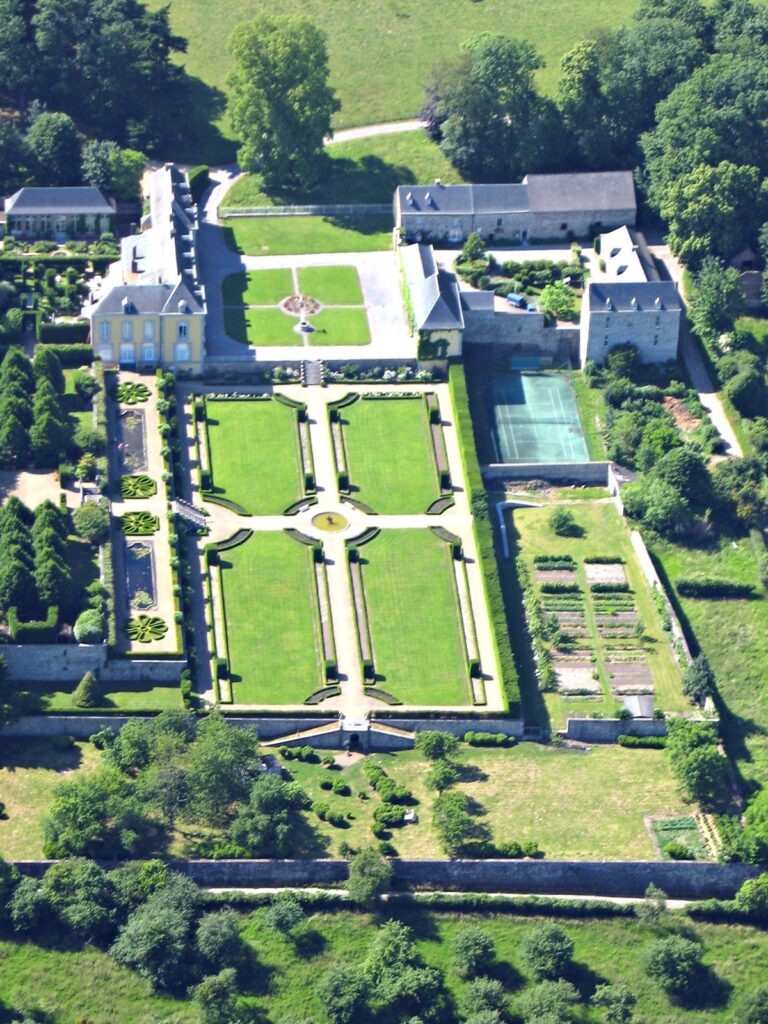
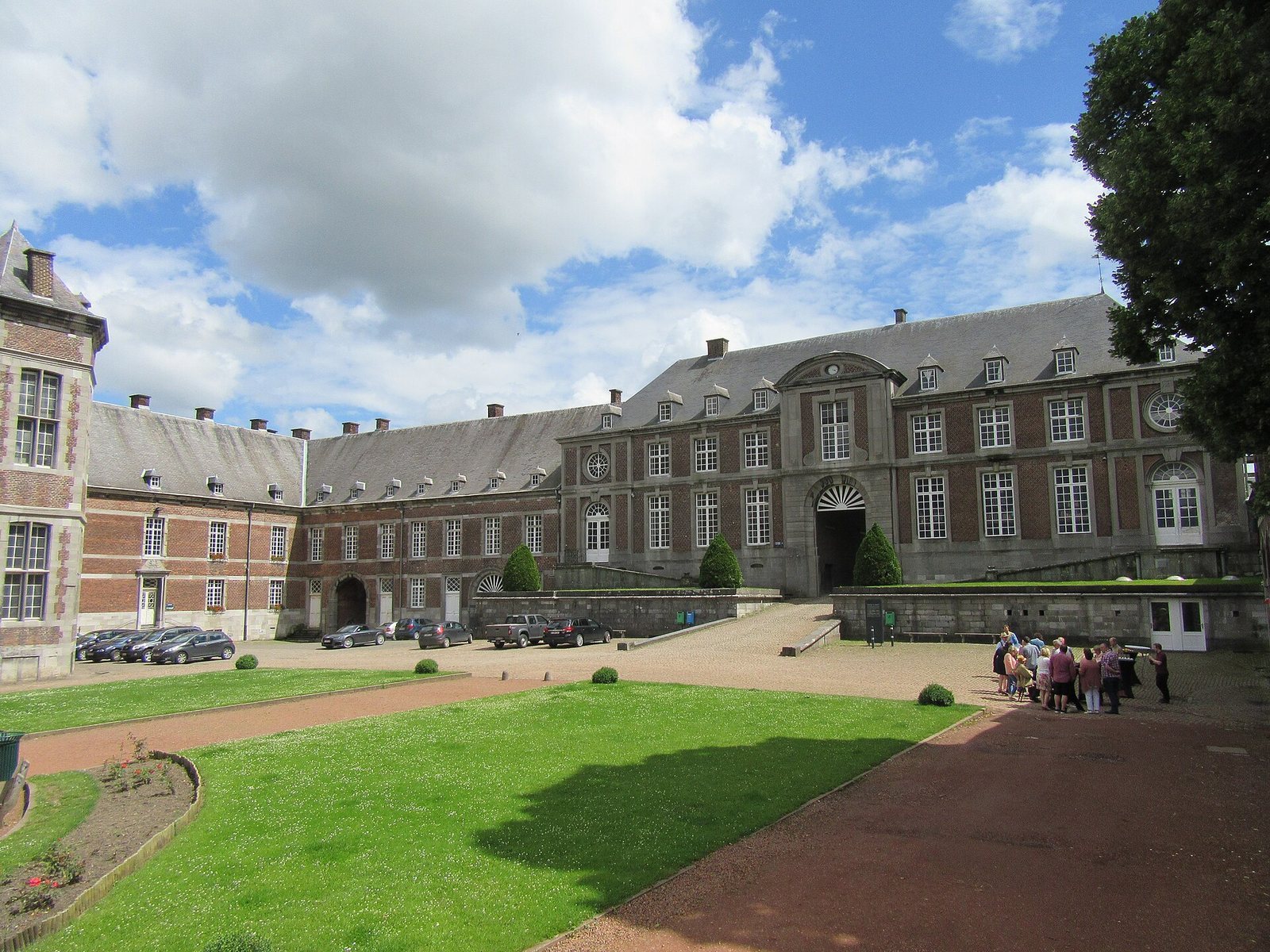
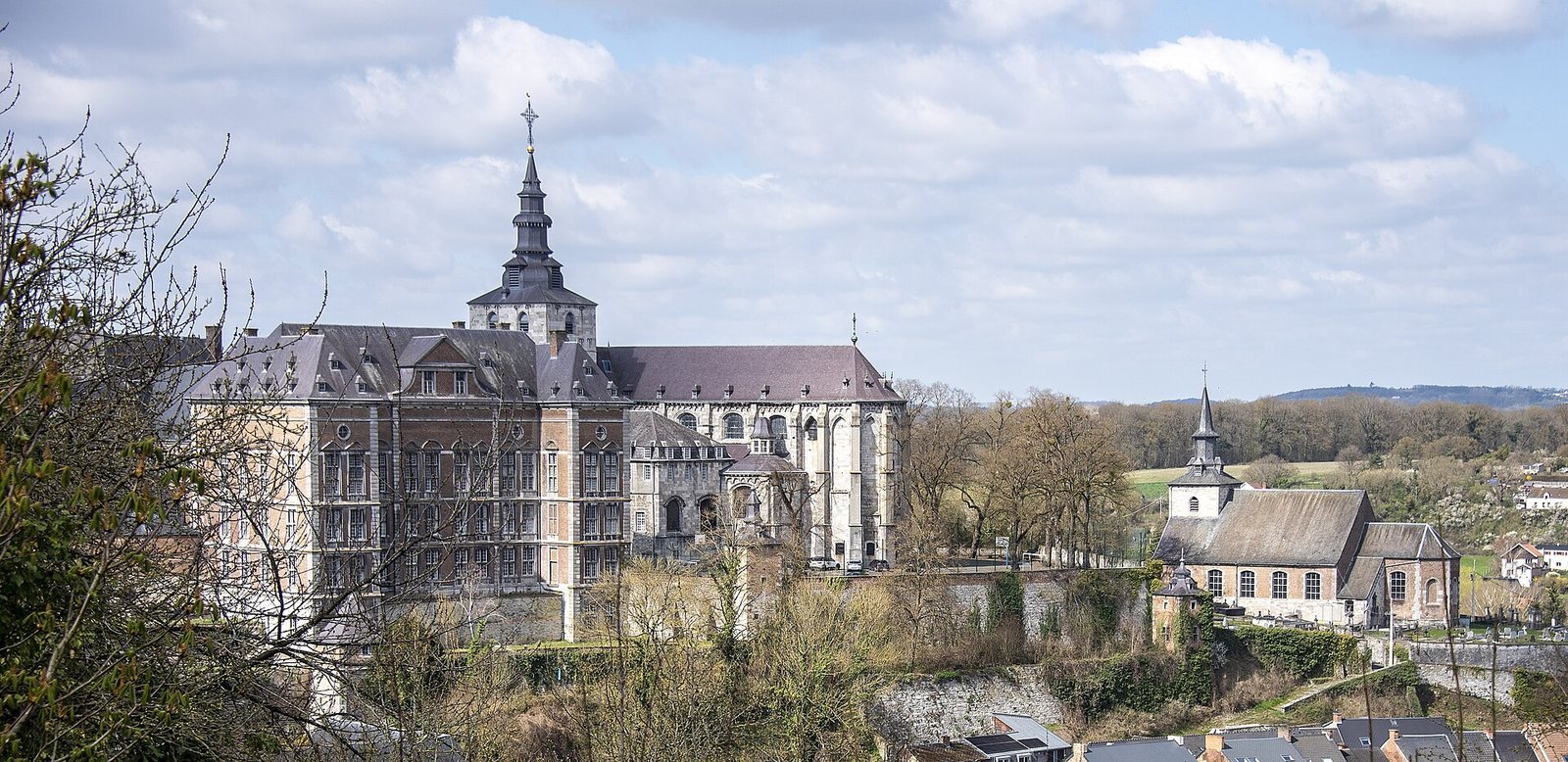
The complex stands on a promontory about 50 metres above the Sambre, overlooking the river and the town of Floreffe. Its main historic buildings date from the 17th and 18th centuries, alongside surviving fabric from the 12th, 13th, and 16th centuries. The buildings and courtyards form a connected group around the abbey church, with terraces and service buildings extending across the site.
Courtyard and conventual buildings
Courtyard and cloister
A green courtyard is enclosed on its south side by the facade of the abbatial quarter, built under Abbot Dufresne to designs by B. Gaine. On the west, a 17th-century building with Tuscan arcades faces the Grand Quarter; the church’s Baroque frontispiece adjoins it. Terraced gardens lie opposite the courtyard. A square cloister, a covered walkway around a courtyard, adjoins the church aisle. The former cloister space is now a covered hall.
Refectory and chapter house
The large rectangular refectory is supported by four substantial stone columns set through its centre. The chapter house and the hall formerly used by lay brothers date from the late 12th century. Lay brothers were community members who generally undertook practical work rather than serving as ordained clergy. The chapter house now contains a small museum.
Library
Built under Abbot Van Werdt, the library is a three-storey building with six bays, tall narrow windows divided into four sections, and triangular or circular pediments. It stands above a 13th-century vaulted underground hall supported by six pillars. The hall had formerly belonged to the Counts of Namur’s castle, and the library overlooks the valley. A prominent staircase in the abbatial quarter has a wrought-iron balustrade.
Farm and service buildings
Mill-brewery and farm
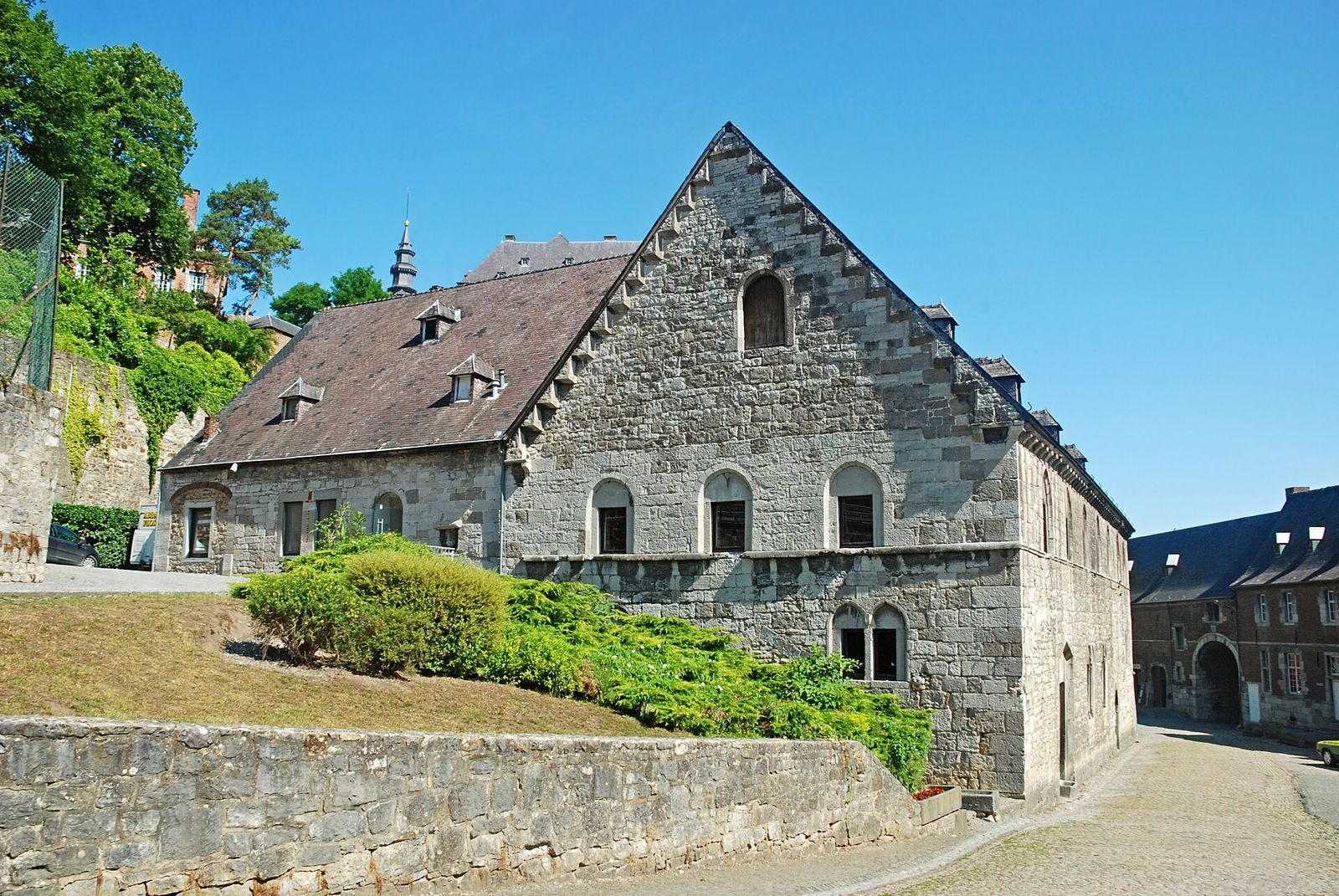
Below the main complex are the farm, mill, and brewery buildings, with a small pond nearby. The particularly well-preserved 13th-century mill-brewery is an exceptional industrial building in Wallonia and a unique example of civil architecture in the Namur region. Its two limestone wings are divided by a channel diverted from the Floreffe stream. A doorway with a triangular lintel and paired windows form part of the surviving structure. It served as a watermill and brewery, with beer possibly produced there from around 1250. The mill machinery has been restored, and a low vaulted room contains 13th-century wall paintings attributed to Walter van Obais. Restored in the 1970s, the building includes dining rooms.
Dovecote
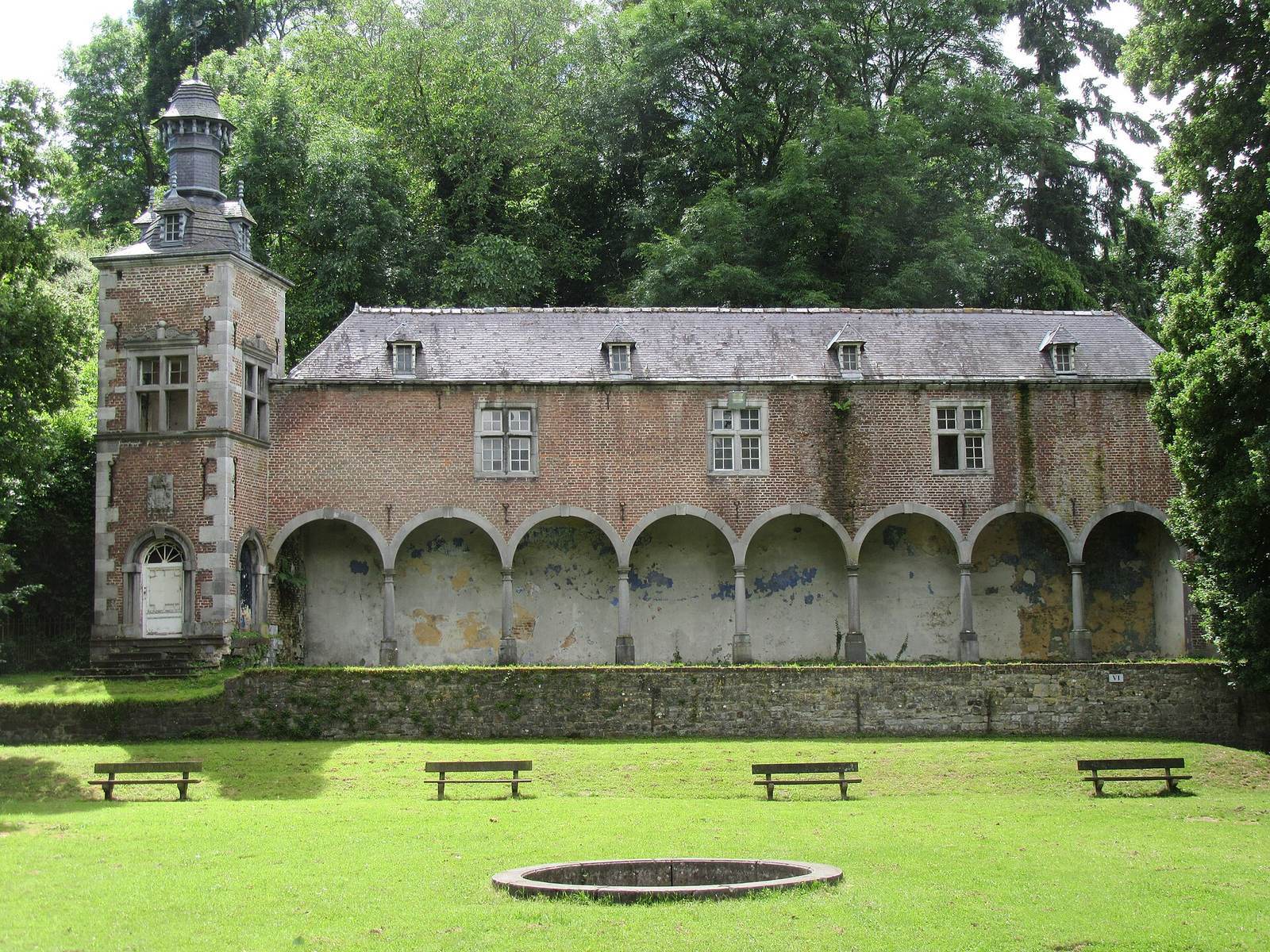
The 18th-century dovecote, a tower built to house pigeons, stands apart from the main buildings among greenery. It was formerly surrounded by water. The farm gate bears the date 1649, the arms of Abbot Charles de Severi, and the motto Benigna Severitate, meaning “With benevolent severity.”
Abbey church
Plan and construction
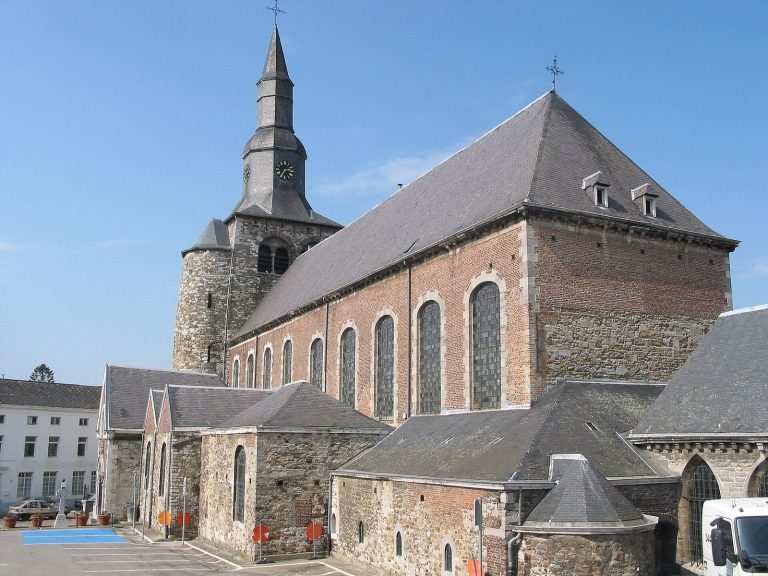
The church measures 90 metres long and 25 metres wide, and is described as Belgium’s second-largest abbey church. Its plan approaches that of an archiepiscopal cross, a cross-shaped plan with two transverse bars. The Romanesque nave has rounded arches, while the Romanesque transept, the crosswise arm of the church, dates to the second half of the 12th century. The nave is 13th-century work, and the choir has pointed-arch Gothic features. A Baroque tower and facade complete the exterior; the tower was built in 1563. The adjoining arcaded pavilion and the choir also include 17th-century work.
Choir and interior
Abbot Roberti renewed the choir, which was substantially altered in the 17th century. The apse, the rounded end of the church, has windows dating to 1638. From 1770 to 1775, architect Laurent-Benoît Dewez redesigned the interior in a Neoclassical style, combining stucco, plaster, whitewash, and existing decoration. This treatment overlays the church’s earlier architectural phases.
The oak choir stalls were made by Pierre Enderlin between 1632 and 1648 and provide 74 seats. Their elaborate decoration presents the history of religious orders from their origins to the mid-17th century, while medallions depict founders and reformers. The stalls are among the earliest works of their kind in Belgium. The 18th-century high altar is shaped like a portico. It contains the stone on which Norbert is said to have celebrated Mass in 1121. An abbey tradition recounts that, during Mass at Floreffe, a drop of blood appeared on the plate beneath the consecrated Eucharistic bread; the assisting deacon was said to have seen it too. A linden-wood group representing the Immaculate Conception, the Catholic belief that Mary was preserved from original sin from conception, was made by Jean del Cour in 1692.
Sacristy and earlier chapel
The small sacristy, a room for church vestments and sacred objects, contains two Romanesque windows, wall paintings, and 13th-century floor tiles. Foundations beneath the church belong to a chapel that probably preceded the abbey.
Later additions and dispersed works
A new seminary wing designed by Belgian architect Roger Bastin was built in 1964, and the school building called La Vigne followed in 1990. These additions allowed the historic buildings to serve other purposes. The complex now includes a secondary school and a boarding school, with buildings also known as the Bastin block, the primary quarter, the Prefect’s Quarter, the Abbatial Quarter, and the Lombet block, formerly the library.
Some of the abbey church’s furnishings were dispersed. Its pulpit is now in Saint-Lambert Church at Bouvignes. Statues of apostles and saints and portraits of abbots and canons are held at Saint-Aubain Cathedral in Namur, in museums, and in private collections. Manuscripts from Floreffe are kept in state and church libraries and archives. They include a community catalogue covering 1435–1647, a Gospel book from 1650, and a necrology, a register of deceased community members, for 1501–1520. The Floreffe Bible, made around 1165 and regarded as a masterpiece of 12th-century miniature art from the Meuse region, is held by the British Library in London.