Fischingen Abbey: A Monastery in Thurgau, Switzerland
Site at a Glance
- Rating
- 4.2
- Popularity
- Low
- Country
- Switzerland
- Primary era
- Early Modern
- Eras represented
- Medieval, Early Modern, Modern
- Civilizations
- Holy Roman Empire, Swiss
- Site type
- Religious
- Remains
- Monastery
On this page16 sections
History
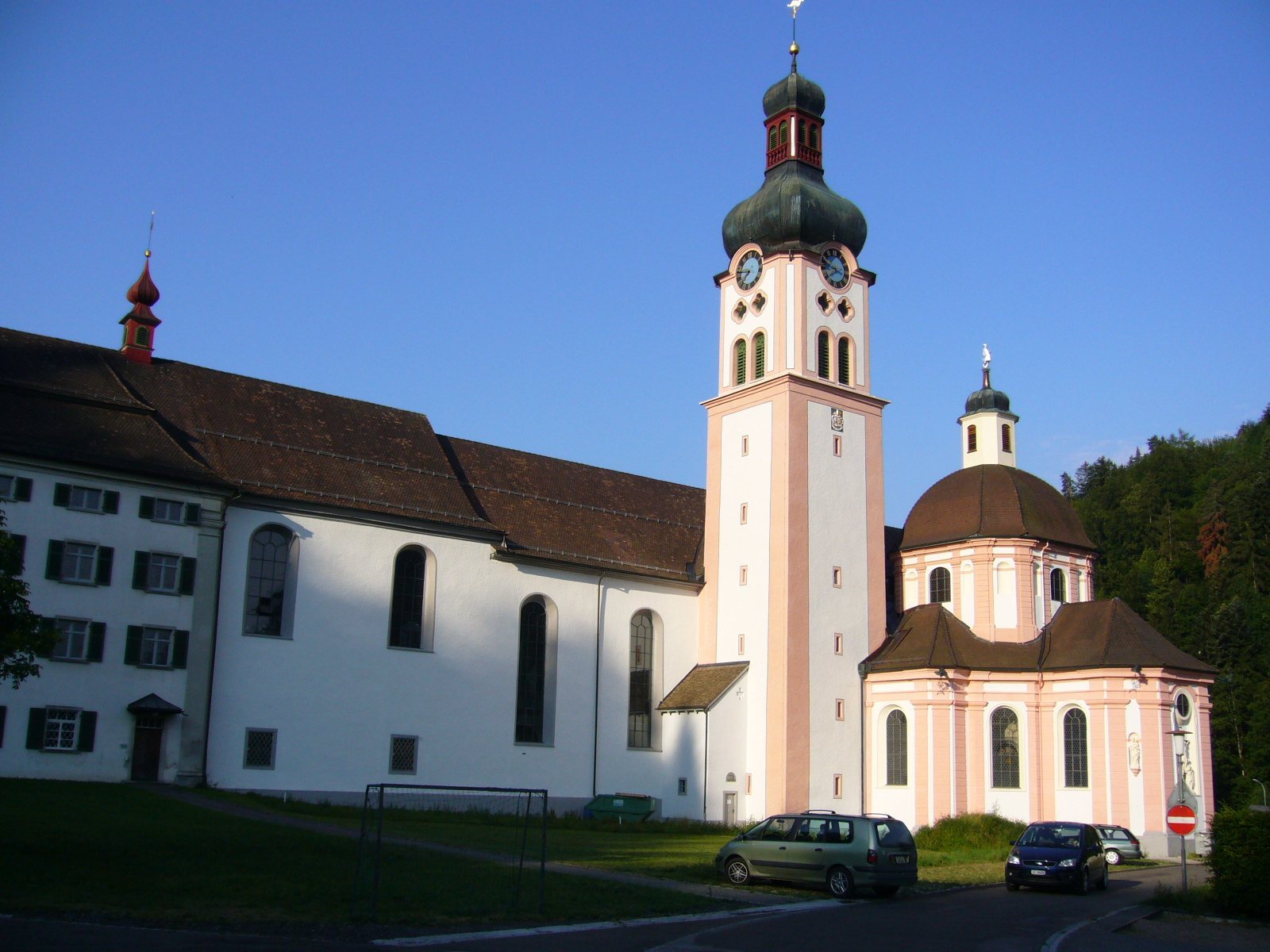
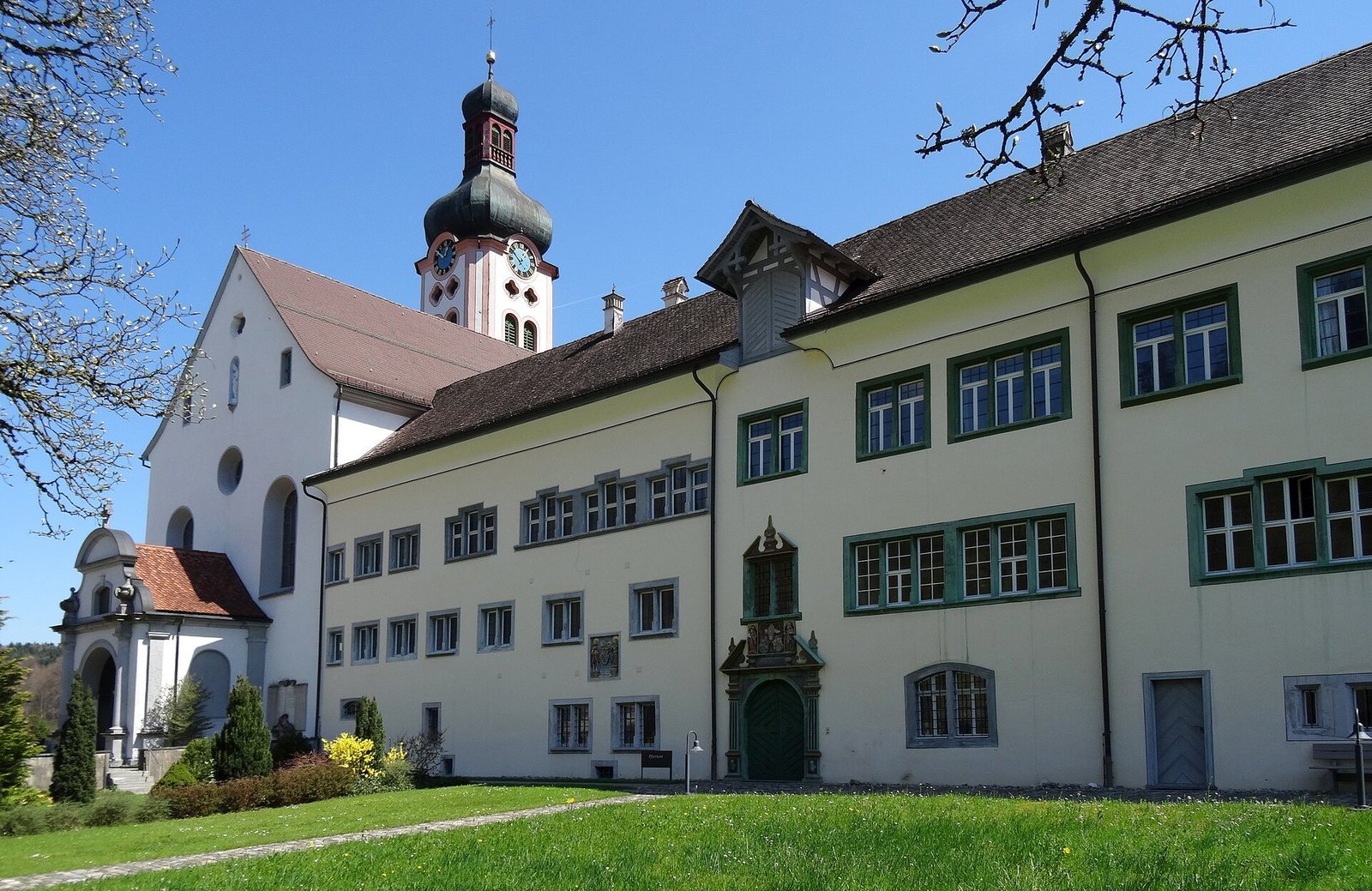
Fischingen Abbey is a monastic complex at the upper reaches of the Murg River in the municipality of Fischingen, Canton of Thurgau, Switzerland. Ulrich II, Bishop of Constance, founded it in 1138 as a monastery over which the bishop held proprietary rights. It was intended as a double monastery, a religious house for monks and nuns with separate accommodation, and also offered shelter to pilgrims travelling between Constance and Einsiedeln Abbey. The complex was later reshaped in Baroque, an elaborate and dramatic style, and Rococo, a more delicate decorative style, during the 17th and 18th centuries.
Foundation and medieval community
Monks from Petershausen Abbey settled at Fischingen, and the hermit Gebino became its first abbot, or head of the monastic community. During the first six years, the community established a bell tower, a guesthouse, and living quarters for its monks and nuns. Around 1210, the monastery had about 150 monks and 120 nuns. The Counts of Toggenburg held rights to protect and oversee the abbey.
Saint Idda of Toggenburg, a medieval Christian saint associated with the region, lived in a cell near the abbey around 1200. Her connection to Fischingen became an enduring part of its religious history.
Thurgau and the Reformation
In 1460, Fischingen came under Thurgau’s administration. Thurgau was then part of the Old Swiss Confederacy, a loose alliance of cantons that preceded the modern Swiss state. During the Reformation, the 16th-century movement that produced Protestant traditions, Abbot Heinrich Stoll and the four remaining monks adopted Reformed beliefs in 1526. Stoll married publicly in the abbey church that year. The other monks also married, remained at the monastery, and continued pastoral work, although monastic life was interrupted for several years.
The Catholic cantons of the Confederacy set about restoring the abbey. In 1532, the Swiss Diet, the Confederacy’s assembly of representatives, removed Stoll from office and required him to leave. Monk Andreas Egli then administered the monastery temporarily with the assistance of two appointed priests. In 1540, the seven Catholic cantons appointed Markus Schenkli as abbot.
Monastic life and rebuilding
Fischingen joined the Swiss Benedictine Congregation, an association of Benedictine monasteries, in 1602. From Abbot Mathias Stähelin’s tenure, beginning in 1604, the abbey maintained a small school chiefly to prepare future monks. Between 1650 and 1780, 134 monks lived at Fischingen, including 97 priests. The community reached 34 monks in 1725. In 1750, only four members had not been ordained as priests. Most monks came from the Old Swiss Confederacy, particularly the St. Gallen region, Thurgau, and Catholic central Switzerland; 17 came from Austria and Germany.
The rebuilding of the abbey was especially associated with Abbot Joachim Seiler, whose tenure ran from 1672 to 1688. The community’s intellectual and material high point is also associated with the later abbots Franz Troger, who served from 1688 to 1728, and Nikolaus Degen, who led the abbey from 1747 to 1776. Degen resigned in 1776 and withdrew to Lommis Castle, where he died in 1778.
Dissolution and new uses
A monastic law passed in 1836 prohibited the admission of novices, candidates beginning religious training. The last abbot, Franziskus Fröhlicher, tried to turn the abbey’s small school into a public gymnasium, or academic secondary school, open to interested young people, particularly those from Thurgau. The school closed in 1839, although the proposed curriculum had received approval from local residents and the Thurgau education council.
After Fröhlicher’s death, the Grand Council of Thurgau dissolved the abbey on 27 June 1848. Its medieval library holdings went to the Thurgau Cantonal Library. In 1852, textile manufacturer Friedrich Imhoof of Winterthur bought the buildings and used them to produce cotton fabrics and shoe uppers. Thurgau councillor August Wild acquired the complex in 1875 and established an international trade school, which did not succeed. In 1879, the Catholic St. Iddazell Association took ownership and opened an orphanage. The institution later became a children’s home and educational establishment, then a residential school for special education in 1976.
During Josef Schmid’s tenure, from 1893 to 1919, the monastery received its first sanitary facilities and electric power. Central heating was installed under Albin Frei, abbot from 1933 to 1943. In 1943, two Benedictine priests from Engelberg Abbey returned to Fischingen and were assigned to run the children’s home.
Former pupils alleged that physical and psychological abuse and sexual assaults took place at the home from the 1950s to the 1970s; some former teachers and pupils disputed the allegations. A historical investigation published in 2014 largely confirmed them and identified failures by those responsible. It also found that pupils had been used, without informed consent or proper authorization, in experiments involving unapproved drugs at the psychiatric hospital in Münsterlingen. Swiss psychiatrist Roland Kuhn led the experiments. The Canton of Thurgau issued an official apology in 2014.
Return of monastic life
Switzerland repealed the constitutional ban on founding new monasteries and re-establishing dissolved ones in 1973. Fischingen reopened in its former buildings in 1977 as a Benedictine priory, a monastic house led by a prior, and rejoined the Swiss Benedictine Congregation. The St. Iddazell Association retained ownership. Florin Cavelti became the first prior, followed by Leo Müller of Disentis Abbey. Extensive renovation work took place in 1997 and 1998. The community numbered ten Benedictines in 2025.
Remains
The surviving complex includes the abbey church, convent buildings, and the Idda Chapel beside the church. Its architectural character reflects the Baroque and Rococo rebuilding, while the church’s painted choir and four organs preserve distinct phases of the site’s artistic and musical history.
Church, chapel, and convent
Abbey church and choir
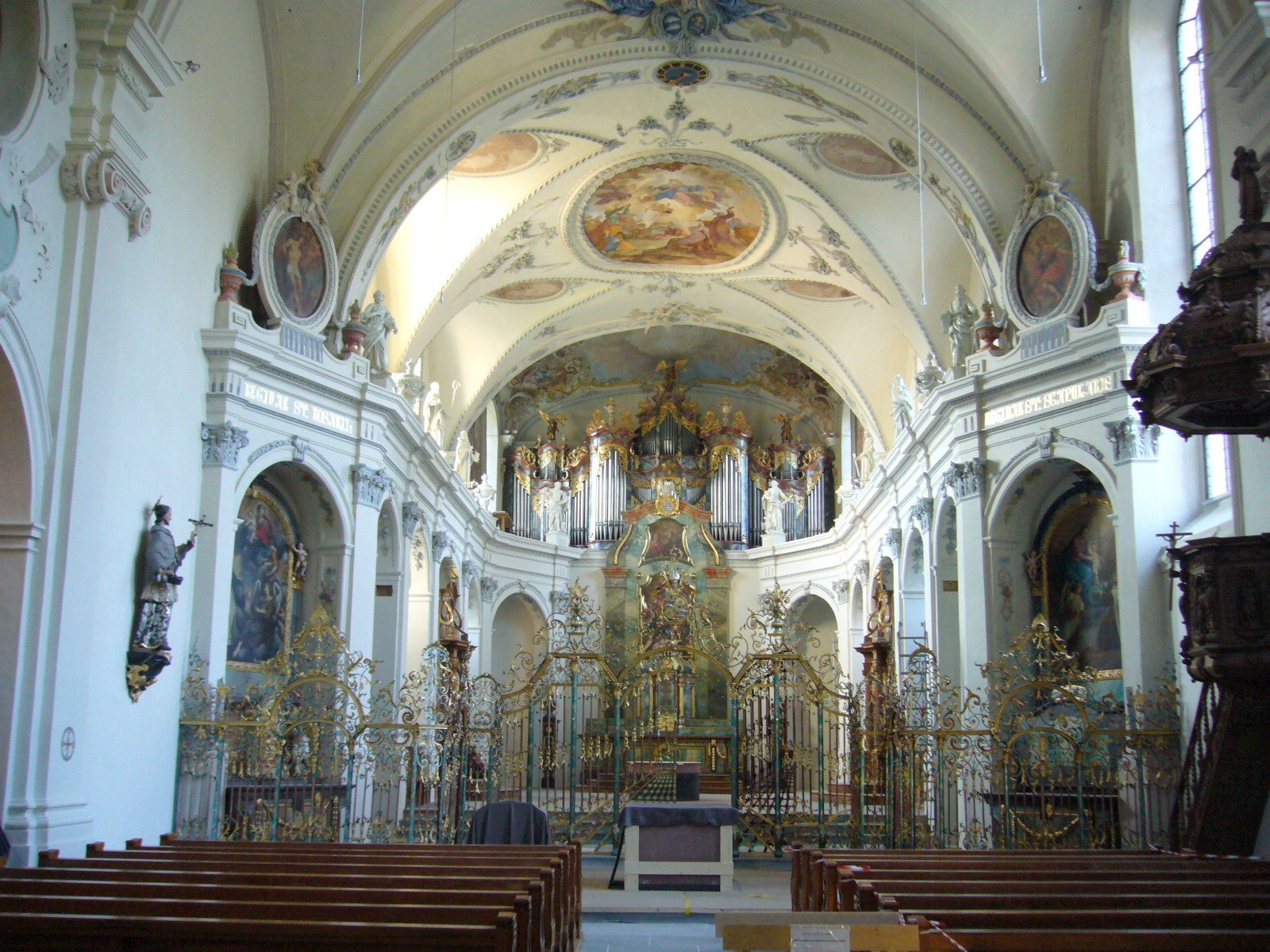
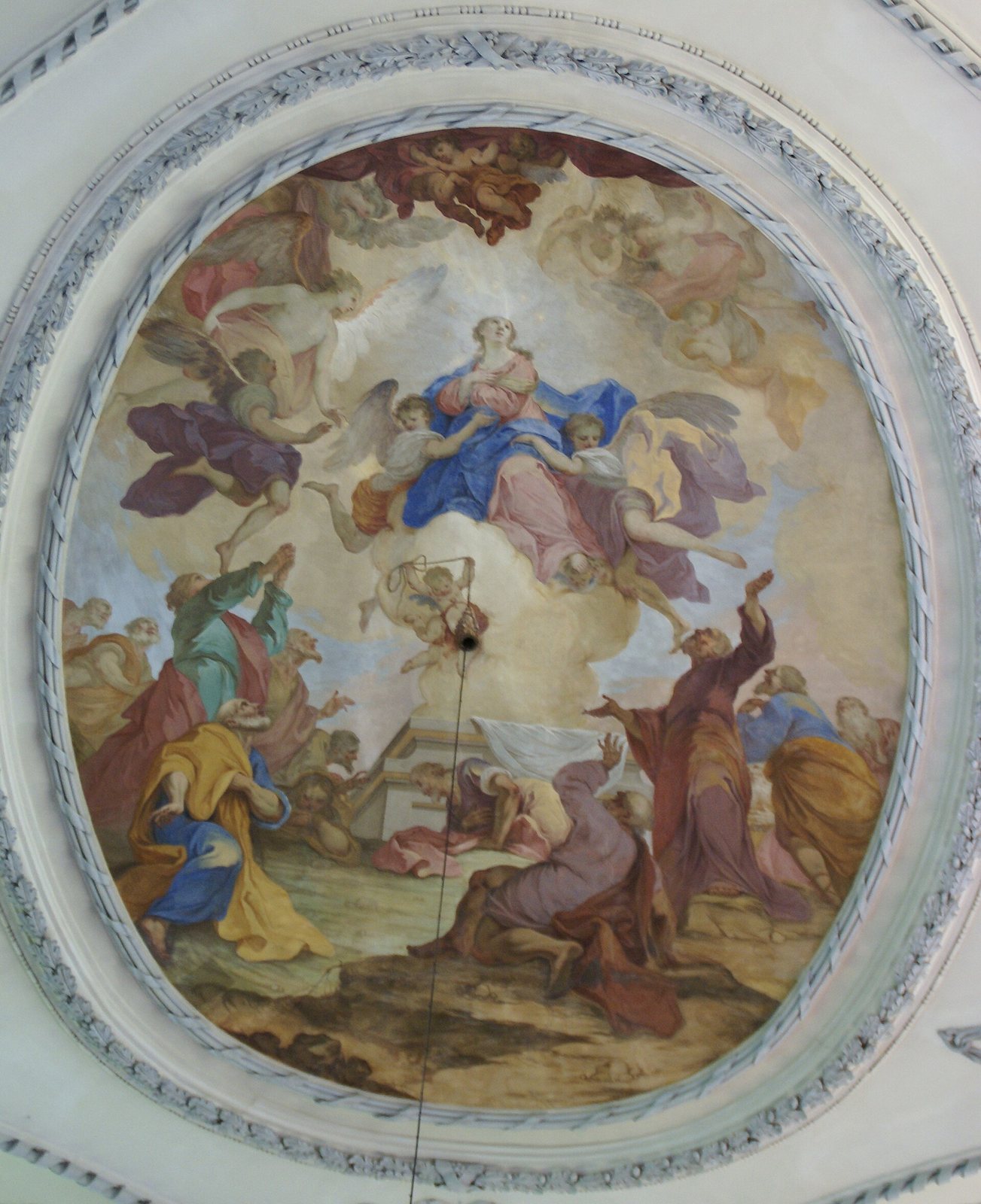
A new abbey church was built from 1685 to 1687. Its choir has ornamental grilles, and the psalm-singing choir is decorated with signed ceiling and wall frescoes painted in 1761 by Johann Jakob Zeiller. A later fresco on the choir ceiling, painted around 1785 to 1790 by Joseph Keller, contains four medallion paintings in curved sections at the ceiling edge. It was once wrongly attributed to J. A. Messmer.
Idda Chapel
The chapel beside the abbey church was built in 1705 and dedicated to Saint Idda. It contains her burial place. A rood screen, the partition separating the choir from the main body of the church, supports one of the chapel’s organs.
Convent buildings
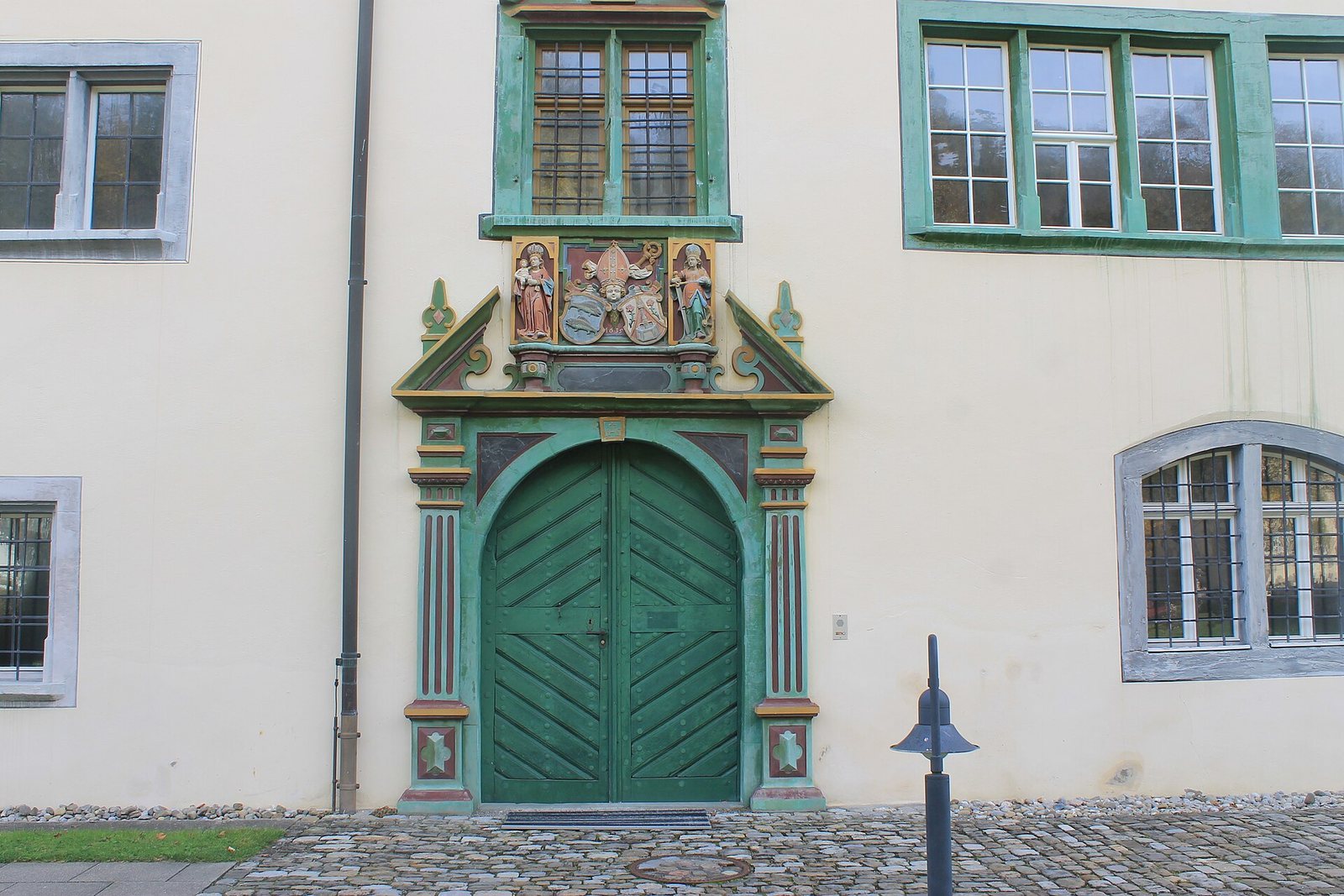
Part of the convent was rebuilt between 1753 and 1761 according to a new architectural plan, and the monks moved into the new accommodation on 4 November 1761. The abbot criticized the workmanship, while the builder objected to interruptions caused by financial difficulties and threatened to seek compensation. At the 1775 Diet in Frauenfeld, they settled the dispute: the builder accepted compensation and gave up completing the work and pursuing further claims.
Organs
Metzler organ in the psalm-singing choir
The Metzler organ in the psalm-singing choir has a case dating from 1763. Metzler Orgelbau built its present instrument in 1957, incorporating substantially altered historical stops, which control sets of pipes. The stops draw on work associated with Abbrederis (1690), Bommer (1741), Aichgasser (1763), Mayer (1914), and Metzler (1957). The keyboard ranges expanded in 1914 remain, while the short octave, a historical arrangement with a shortened bass-key range, was removed throughout the instrument. Its keys operate the notes mechanically, and an electrically controlled air system operates the stops. The organ has two user-set combinations of pipe sets, three fixed settings, and links between its hand keyboards and foot keyboard. A major overhaul and cleaning took place in 2014, the first in 57 years.
Metzler organ in the Idda Chapel
Metzler built the chapel organ in 1967, placing it in the surviving case of a Bommer organ from 1751. It has ten stops, one hand keyboard, and a foot-operated pedal. Its tonal design follows an earlier chapel organ made by Johann Abbrederis in 1705. Its tuning follows Johann Georg Neidhardt’s 1732 small-town system, a method of adjusting musical intervals for a particular setting.
Bommer positive organ
Johann Jacob Bommer of Weingarten in Thurgau made this small, fixed-position organ in 1727 for the abbey church choir. It has five stops and follows Neidhardt’s 1732 village tuning system. Manfred Mathis restored it in 1957, and Metzler carried out a further restoration in 1996.
Van Vulpen organ
Installed on the west gallery in 2020, the Van Vulpen organ was originally built in 1954 as a private house instrument and later enlarged by Flentrop Orgelbouw of Zaandam. It has nine stops, one hand keyboard, and a foot-operated pedal, and uses Neidhardt’s 1732 village tuning system. Ekkehard Fehl Orgelbau serviced it in 2021.