Eyüp Sultan Mosque: An Ottoman Mosque and Pilgrimage Complex in Istanbul


Site at a Glance
- Rating
- 4.8
- Popularity
- Very High
- Country
- Turkey
- Primary era
- Early Modern
- External website
- Open
- Eras represented
- Medieval, Early Modern
- Civilizations
- Ottoman
- Site type
- Religious
- Remains
- Mosque
On this page10 sections
History
Eyüp Sultan Mosque is an Ottoman Sunni Muslim mosque in Turkey, located in Eyüpsultan, Istanbul. Founded in 1458 beside the traditional burial place of Ebu Eyüp el-Ensari, it became the first Ottoman mosque established after the conquest of Constantinople and remains an important pilgrimage site.
The shrine and the Ottoman foundation
The mosque stands outside the former walls of Constantinople on the Golden Horn. It takes its name from Ebu Eyüp el-Ensari, an early Muslim companion of Muhammad who served as a standard-bearer. He is traditionally believed to have died during the first Arab siege of Constantinople in the 670s, and the site came to be identified as his burial place.
Five years after the Ottoman conquest of Constantinople, Sultan Mehmed II founded a mosque complex beside the tomb. This type of Ottoman charitable and religious foundation was known as a külliye and could include a school, soup kitchen, public bath, tomb, and other service buildings. Tradition associates the discovery of the grave with Mehmed II and his religious teacher Akşemseddin. During the search, a white marble bearing an inscription identifying the grave was reportedly found.
The complex originally included a theological school, soup kitchen, and public bath. The school was probably demolished when the mosque was rebuilt, while most of the bath survived. Its original changing room was later replaced by a wooden structure. Several years before the rebuilding, Mihrişah Valide Sultan, the mother of Selim III, established a nearby charitable complex containing an imaret, or soup kitchen, and a tomb.
Dynastic ceremonies and burial ground
The sanctity of the shrine gave the complex a central place in Ottoman dynastic ritual. At the beginning of their reigns, Ottoman sultans travelled there along the Cülus Yolu, or Accession Way, to receive the Sword of Osman. The ceremony symbolized the assumption of the Ottoman sultanate. A tradition also holds that Turks visited the site before continuing on pilgrimage to Mecca.
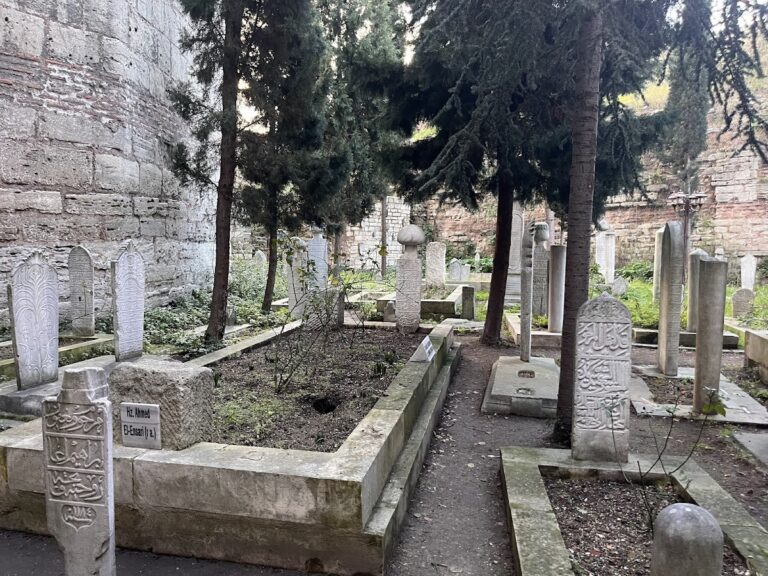
The mosque and its surroundings became a preferred burial area for Ottoman officials and members of the imperial family. Those connected with the site include the grand viziers Sokollu Mehmet Paşa and Siyavuş Paşa, Lala Mustafa Paşa, who conquered Cyprus for the Ottomans in the sixteenth century, Adile Sultan, and Mihrişah Valide Sultan. The tomb of Sultan Mehmed V, designed by Mimar Kemaleddin Bey in 1918, stands farther away overlooking the water.
Earthquake, destruction, and rebuilding
An earthquake in 1766 severely damaged the complex, and the mosque was in a ruinous condition by the end of the eighteenth century. In 1798, Sultan Selim III ordered the mosque to be demolished and rebuilt, retaining its minarets. The reconstruction was directed by the architect Uzun Hüseyin Ağa and was completed on 7 July 1800.
The minarets also underwent changes. Sultan Ahmed III had both rebuilt in their present form during the early eighteenth century. After lightning damage, Sultan Mahmud II ordered the eastern minaret to be rebuilt in its original style in 1822. Another account dates damage to the minaret on the Golden Horn side and its rebuilding to 1823.
Continuing religious use
The site’s religious traditions continue to shape its use. Boys awaiting circumcision are sometimes brought to the mosque in ceremonial clothing, and collective circumcision ceremonies have been held for children from families in need. During Ramadan, the courtyard is used for breaking the fast. The mosque, its square, and the shrine continue to receive pilgrims throughout the year.
Remains
The surviving complex combines a rectangular mosque, two courtyards, Ebu Eyüp el-Ensari’s mausoleum, a preserved public bath, and Ottoman funerary and charitable structures. The Eyüp Cemetery extends up the hill behind the mosque toward a viewpoint overlooking the Golden Horn. The present building follows the Classical Ottoman arrangement associated with Mimar Sinan, while its decoration incorporates eighteenth-century Ottoman Baroque forms.
The mosque and courtyards
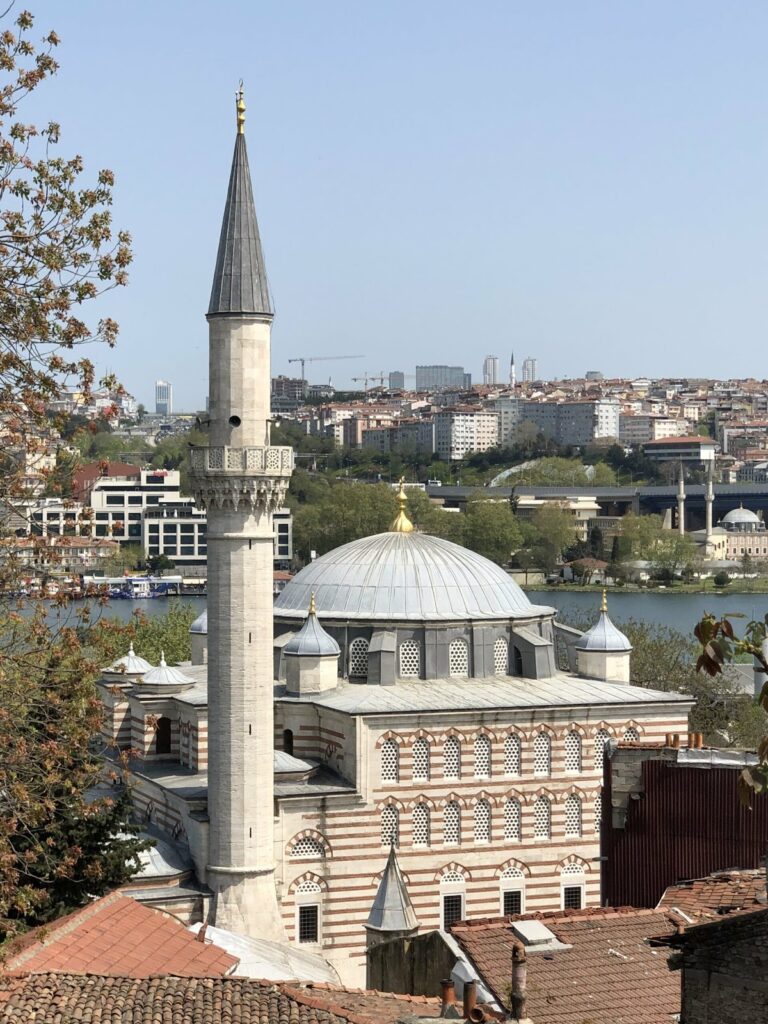
The mosque is primarily built of white stone and has a rectangular prayer hall measuring approximately 26 by 11 metres. Its central dome is about 17.5 metres in diameter and is surrounded by semi-domes in an octagonal baldaquin arrangement, in which eight principal supports carry the dome’s weight. Windows in the central dome and semi-domes illuminate the interior. White marble columns bound with brass, simple Ionic-like capitals, and gilded details contribute to the building’s appearance.
Classical Ottoman planning is combined with Ottoman Baroque decoration, an eighteenth-century idiom known for flowing shapes, carved plant and shell forms, elaborate gateways, and richly worked interiors. Engaged columns, foliage carving, shell motifs, calligraphic inscriptions, and undulating ornament appear on the gateways, mihrab, and minbar. The mihrab is the prayer niche indicating the direction of Mecca, while the minbar is the pulpit used for the sermon. The two minarets each have two balconies and retain an earlier style.
An irregular outer courtyard leads to a rectangular inner courtyard. An elevated enclosed passage along the outer courtyard’s south side once provided the sultan’s private entrance to the mosque and to a screened balcony in the prayer hall. A fountain for ritual ablutions stands in the outer court.
The inner courtyard connects the mosque with the mausoleum. At its centre, an old plane tree grows from a rectangular garden platform whose corners carry Baroque marble fountains. Four fountains around the platform are known as the Hacat or Kısmet fountains. Ottoman sultans were girded with the Sword of Osman at this location. The Sinan Paşa pavilion that once occupied it was demolished in 1798.
A portico of arches and domes runs along three sides of the inner courtyard before the mosque entrance. The complex’s two minarets were rebuilt in the early eighteenth century, and one was reconstructed again after lightning damage in the early nineteenth century.
Ebu Eyüp el-Ensari’s mausoleum
The mausoleum stands on the northwestern side of the inner courtyard, opposite the principal entrance to the prayer hall. A projecting portico leads to a vestibule and then to an octagonal domed tomb chamber. The sarcophagus is enclosed by a Baroque-style silver screen decorated with framed calligraphy, lamps, and other ornaments.
Silver inscriptions in thuluth, a rounded monumental script used for religious and architectural writing, form a major part of the interior decoration. The calligrapher Mustafa Rakim Efendi executed these inscriptions. Sultan Mahmud II commissioned the silver covering for the sarcophagus.
Iznik tiles from different periods cover the mausoleum’s exterior wall facing the portico and the vestibule walls. They were assembled during the mosque’s reconstruction in 1798 and 1799. Many vestibule tiles have the deep sealing-wax-red glaze known as Armenian bole and date from around 1580. Related examples are held in the Victoria and Albert Museum, while the British Museum has a panel of three navy-blue and turquoise tiles dating from around 1550 that resembles tiles formerly used on the shrine’s exterior.
In 2022, a person damaged tiles on both sides of the courtyard’s prayer window with a hammer, claiming that their designs contained devil’s horns. The broken tiles were repaired in August of that year.
Bath and associated structures
The public bath retains most of its historic fabric, although its original changing room has been replaced by a more recent wooden structure. The wider complex also contains Ottoman funerary and charitable buildings, including the nearby imaret and tomb complex associated with Mihrişah Valide Sultan.
Religious objects
The mosque contains relics believed to have belonged to Muhammad. One stone is said to bear the Prophet’s footprints and to have been brought from the Kaaba.
Nearby sites