Exaltation of the Holy Cross Church in Tczew: A Gothic Parish Church in Poland


Site at a Glance
- Rating
- 4.6
- Popularity
- Low
- Country
- Poland
- Primary era
- Medieval
- External website
- Open
- Eras represented
- Medieval, Early Modern, Modern
- Civilizations
- Crusader, Polish–Lithuanian Commonwealth, Teutonic Order
- Site type
- Religious
- Remains
- Church
On this page22 sections
History
The Exaltation of the Holy Cross Church in Tczew, Poland, is a Roman Catholic parish church built in the Gothic period under Teutonic rule, with its present form constructed in the first half of the fourteenth century. It is the seat of the parish of the same dedication within the Tczew Deanery of the Diocese of Pelplin. The church developed from an earlier medieval foundation and became a major religious building in a town that grew economically and socially during the period of the Teutonic Order, a German military-religious order that ruled territories around the southern Baltic.
Early parish and Teutonic-period rebuilding
A parish priest named Jan is mentioned in 1258. This reference may support an eighteenth-century record that gives 1226 as the consecration date of the parish church. The earlier building may have been wooden. In the mid-thirteenth century, foundations were laid for the chancel of the present church, while its massive tower was also constructed. The first arrangement may have combined a tower chapel with an adjoining wooden church.
The early church was almost completely destroyed in November 1308, after the Teutonic takeover of Tczew. During the following period, the town experienced economic and social growth. In 1364, as part of a renewed town foundation, Grand Master Winrich von Kniprode, the supreme governing officer of the Teutonic Order, confirmed the parish priest’s rights to three włókas of land. A włóka was a historical land-measurement unit whose exact area varied by region and period. Income from these holdings may have helped support the church’s enlargement.
The present building was created by extending the burned tower with a new brick church. Construction proceeded from the chancel through the nave toward the tower, and the work was complete before 1364. This campaign established the four-bay, three-aisled Gothic hall that survives today, together with its three-bay chancel.
Polish rule, the Reformation, and the town fire
Tczew came under Polish rule in 1457. Around 1525, the Reformation, the sixteenth-century movement associated especially with Martin Luther that divided Western Christianity and produced Protestant churches, reached the town. Most parishioners, many of them German-speaking, became Protestants. Because urban guilds owned separate chapels and altars, Reformed services began to be held in those spaces. Catholics and Lutherans jointly controlled the parish church until 1595. During the Swedish wars, from 1626 to 1635, the church again came under the control of local Protestants.
On 4 October 1577, soldiers serving King Stephen Báthory, who ruled Poland from 1576 to 1586, accidentally started a fire while encamped outside Tczew on the march toward Gdańsk. The blaze destroyed almost the entire town. The church lost all its roofs, although most of its vaults survived, and the damage was repaired after about six years. The same fire destroyed town records and privileges kept in the nearby Klesza Tower.
Baroque furnishings and nineteenth-century renewal
Many of the altars and liturgical furnishings that remain today were acquired in the late seventeenth and eighteenth centuries. In 1686, Bishop Bonawentura Madaliński instructed the parish priest Franciszek Czarliński to commission a new high altar. It was completed four years later and had been painted and gilded before 1779. Other altars from the early eighteenth century were dedicated to saints including John of Nepomuk, Roch, James, Joseph, Anne, and John the Baptist. Later dedications included Our Lady of Częstochowa and the Immaculate Conception.
From 1830 to 1841, the church was closed because of its poor technical condition, and services were held in the former Dominican church. A general renovation began in 1838 and 1839 under the parish priest Henryk Mettenmeyer, who secured 5,000 thalers from King Frederick William III of Prussia. The work repaired the interior and replaced the roof. Afterward, the church was reconsecrated on 5 December 1841.
Parish priest Robert Sawicki continued the rebuilding during his tenure from 1871 to 1925. He obtained 50,000 marks from the indemnity paid by France to Germany after the Franco-Prussian War of 1870 to 1871, a conflict between the Second French Empire and the North German-led German coalition that helped establish the German Empire. Much of the church’s present interior appearance took shape during Sawicki’s long service. In 1878, a Baroque altar assembled partly from elements probably taken from the former Dominican church was installed in a chapel beside the chancel. It was dedicated to Our Lady of the Rosary in 1879, when a painting of Mary and the Child was placed in it.
Twentieth-century decoration, war damage, and restoration
The church had no wall or vault paintings until the early twentieth century. Between 1910 and 1914, the painter Klink decorated the chancel, nave, Our Lady of the Rosary Chapel, and pillar arches. The First World War and its political consequences interrupted the work. In 1937, parish priest Aleksander Kupczyński commissioned Władysław Drapiewski to complete the decoration of the chancel.
During the interwar period, the sculptor Mikołaj Cichosz worked on the restoration. His principal achievement was a monumental Neo-Gothic Altar of Christ’s Tomb, made between 1927 and 1930. The pavement was relaid, the pews were replaced, and three bells were purchased. The Second World War caused no major direct damage to the church, but German authorities requisitioned those three bells in 1942 and had them melted down. In March 1945, the destruction of the bridges over the Vistula damaged the roofs and almost all the stained-glass windows.
In the 1970s, parish priest Wacław Preis directed a thorough renewal of the interior. The original colours of the altars, pulpit, and confessionals were uncovered, the wall paintings were cleaned, and stained-glass windows were installed in the chancel. On 29 August 1982, the tower caught fire for unexplained reasons. The blaze damaged parts of the nave roof, melted the bells, and partly destroyed the organ. Parishioners moved threatened furnishings to St Stanislaus Kostka Church. In the following years, the tower received a new masonry termination, its roof structure was completed, and new roof tiles were laid. The parish also funded a new organ and four bells, named Mary, Redeemer of Man, John Paul II, and Wacław. They were consecrated on 7 December 1985.
The church has been entered in Poland’s register of historic monuments under number 430 since 4 January 1972.
Remains
Building and vaults
Tower
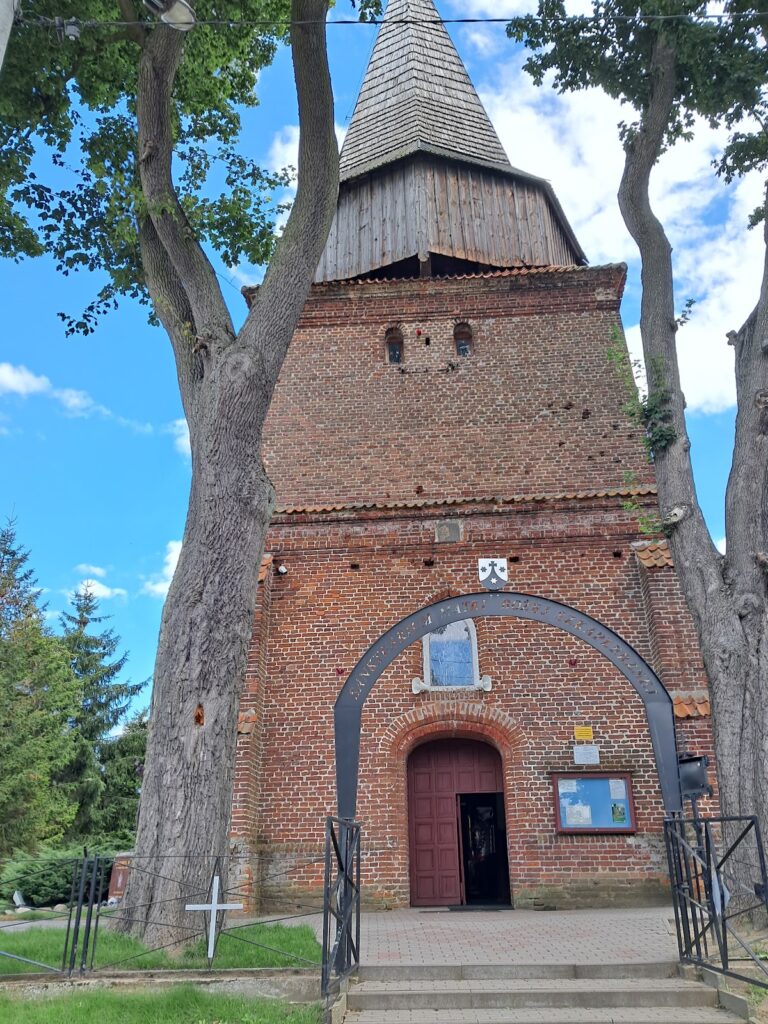
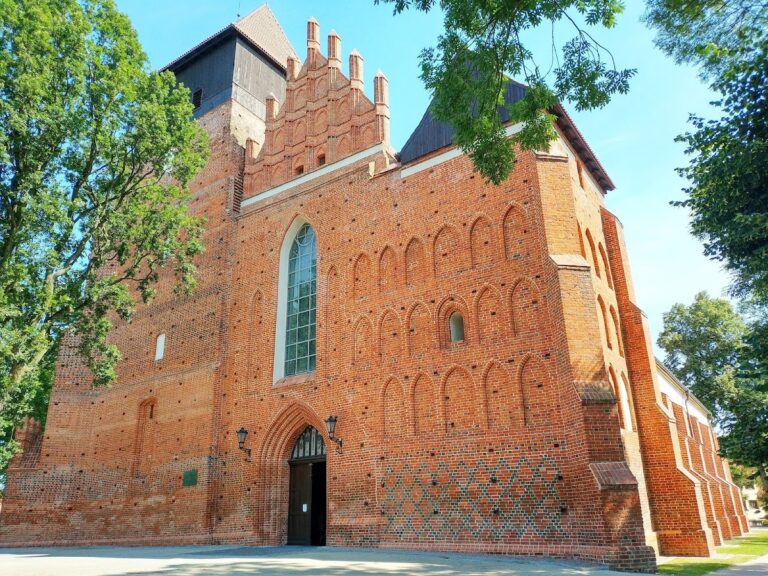
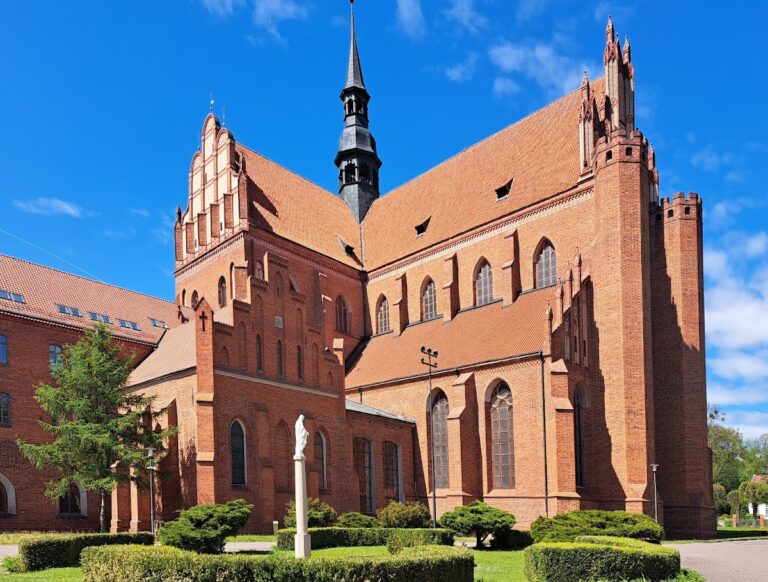
The church is a Gothic brick hall church, meaning that its nave and aisles are approximately equal in height and lack a separate upper window zone above the side aisles. Its oldest surviving element is the massive tower, approximately 30 metres high. The upper vaulted levels may originally have contained two chapels. On the east elevation, the former roofline remains visible at a point approximately five metres above the present roof, preserving evidence of an earlier phase of the building.
Chancel and chapels
The four-bay church has three aisles and a three-bay chancel ending in five sides. The chancel is joined to the tower. A sacristy and treasury were attached to its north wall. Later, the spaces between the outer buttresses of the aisles were enclosed to create two continuous rows of chapels. These side chapels subsequently received decorative roofs concealed behind triangular ornamental gables.
The chancel contains the oldest surviving star vault, a ribbed vault whose ribs form star-shaped patterns. Its ribs create six-pointed stars, while the main nave has eight-pointed stars. Both systems are connected by a continuous ridge rib, a longitudinal rib linking successive vault bays, which runs from the chancel toward the tower. The supports include corbels, or projecting blocks that carry architectural weight. Particularly notable corbels survive in the sacristy, including ornamental examples and two bearing simplified human faces.
Medieval furnishings and painted decoration
Early parish objects
A granite baptismal font now stands in the south porch. It is the oldest surviving material witness to the early history of the parish church. The mid-fourteenth-century iron grille of the sacrament house has an openwork quatrefoil design and was probably made in a local medieval smith’s workshop. Fittings on the sacristy door date from the first half of the fourteenth century. Their hinges, probably made by a local artist, are shaped as stylised foliage with simplified leaves and flowers.
Chapel painting and Pietà
A late-fourteenth-century wall painting uncovered in the Chapel of the Holy Women shows busts of eight female saints within a triple pointed-arch arcade. Their attributes identify Elizabeth, Helena, Catherine, Hedwig, Genevieve, Barbara, and Dorothy; the eighth figure is probably Irene. Conservation in the chapel also revealed its original Gothic floor.
The only surviving medieval sculpture identified in the church is a Pietà from the second quarter of the fifteenth century. It belongs to the Beautiful Style, a form of Gothic sculpture known for refined and graceful treatment of sacred figures, and is attributed to one of the Gdańsk masters.
Altars, pulpit, and devotional furnishings
High altar and side altars
The high altar fills the eastern wall of the chancel. It is approximately 8.60 metres wide and 14 metres high. Its elaborate woodcarving, chiefly from the early eighteenth century, includes paintings of the Crucifixion and the Lamentation. The ensemble is regarded as an outstanding example of late Baroque Pomeranian art. The former altar of Saint Nicholas dates from 1792. In 1928, a new statue was placed in its niche and the altar was rededicated to the Sacred Heart.
Pulpit and Rococo furnishings
A richly carved, painted in several colours, gilded, and silvered pulpit was installed in the second quarter of the eighteenth century. Five winged angels on its canopy represent human peoples identified in the decoration as a Black African, an Arab, a Chinese person, a European, and an Indigenous American. The imagery expresses the universality of the Christian Church.
In 1783, five wooden, flat-carved bosses were added to the chancel and main-nave vaults. Their inscriptions and images represent the Holy Spirit, the Lamb of God, a cross with a crown of thorns, and the monograms IHS and Maria. Radiant glories surround the bosses, whose Baroque decoration is integrated with the Gothic ribs. Two Rococo confessionals in the north aisle have rocaille carving and penitential imagery on their backs and doors. Two carved and gilded wooden candle stands, each three metres high, carry rich Rococo plant ornament.
Three eighteenth-century processional feretories, portable devotional objects used in religious processions, depict the Nursing Madonna, also called the Tczew Madonna, Saint John of Nepomuk, and the Madonna and Child. The first contains an earlier Mannerist painting of Mary nursing the Child, covered by gilded and silvered metal garments.
Treasury and liturgical metalwork
Medieval goldsmiths’ work
The treasury contains fifteenth-century goldsmiths’ works probably made in Gdańsk workshops. A reliquary cross has a six-sided base engraved with scenes from the Passion, modelled on German prints. Kneeling angels hold a container for relics of the True Cross, while an upper chapel contains a carefully executed Pietà. The arms end in gem-set trefoils surrounded by openwork foliage.
One of two fifteenth-century chalices is dated 1451. Its base bears the date and a goldsmith’s mark, together with later inscriptions recording its history. The second chalice has an openwork chapel that echoes Gothic architectural forms, twelve apostles on its stem, and precisely engraved scenes on its base. A medieval inscription states that it belonged in 1492 to the Priests’ Brotherhood “zu dyrszaw.” A fifteenth-century paten, a plate used with a chalice, is decorated with the Manus Dei, or Hand of God, a Christian symbol of divine intervention or blessing, together with plant-geometric ornament. Some researchers associate it with the second chalice.
Eighteenth-century vessels and furnishings
The treasury also preserves an eighteenth-century monstrance, a vessel used to display the consecrated Eucharistic host, made by the Gdańsk master Jan Gotfryd Schlaubitz. An inscription on its richly decorated base records its donation by Wincenty May in 1742. Other objects include a silver eternal lamp made by Zygfryd Oernster in 1727 and a Rococo chalice made around 1790 by Jan Jakub Bromma. The chalice bears the coats of arms of its donors, Marianna and Szymon Kicki, owners of nearby Stanisław.
Additional treasury furnishings include a ciborium from around 1700, a covered vessel for consecrated hosts, a partly gilded silver reliquary cross, patens, and ampoules for sacramental water and wine. Four eighteenth-century vestments made of French brocade, silk, taffeta, and damask are also preserved.
Six pairs of medieval brass candle stands have lion figures on the feet of their bases. Eighteenth-century altar furnishings include sixteen brass candlesticks supported on lion’s paws and thirty tin candlesticks bearing dates and the initials or names of donors. Three surviving tin crosses include one stamped by the Gdańsk pewterer Johann Waese and dated 1716.
Paintings, windows, organ, and bells
Interior decoration and stained glass
Klink’s early twentieth-century decoration includes medallions of the prophets Isaiah, Jeremiah, Ezekiel, and Daniel, as well as the Carrying of the Cross and paintings in the nave, chancel, Our Lady of the Rosary Chapel, and pillar arches. Drapiewski completed the Passion cycle in the chancel with three large scenes, the Prayer in Gethsemane, the Crowning with Thorns, and the Flagellation.
Neo-Gothic oak choir stalls and a communion rail were installed in front of the high altar after the early twentieth-century decoration. The stained-glass windows made in the late nineteenth century by A. Redner’s Wrocław workshop were lost. Four windows supplied around 1910 by F. Binsweld Glassmalerei und Kunstglaserei of Trier partly survive: two show the Evangelists Matthew and Luke, while two have plant-geometric decoration. The Our Lady of the Rosary Chapel contains windows transferred from the former Dominican church, depicting the Ascension and the Good Samaritan.
Organ
The history of the church’s organs reaches back to 1870. The present instrument was made by Józef Moolin of Odry and reuses the historic Neo-Gothic organ case associated with standard compositions by the brothers August and Max Terletzky. It has thirty stops, fully mechanical action, two manuals, and a pedal.
Bells
The tower has held several successive bell ensembles. The first John the Baptist bell, cast before 1577, weighed approximately two tonnes and was destroyed in the town fire. A replacement of the same name and weight was cast in 1584 from its surviving metal. It rang until cracking during funeral ringing in February 1882. A third John the Baptist bell was cast in Gdańsk in August 1882 by Jan Collier’s foundry and weighed 2,800 kilograms. That year, the former Jesus Crucified bell of 1666 was repaired and renamed Mary; it bore an image of the Madonna and Child.
Other historic bells included Nicholas, cast in Gdańsk in 1772 by Michał Wittwerck’s foundry and weighing 657 kilograms, and Anna, made before 1632 and weighing 100 kilograms. Anna had formerly belonged to the Protestant congregation of the former Church of Saint George. It served as a funeral bell until 1805, when Stefan took over that function, and afterward rang daily for the Angelus.
The five-bell ensemble rang together only rarely. Its last common ringing was on 20 August 1917, after which German authorities requisitioned John the Baptist and Mary for military purposes and destroyed them. In 1930, three replacement bells were cast at the Felczyński brothers’ foundry in Kałusz: Christ the King, weighing 2,991 kilograms; John the Baptist, weighing 1,475 kilograms; and Bernard, weighing 806 kilograms. They were hung with the surviving Nicholas bell. Anna remained separate because it did not harmonise with the ensemble and continued to ring alone for the Angelus. The five-bell set last rang on the morning of 1 September 1939.
Nearby sites