Holy Trinity Church in Lubiszewo Tczewskie: A Roman Catholic Sanctuary in Poland


Site at a Glance
- Rating
- 4.8
- Popularity
- Very Low
- Country
- Poland
- Primary era
- Medieval
- External website
- Open
- Eras represented
- Medieval, Modern
- Civilizations
- German, Knights Hospitaller
- Site type
- Religious
- Remains
- Sanctuary
On this page13 sections
History
Holy Trinity Church in Lubiszewo Tczewskie, Poland, is a Roman Catholic church and Marian sanctuary whose history reaches back to the late twelfth century. Duke Grzymisław initiated the first church in 1185, and Bishop Stefan of Kuyavia dedicated it in 1198.
Medieval foundations and religious orders
From 1198 until about 1370, the church was held by the Knights Hospitaller, a medieval Catholic religious and military order that maintained hospitals and controlled religious and territorial properties. It later passed to the Teutonic Order, another Catholic military order active in the medieval Baltic region.
Before 1348, the knight Henning of Wartenberg built a chapel in the cemetery for the Hospitallers so that they could attend Mass. In 1348, a new brick church replaced the earlier wooden building on the site.
Parish development and later alterations
In 1596, the church became a filial church of the parish in Tczew. Its western nave was extended and a tower was added in 1823. A 16-stop organ with two manuals was installed in 1914, and Lubiszewo became an independent parish in 1928.
The church’s Marian history centers on a figure of Our Lady of Consolation that has stood in a side altar since 1728. Parish priest Paweł Lubieński began efforts to establish a Marian sanctuary at Lubiszewo in 1953. After his death, the work continued under his successor, Roman Misiak.
Sanctuary of Our Lady of Consolation
On 9 June 1993, Bishop Jan Bernard Szlaga ordered preparations for the coronation of the figure. Pope John Paul II blessed crowns for Mary and the Christ Child in Gniezno on 3 June 1997. On 31 August 1997, Archbishop Józef Kowalczyk, the Apostolic Nuncio to Poland and the pope’s diplomatic representative in the country, crowned the figure in the presence of Bishops Jan Bernard Szlaga, Tadeusz Gocłowski, Marian Przykucki, Andrzej Śliwiński, and Jan Chrapek.
By decree of the Bishop of Pelplin, Lubiszewo became the Sanctuary of Our Lady of Consolation, and each successive parish priest received the title of custodian. Bishop Jan Bernard Szlaga blessed a commemorative plaque recording the establishment of the sanctuary on 7 September 1997. In 2007, the tenth anniversary of the coronation, an outdoor altar and Stations of the Cross were consecrated on the coronation square as votive offerings of thanksgiving. The annual indulgence celebration takes place on the first Sunday of September under the leadership of the diocesan bishop.
The church is entered in Poland’s heritage register under number A-601, with the entry dated 30 May 1972. Its largest bell dates from 1951, while the two smaller bells date from 1958.
Remains
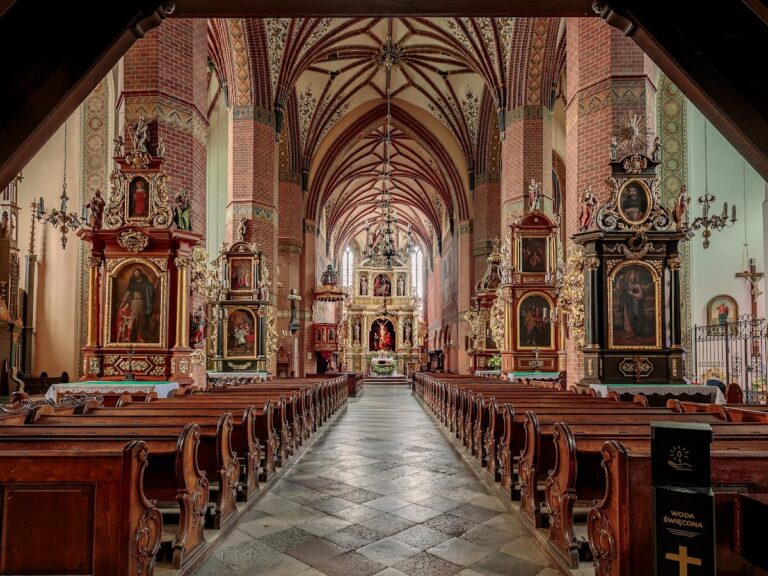
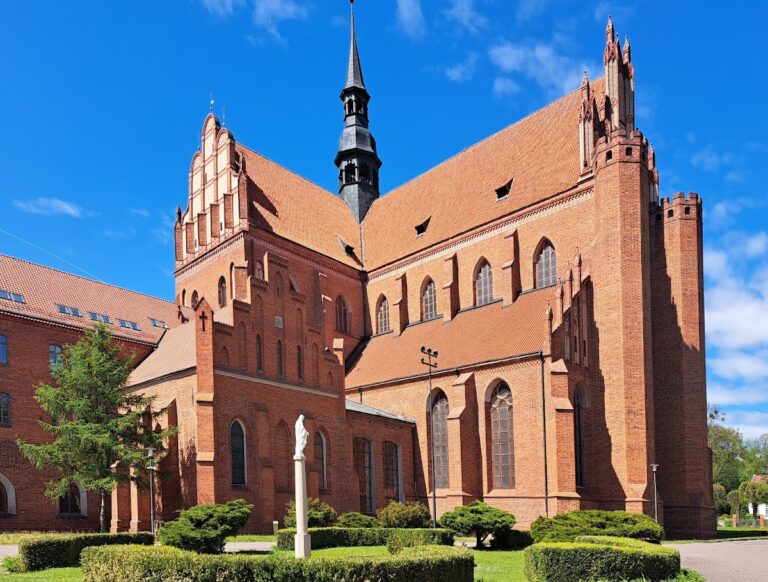
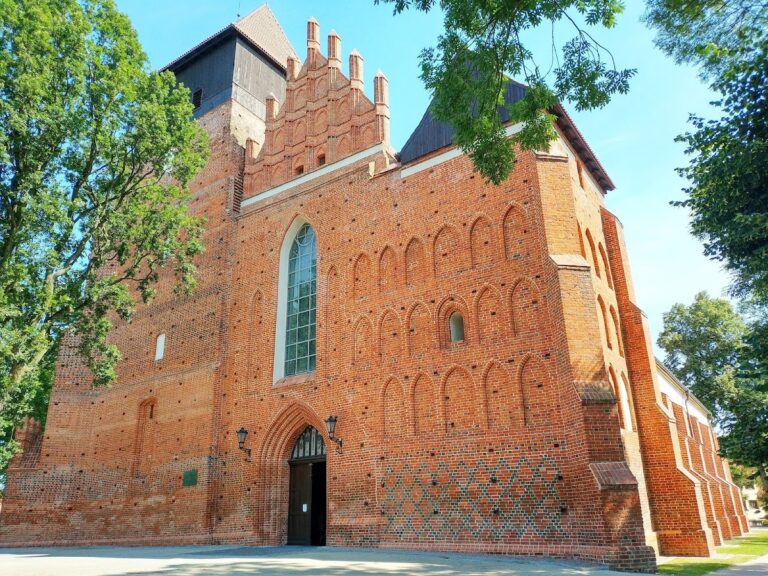
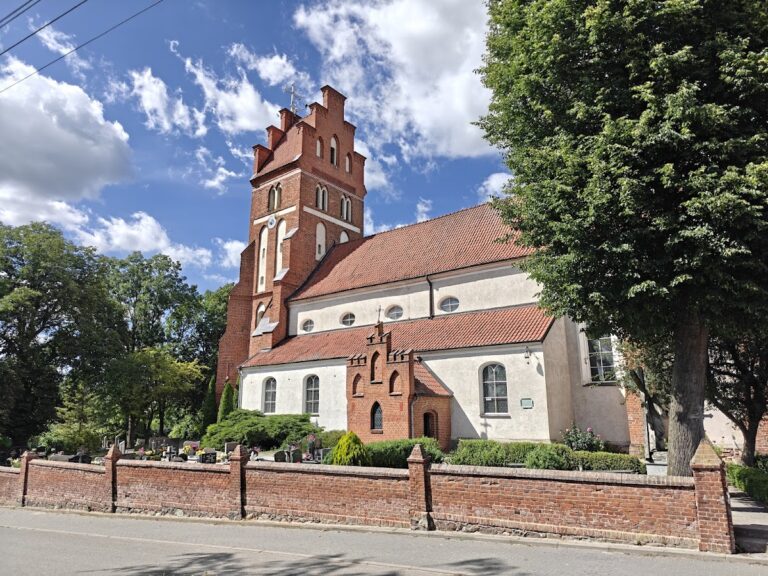
Holy Trinity Church is a brick building with a western nave extension and a single tower, both added in 1823. The surviving church also contains a 16-stop organ with two manuals and the side altar associated with the Sanctuary of Our Lady of Consolation.
Church structure and furnishings
Brick church and tower
The church’s brick fabric incorporates the building that replaced the earlier wooden church in 1348. Its western nave was enlarged in 1823, when the single tower was constructed. The bell equipment includes one bell from 1951 and two smaller bells from 1958.
Organ
A 16-stop organ with two manuals was installed in 1914. It remains one of the church’s recorded furnishings.
Madonna and Child
Fourteenth-century figure
The principal object of veneration is an approximately 80-centimetre-high Madonna and Child, a representation of Mary holding the infant Jesus. It was created around 1380, during the second half of the fourteenth century, in the Pomeranian Madonna Workshop. The smiling faces of the Virgin and Child are described as unusual among Polish Madonna figures. Saint Monica and her son, Saint Augustine, kneel at the sculpture’s feet.
Side altar
The sculpture was originally kept in the private chapel of the Czarliński family in nearby Stanisławie. Its presence was first recorded in 1728, when it was transferred to Holy Trinity Church and placed in a side altar. The figure remains there. During preparations for the 1993 coronation, the Madonna and Child was conserved and gilded, while the side altar was also conserved and the sculpture secured against theft.
Coronation square
Outdoor altar and Stations of the Cross
The coronation square contains an outdoor altar and Stations of the Cross created in 2007. They were consecrated as votive offerings of thanksgiving on the tenth anniversary of the Madonna and Child figure’s coronation.