Joannites’ Castle in Skarszewy: A Gothic Medieval Stronghold


Site at a Glance
- Rating
- 4.2
- Popularity
- Very Low
- Country
- Poland
- Primary era
- Medieval
- External website
- Open
- Eras represented
- Medieval, Early Modern
- Civilizations
- Crusader, Kingdom of Prussia, Knights Hospitaller
- Site type
- Military
- Remains
- Castle
On this page6 sections
History
Joannites’ Castle in Skarszewy, Poland, is a Gothic castle built by the Knights Hospitaller between 1320 and 1334 above a bend of the Wietcisa River. The Knights Hospitaller, also called the Order of Saint John, were a Catholic military-religious order that combined religious, charitable, and military activities during the medieval period. The castle replaced an older stronghold, and construction was completed in 1334.
Medieval rule and Polish control
In 1370, the castle was acquired by the Teutonic Order, a German-founded Catholic military-religious order that administered castles and territories in the eastern Baltic region. It was placed under the oversight of the vogt of Tczew. During the Thirteen Years’ War, a conflict between Poland and the Teutonic Order, the castle changed hands repeatedly. In 1466, it came under Polish control.
Destruction and changing uses
Pomeranian voivodes, the senior governors of the Pomeranian province, resided in the castle from 1613. During the Polish-Swedish War, the building was burned and partly destroyed in 1629. Its major alterations belong to the sixteenth, seventeenth, nineteenth, and twentieth centuries.
Prussian authorities took possession of the castle in 1772, when it was in poor condition. Parts of the building were dismantled, and the remaining structure was converted for use as a salt warehouse and residential building. Residential and storage functions continued until 1982.
Restoration and cultural use
Remodeling began in 1982, including restoration of the walls and roof, to adapt the castle as the headquarters of the Skarszewy Municipal Cultural Centre. The building now contains conference rooms and hosts exhibitions and galleries organized by the centre. It is a protected immovable monument in Poland, entered in the heritage register as number 602 on 21 December 1972.
Remains
Surviving medieval and later fabric
The surviving remains include the cellars of the oldest building and part of the ground-floor walls of the residential structure created during the later conversion. Together, these elements preserve evidence of the castle’s medieval origin and its subsequent adaptation for domestic and storage purposes.
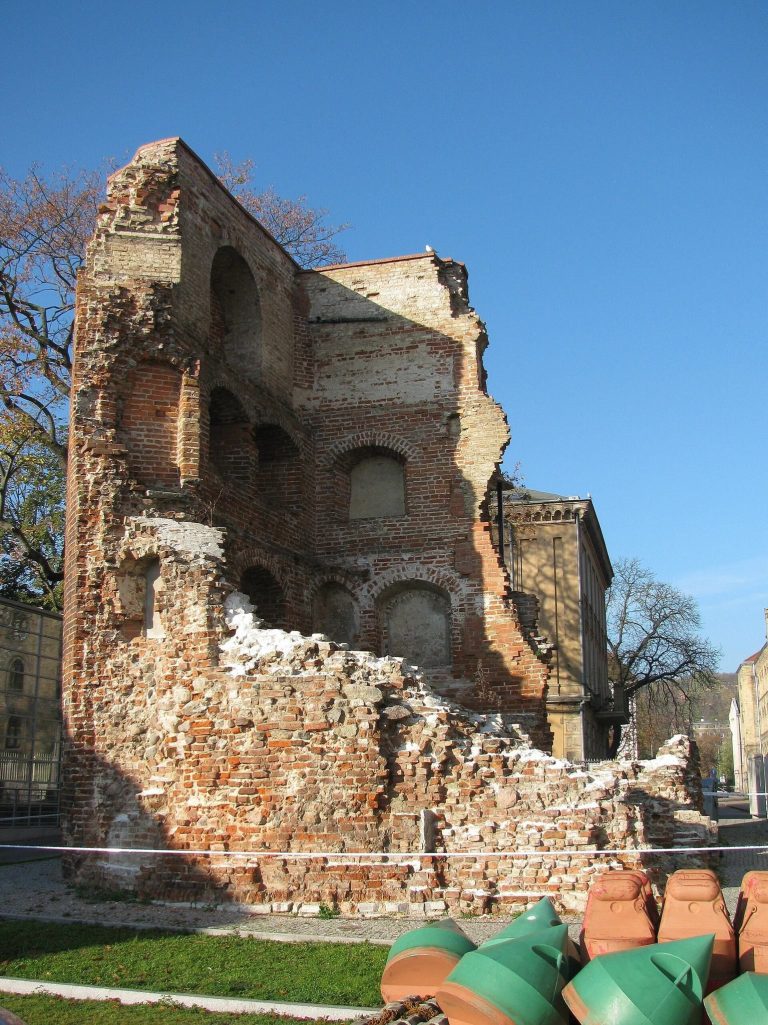
An exposed brick wall retains traces of blocked-up windows and entrances, along with other signs of alteration. Most of the building was originally plastered, but the brickwork was exposed in the early twenty-first century. The surviving fabric and the exposed wall show the successive rebuilding and structural changes that shaped the castle after its medieval construction.