Kırkgöz Han: A Seljuk Caravanserai in Türkiye


Site at a Glance
- Rating
- 4.2
- Popularity
- Low
- Country
- Turkey
- Primary era
- Medieval
- Eras represented
- Medieval
- Civilizations
- Seljuk
- Site type
- Economic
- Remains
- Caravanserai
On this page7 sections
History
Kırkgöz Han is a Seljuk caravanserai in Türkiye, near Antalya in the Döşemealtı district, built during the reign of Sultan Giyaseddin Keyhüsrev II between 1237 and 1246. It served the historic road connecting Antalya with Konya, the capital of the Sultanate of Rum, the medieval Seljuk state that ruled much of Anatolia. As a roadside complex for caravans, it provided enclosed and open spaces for travelers, animals, storage, and related services.
A royal foundation on the Antalya–Konya road
Kırkgöz Han was the second han on the route after Evdir Han, while Susuz Han stood farther north. The building was founded and commissioned as a ribat, an Islamic religious and defensive institution that could also refer to an endowed roadside establishment, by Ismat al-Dunya wa’l-Din, the third wife of Alaeddin Keykubad. Alaeddin was the father and predecessor of Giyaseddin Keyhüsrev II. An inscription from 1232 at Çarsi Camii in Uluborlu identifies Ismat al-Dunya wa’l-Din as a malika, or queen.
A damaged inscription above the southern entrance names Giyaseddin Keyhüsrev II and places the construction within his reign, although the precise year cannot be recovered. The han’s design resembles other southern Seljuk buildings associated with the period, including Şarapsa Han and Kargı Han. These structures were probably built after the Battle of Köse Dağ in 1243, a major Seljuk defeat by the Mongols that intensified Mongol pressure on Anatolia. During this period, the sultan mainly remained south of the Taurus Mountains to avoid the Mongol advance.
Later preservation
Restoration of Kırkgöz Han began in 2007. The work forms part of the site’s modern preservation history, while the surviving structure and its inscriptions continue to convey its place within the Seljuk road network and the political world of 13th-century Anatolia.
Remains
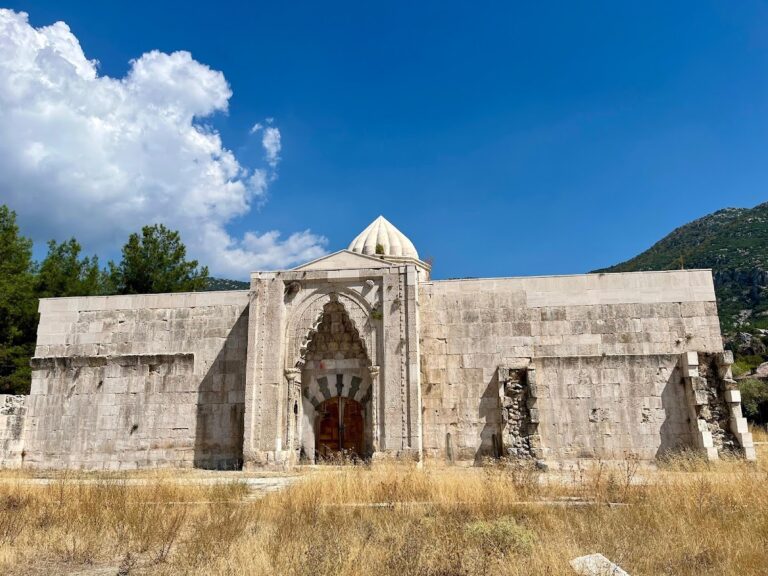
Kırkgöz Han covers approximately 3,000 square metres. Around half of the complex is roofed, and the open courtyard measures about 33 by 52 metres. The southern entrance leads into this central space, while the enclosed section occupies the northern side and roofed ranges extend along the east and west.
Entrance and southern side
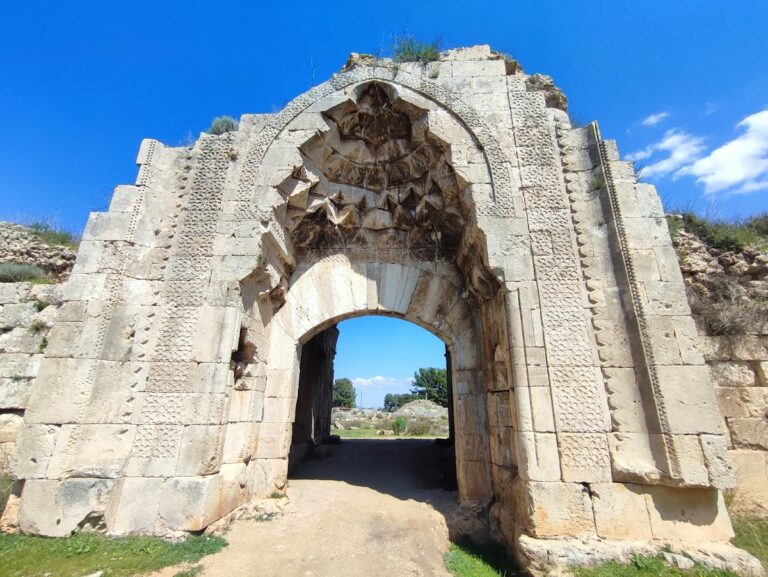
The entrance is set in the southern facade. Two enclosed rooms flank the doorway, each opening separately onto the courtyard and probably serving as quarters for guards. Two further open cells occupy the southern corners. The portal has a restrained arched profile with two inset columns, each finished with a plain cubical capital.
Courtyard ranges and northern hall
The northern enclosed section is an 11-by-60-metre transverse hall covered by a barrel vault. Belt arches divide the hall into six equal sections. A small central door provides its only entrance, while small slit windows admit light. The roof rises above the adjoining side ranges. Along the western and eastern sides, arcades lead to six open cells in each range. At the northern end, both ranges finish in a larger enclosed room with a barrel vault. The eastern range may have contained the mosque, as at the contemporary Kargı Han east of Antalya.
Portal masonry and building inscription
The han has relatively little ornamentation. Its stones are carefully worked, and many carry stonemasons’ marks. The dressed blocks of the portal are of higher quality than the masonry of the walls. Above the doorway, within the entrance niche, a six-line inscription is carved on a limestone block. It is the longest surviving inscription at a Seljuk caravanserai. The text names the sultan, refers to his crown, banner, and belt, and identifies Ismat al-Dunya wa’l-Din as the patron. In Scott Redford’s translation, she is praised as an exalted queen and as the pearl of the crown of nations.