Evangelische Kirche Oberbiel: A Reformed Parish Church in Solms, Germany


Site at a Glance
- Rating
- 3.3
- Popularity
- Very Low
- Country
- Germany
- Primary era
- Early Modern
- External website
- Open
- Eras represented
- Medieval, Early Modern
- Civilizations
- Holy Roman Empire
- Site type
- Religious
- Remains
- Church
On this page10 sections
History
Evangelische Kirche Oberbiel is a protected historic church in Solms, Germany, whose present form combines a medieval choir with a Baroque nave renewed in 1784. The church stands within the older history of Oberbiel, now part of Solms in the Lahn-Dill district of Hesse, and has remained an Evangelical Reformed congregation.
Medieval Parish and Patronage
In the Middle Ages, Oberbiel served as the mother church of the branch church at Niederbiel. A mother church was the principal church of a wider ecclesiastical area, while a branch church depended upon it. Albshausen and Steindorf were later added to the Oberbiel parish. A parish priest of Biel is first mentioned in 1267.
Ecclesiastically, the parish belonged to the Archipresbyterate of Wetzlar, a medieval level of church administration, within the Archdeaconry of St. Lubentius at Dietkirchen and the Archdiocese of Trier. The church was originally dedicated to Saint Vincentius. The Lords of Cleen and Werdorf held its patronage, a right that gave them influence over clerical appointments and church administration, until 1422. In that year they transferred the right to Altenberg Abbey, and the associated congregations were incorporated into the former monastic foundation.
Reformation and Confessional Change
The Reformation, the sixteenth-century movement that challenged Roman Catholic doctrine and church organization, developed gradually at Oberbiel. Evangelical tendencies appeared during the pastorate of Georg Schott, who served from 1517 to 1531 before being removed from office. During the 1530s, the congregation turned away from practices including religious processions. From 1542, communion in the County of Solms was celebrated in both kinds, meaning that worshippers received both bread and wine.
By 1549 at the latest, under Pastor Heiderich Tillenburg, Oberbiel had adopted the evangelical confession. A later change followed under Count Konrad of Solms-Braunfels. On 7 September 1582, the Hungener Synod decided that pastors in the Solms territories should adopt the Reformed confession, a Protestant tradition shaped by Swiss and later Calvinist theology. This confessional change also influenced the church’s furnishings.
The Thirty Years’ War, the major European conflict of 1618 to 1648 that combined religious and political struggles, brought another temporary reversal. From 1626, the congregation became Catholic again for several years. Swedish intervention in 1632 allowed the renewed practice of the evangelical faith.
The 1784 Renewal
A major rebuilding phase took place in 1784, when the nave was renewed during the pastorate of Jacob Wilhelm Caps, who died in 1797. The Prince of Solms-Braunfels authorized a collection that raised 333 guilders for the work. The bell frame was renewed and strengthened because the tower was at risk of collapse, much of the roof was reroofed, and the entrance was moved to the west side. The interior galleries, ceiling, pulpit wall, and other furnishings belong in large part to this transformation.
The organ also entered the church during the 1784 renewal. Johann Peter Rühl installed it with a new keyboard containing the bass notes D-sharp and F-sharp and improved its windchests, the mechanisms that distribute air to the pipes. Johann Georg Bürgy repaired the instrument in 1821. In 1843, Peter Dickel added a Principalbass 8-foot stop to the pedal and a Hohlflöte 8-foot stop to the manual. After 1934, a Subbass 16-foot stop was placed on a separate pneumatic chest.
Parish Reorganization and Recent Organ Work
The Oberbiel parish district was dissolved on 1 April 1932. Albshausen and Steindorf nevertheless remained pastorally connected with Oberbiel until 1954, when both became an independent parish. Niederbiel became an independent congregation on 1 July of the same year.
Oberbiel remained part of the Evangelical Church in the Rhineland through the Braunfels church district until the end of 2018. In 2019, that district became part of the Evangelical Church District on the Lahn and Dill. Oberbiel and Niederbiel entered a pastoral union on 1 April 2021.
The organ underwent further changes in the twentieth century. In 1970, Orgelbau Hardt renewed the Mixture III and the façade pipes, converted the Quinte 3-foot stop into a Sesquialtera II by adding the third of the mixture, and installed a Trompete 8-foot stop. The Subbass was already no longer present at that time. Hardt carried out the instrument’s most recent renovation in 2019.
Remains
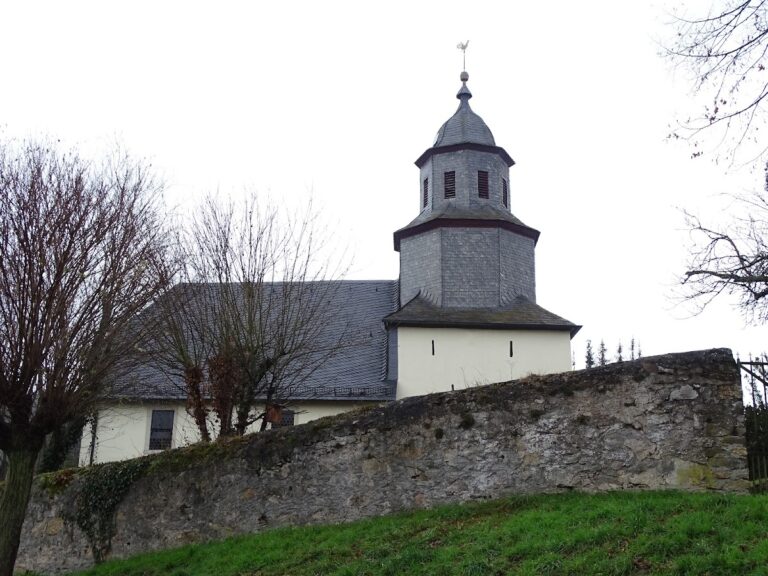
The church is a hall church, meaning that it has one principal interior space rather than separate parallel naves. It stands on a rise north of the old village center, within the former cemetery, whose enclosing wall survives only in part. The building is aligned slightly east-northeast. A narrower medieval rectangular choir is joined to the 1784 Baroque nave, and both parts are united beneath one roof.
Exterior and Roof Turret
The nave has a shingled hipped roof. Two tall eighteenth-century windows with shallow segmental arches light the south wall. Smaller high-set windows of similar shape are placed on the north wall and above the west portal. The tall rectangular west portal has a lintel referring to the 1784 renewal and is sheltered by a small canopy. Each of the three walls of the medieval choir contains a round-arched window.
A three-tiered, six-sided roof turret rises from the center of the hipped roof. Its shaft has round-arched and tall rectangular openings for the bells, while the south side carries the clock face. Above an open lantern with round-arched openings is a bulbous hood, crowned by a finial, a cross, and a weather vane. The bell chamber holds three steel bells cast by Rincker in 1920. They replaced bronze bells surrendered in 1917.
Memorials and Interior Arrangement
A gray epitaph on the south exterior commemorates Pastor Jacob Wilhelm Caps, whose tenure coincided with the 1784 renewal. A gray memorial stone for his wife, Victoria Charlotta, née Crollius, is built into the south interior wall. At the western end of the south wall, a bronze plaque gives important dates in Oberbiel’s church history and names 21 pastors who served between 1570 and 1977.
The interior has a mirror ceiling and a three-sided gallery installed in 1784. The gallery rests on bulbous square posts, and its parapet is divided into horizontally rectangular panels. The 1784 pulpit wall has the organ gallery on its east side and two segmental-arched openings. One leads to the stairs serving the organ gallery and pulpit, while the other gives access to the sacristy.
Pulpit, Paintings, and Furnishings
The polygonal wooden pulpit was made around 1600 in the Renaissance style. Projections on its lower cornice form bases for free-standing columns that support the upper cornice. Ionic-volute columns divide the panels, which carry ornamental carving beneath round arches. The upper frieze bears Luke 10:16 in the Luther Bible. Two angels that once supported the lost sounding board have survived.
Two ceiling paintings, the Resurrection of Jesus and the Lamb with the Book, came from Altenberg Abbey. Wilhelm of Solms-Braunfels donated these paintings and the two works on the organ-gallery parapet, which depict the Last Supper and the Baptism of Christ, after the abbey’s dissolution. The altar bears the coat of arms of the Prince of Solms-Braunfels. Wooden pews are arranged with a central aisle.
Historic Gallery Organ
The side-playing gallery organ dates from around 1700. It is probably associated with the Grieb family of organ builders from Griedel, whose workshop was later continued by Dreuth. The instrument is largely preserved and is considered one of the oldest organs in the region. It originally had eight stops on one manual with a permanently coupled pedal. A short octave, an early keyboard arrangement that provided commonly used bass notes within a compact range, formed part of its early keyboard system.
The instrument’s five-part façade has a raised pointed central tower between two twisted columns. A shared cornice is crowned by two gilded Solms lions, above a somewhat lower flat field with a transom rail and a high flat field. The pipe fields have gilded ornamental boards above and below. At the sides, two twisted free-standing columns and rocaille blind wings with angel figures complete the front. The profiles of the lower and upper cornices are gilded, and an angel’s head forms the console beneath the central tower. The lower case panels show garlands with bows, while two angels holding palm branches are mounted at gallery-parapet level.
Local tradition holds that the organ came from a nearby castle or palace. After its later alterations, the instrument has nine stops, of which five dating from around 1700 remain original. Its surviving structure, early components, and later repairs preserve the technical history of music-making in the church across several centuries.